
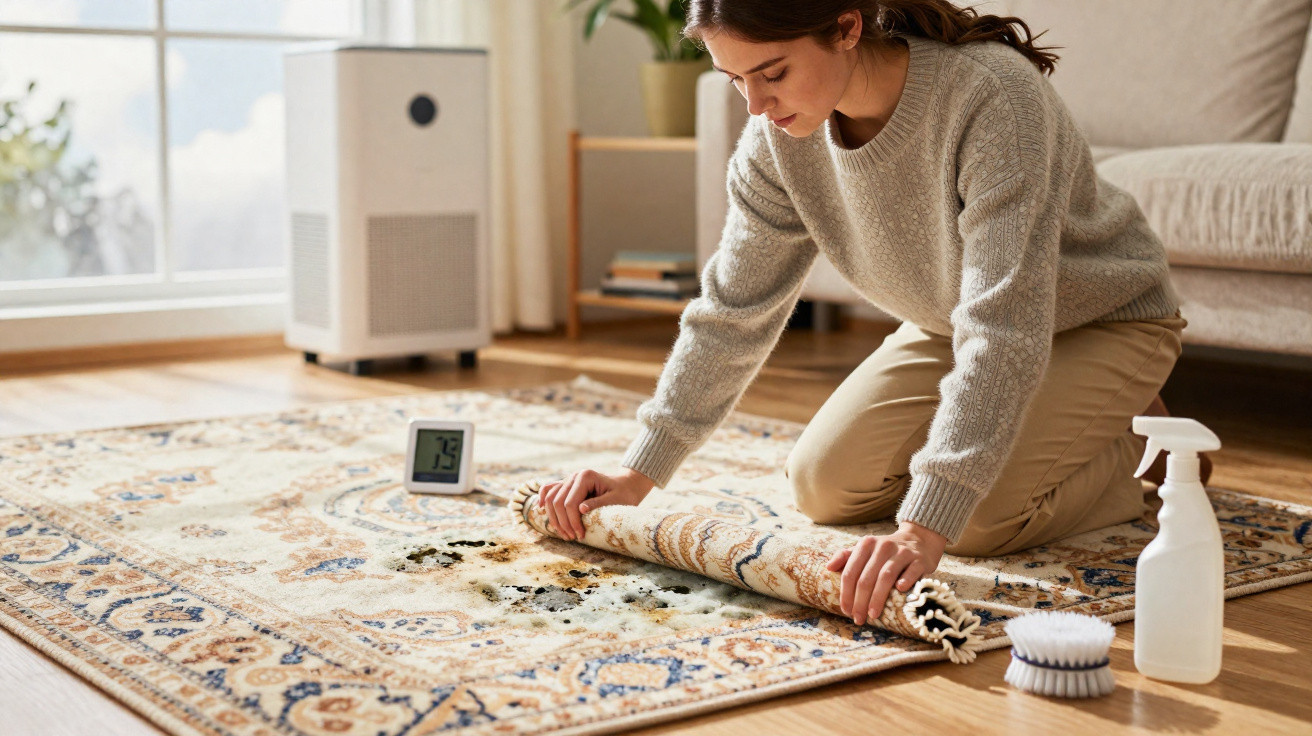
Closed windows, heating on, a cosy home.
Yet, unnoticed, something on the floor is becoming a haven for mould.
At the height of winter, many people rush to seal gaps, turn up the heating and make their homes feel like a refuge. At the same time, less air circulates, humidity rises and a familiar issue returns: mould, unusual smells and respiratory flare-ups. The main accomplice is not on the walls or in the bathroom, but directly beneath your feet.
The culprit beneath your feet: how rugs become mould incubators
Rugs are chiefly responsible for holding moisture and fungi in living areas. Whether it is a deep-pile living-room rug, a hallway runner or a kitchen mat, each one acts like an unobtrusive sponge.
While you may be looking for damp penetration, a leak or poorly sealed windows, the rug continues to draw moisture from the air, trap dust and collect organic debris: pet hair, dead skin, crumbs, drink splashes and dried mud from shoes. This “buffet” provides everything mould needs to take hold.
A rug can look clean on the surface while still harbouring millions of microscopic spores deep within its fibres.
Winter makes matters worse. Homes remain closed up for longer, ventilation decreases and indoor air is often more humid because of hot showers, longer cooking times and, in some cases, clothes being dried on an indoor airer. Sitting still on a cold floor, the rug steadily absorbs this moisture.
The concern is not merely cosmetic. Every footstep on a rug acts as a shake that sends spores into the air. Children playing on the floor, pets rolling on the rug and even ordinary movement around the house can disperse particles that may lead to eye irritation, a blocked nose, coughing and asthma attacks in sensitive people.
Why natural fibres hold so much water
Wool, cotton, sisal and other natural-fibre rugs are prized for their comfort and more refined appearance. In damp conditions, however, they have a drawback: they are exceptionally effective at absorbing and retaining water.
These materials are described as hygroscopic. In practical terms, they draw water straight from the air, even when no drink has been spilled and there is no visible puddle. They can do so in considerable amounts.
A natural-fibre rug can retain up to four times its own weight in water before it feels damp to the touch.
As a result, the rug can still appear dry even though its fibres have been damp deep down for hours. When moisture remains for longer than 24 to 48 hours, fungi and bacteria start colonising the fabric base. The effect is stronger in long-pile designs: humid air becomes trapped between the fibres, producing a warm, stuffy microclimate at floor level.
When a rug becomes a reservoir of respiratory problems
This concealed environment encourages not only mould but also dust mites. Together, they create a mix of allergens that can move around the entire home with any airflow.
- Mould spores irritate the airways and may worsen sinusitis.
- Dust mites feed on dust trapped in the fibres.
- A damp or musty smell can develop, even where only basic cleaning is carried out.
- Children, older people and those who already have rhinitis, asthma or bronchitis tend to experience symptoms first.
Homes with pets add hair, saliva, occasional traces of urine and wet paws to the mix, increasing the amount of organic material available to fungi.
The simple routine that protects your rugs in winter
The good news is that you do not need to live without rugs. The key is to change how they are maintained, particularly during the colder season, when homes stay shut for longer.
Frequent mechanical cleaning and a little air circulation can drastically reduce the risk of mould in rugs.
A minimum maintenance routine
A straightforward routine can greatly reduce the build-up of moisture, dust and spores:
- Vacuum at least twice a week, using the appropriate rug attachment to remove dust, hair and organic debris.
- Dry every damp mark immediately by pressing it with absorbent paper and, if needed, using a hairdryer on a warm setting from some distance away.
- Machine-wash small rugs at 40 °C, following the care label, roughly once a month during winter.
- Air the home for at least 10 minutes every day, opening windows on opposite sides where possible to create a through-draught.
For large rugs that cannot go into a washing machine, arrange professional cleaning once or twice a year and increase vacuuming to weekly during winter. Where mould is visible, surface removal is not enough; replacement is often the only safe option.
How to control indoor humidity
There is little benefit in having a clean rug if the air inside the home remains too humid. That creates the ideal conditions for the issue to keep returning.
| Source of moisture | What to do |
|---|---|
| Hot shower | Keep the extractor fan running and leave the door slightly open after showering so steam can escape outside rather than into the hallway. |
| Kitchen | Use the cooker hood or extractor whenever cooking, and avoid boiling water for long periods without a lid. |
| Clothes drying indoors | Avoid drying clothes in the same room as rugs; if there is no alternative, use a dehumidifier. |
| Damp penetration or a leak | Find and fix it quickly; never leave a rug on a visibly damp floor. |
Once indoor relative humidity exceeds 60%, fungi begin to thrive. A range of 40% to 50% is generally safer for most homes. Simple humidity meters, or hygrometers, make it possible to monitor these levels rather than guessing.
The right rug for the right room
Some rooms require extra care. Kitchens, bathrooms, utility rooms and entranceways naturally collect water and dirt. In these spaces, a deep-pile wool rug is an open invitation to mould.
For such areas, thinner synthetic options, including polyester or polypropylene, are usually more suitable because they dry faster and retain less water inside their fibres. Thick rugs are better kept for the living room or bedroom, preferably away from doors opening directly onto rain or the street.
When it is worth considering going without rugs
In homes with a serious history of mould, children with chronic respiratory illnesses or people with weakened immunity, removing rugs during winter can be a temporary strategy. Favourite rugs can be stored in tightly sealed bags and brought back out when humidity falls in spring.
Mould, allergies and other risks that come through the floor
Many people associate mould only with dark marks on walls. In rugs, the process is quieter. Smell is usually the first warning sign. If the home always seems to have the odour of a closed wardrobe when you walk in, it is worth suspecting the floor, even if everything looks fine.
People with allergic rhinitis often notice quickly: their nose itches when they sit on the rug, coughing begins when they lie on the floor with children, and their eyes water after a few minutes playing there. The body is not always reacting to “ordinary dust”; it is often responding to mould spores and fungal fragments.
In more serious situations, such as very damp flats or ground-floor homes in rainy areas, rugs can also concentrate bacteria brought in from outdoors, including on pets’ paws. This collection of microorganisms keeps the immune system constantly alert, which can wear the body down over time.
A few useful concepts to understand
Two terms often arise in conversations about rugs and humidity: “hygroscopic” and “spores”.
- Hygroscopic describes any material that absorbs water from the air without needing direct contact with liquid. Wool and cotton are classic examples.
- Spores are the “seeds” of fungi. They travel through the air, settle on surfaces and, if they find moisture and food, begin a new colony.
Keeping a rug damp essentially provides the perfect “plant pot” for these spores to germinate. Unless the cycle is interrupted through proper cleaning and drying, every new generation of fungi creates more spores, increasing contamination throughout the home.
Practical situations for adapting your home today
Considering real-life situations makes it easier to see how small changes can reduce the problem. Picture a small flat where someone works from home, takes long hot showers, leaves a clothes airer in the living room and hardly ever opens the windows because it is cold. A large, deep-pile rug in the middle of the room will act as a sponge for this moisture-laden environment, even if it is cleaned occasionally.
If that same resident starts opening the windows for 10 minutes in the morning, moves the airer to the utility area, vacuums the rug twice a week and dries any splashes immediately, the likelihood of mould drops considerably. The rug remains a sensitive point, but it no longer acts as an active store of moisture and fungi.
Another common example is a home with young children who play directly on the living-room rug. In that case, it makes sense to prioritise materials that can be machine-washed regularly, use a simple dehumidifier on the dampest days and follow an almost religious vacuuming routine. The aim is not a “sterilised” home, but to lower the microbial load to a level the body can tolerate without constant flare-ups.



Comments
No comments yet. Be the first to comment!
Leave a Comment