
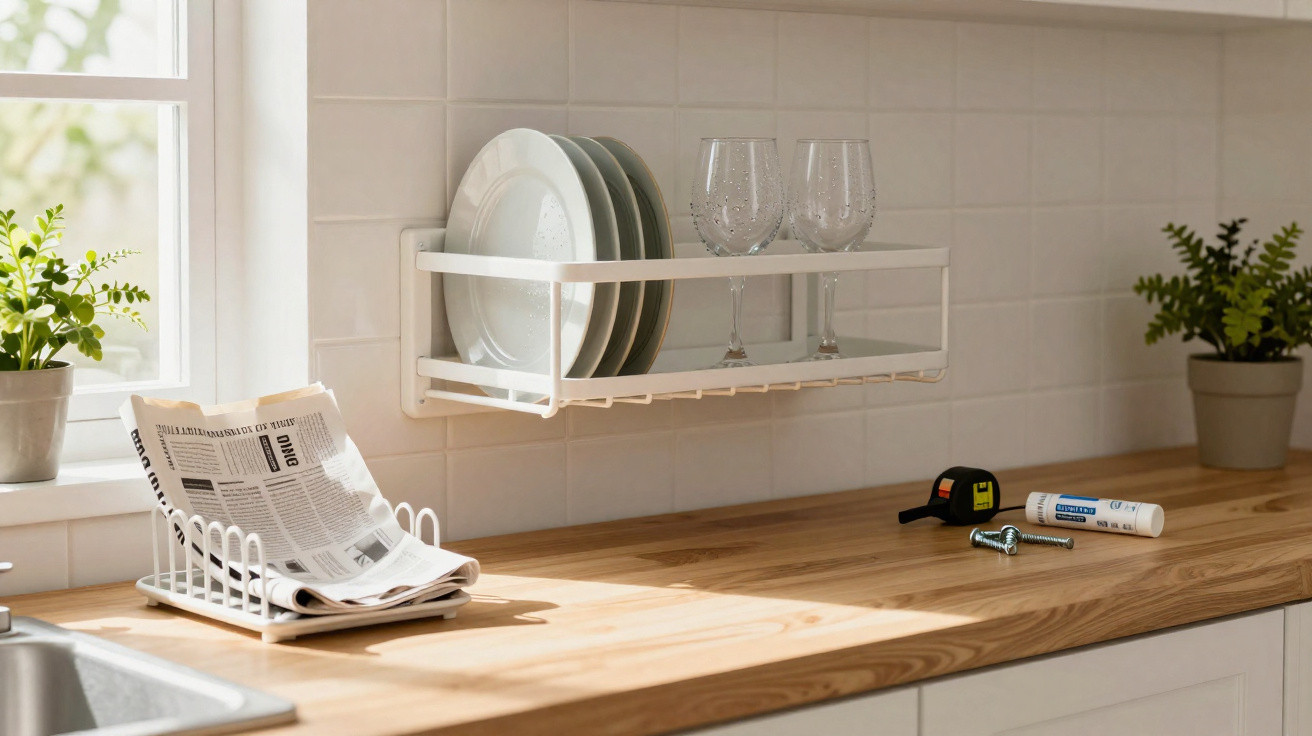
A discreet change is putting an end to all that.
Anyone who cooks every day knows the issue: piles of plates, damp worktops and a bulky draining rack right beside the sink. This is exactly where a new trend currently taking over online households comes in – and it is surprisingly simple: the traditional draining rack is moving from the worktop to the wall.
Why the traditional draining rack is becoming increasingly irritating
For years, the draining rack was as much a fixture in the kitchen as the cooker and fridge. Yet many people only realise how impractical it is once they stop using one. Kitchen planners repeatedly mention three issues.
- Constantly damp surfaces: Water collects beneath the rack. This leaves marks, can cause the worktop to swell in the worst case, and turns silicone seals grey.
- Visual clutter: Plates, mugs and plastic containers are all left out in the open. Even a tidy kitchen can look untidy as a result.
- Lost space: Particularly in small kitchens, the rack takes up valuable worktop room that is needed when cooking.
There is another factor that many people overlook: food residue, limescale and grease tend to build up in the rack's gaps. Without regular cleaning with a brush and cleaner, you can quickly end up with a small bacterial breeding ground beside the sink.
“The draining rack has been considered standard for decades – but in modern, often smaller kitchens, it simply no longer fits reality.”
The new trend: the wall-mounted draining rack
Rather than placing a cumbersome rack on the worktop, more and more people are fitting a dedicated wall-mounted draining rack above or directly beside the sink. Crockery dries in the air there, while the surface underneath remains clear.
The concept may sound simple, but it noticeably changes everyday life. Once you have the entire worktop area beside the sink free, you will usually not want to go back.
The key benefits at a glance
- More worktop space: The surface by the sink is finally available for a chopping board, blender or ingredients instead of being blocked by a rack.
- A drier area: Many wall-mounted models channel dripping water straight into the sink. No puddles and no marks.
- A tidier appearance: Plates and glasses are arranged in compartments, often positioned a little higher up – which looks calmer than a chaotic stack at eye level.
- Surprisingly generous storage: Good systems can hold up to around 10 kg and provide separate sections for plates, bowls, mugs and cutlery.
- Straightforward installation: Depending on the model, it can be mounted by drilling into the wall or, for lighter versions, with extra-strong adhesive strips.
The wall-mounted draining rack becomes a small space-saving solution, especially in fitted kitchens with narrow worktops. Even in rented homes, many landlords are more likely to recommend this approach than allowing wooden worktops to become swollen from constant moisture.
What to consider when choosing a wall-mounted draining rack
Before ordering straight away, it is worth taking a quick look at the dimensions, material and wall type. Not every model will suit every kitchen.
Step 1: Check the available wall space
Ideally, measure the area above the sink or to one side of it carefully:
- Width between the wall cupboard and the wall
- Height between the worktop and the underside of the wall units
- Distance from the tap, so that nothing knocks against it
For single-person and two-person households, a narrower model is usually sufficient. Families with plenty of plates and lunch boxes are better served by wider, double-row racks.
Step 2: Check the load capacity and construction
Manufacturers generally state a maximum load. As a rough guide:
| Household | Recommended load capacity | Recommended width |
|---|---|---|
| Single person | up to approx. 5 kg | 40–50 cm |
| Couple | 6–8 kg | 50–70 cm |
| Family | 8–10 kg | 70–90 cm |
Anyone who hand-washes large saucepans and glass dishes every day should opt for a larger size and choose sturdy screw fixings.
Step 3: Material and hygiene
Two material groups are particularly popular:
- Stainless steel: Resistant to rust, durable and easy to wipe clean; ideal for frequent washing-up and damp kitchens.
- High-strength plastic: Lighter, often less expensive and available in many colours; well suited to small households.
Removable drip trays or integrated channels that direct water straight into the sink are useful features. They help keep the nearby tiles and grout dry.
Installation: adhesive or drilling?
Whether drilling is necessary largely depends on the surface and on the weight the rack will need to support later.
- Drilling: The safest option for tiles, concrete and brick. Suitable for heavy metal racks with a high load capacity.
- Adhesive: Only sensible for lightweight models and smooth tiles. Ideal for tenants who would rather not make holes.
Important: adhesive solutions only work if the surface is free from grease and soap. If you have used washing-up liquid on the area beforehand, wipe it down thoroughly with an alcohol-based cleaner.
“The greater the load capacity, the more likely the rack should be fixed conventionally with wall plugs – otherwise plates and glasses will eventually end up in the sink.”
When switching really makes sense
Changing to a wall-mounted rack is particularly worthwhile in three situations:
- Tiny kitchens in city flats: Every square centimetre of worktop space matters.
- Open-plan kitchens: Anyone looking from the sofa towards the sink will appreciate having less visible clutter.
- Families doing lots of washing up by hand: Otherwise, everything quickly piles up beside the sink.
Many users say that after a few days they barely think about it. Reaching upwards for a plate becomes as natural as reaching for a wall cupboard.
Risks and common mistakes – and how to avoid them
The trend is not entirely without pitfalls. A few problems occur time and again:
- Overloading it: If more crockery is placed on the rack than intended, screws can be pulled out of the wall.
- Choosing the wrong wall: Thin plasterboard walls can only support wall plugs to a limited extent. Suitable cavity fixings are essential here.
- Poor positioning: If the rack is mounted too high, placing heavy plates into it becomes tiring.
If you are unsure, briefly ask an experienced DIYer or use online guides designed specifically for your wall type. Installing it properly once will save trouble later on.
How it changes the kitchen routine
The biggest difference becomes clear in daily use: when you wash a few plates, they go straight into the wall-mounted draining rack, water drips into the sink and the worktop stays free. Nothing has to be moved out of the way to make space while cooking.
Many people combine the wall-mounted rack with a small folding silicone draining mat that only goes on the worktop when needed – for large baking trays or frying pans, for example. Afterwards, it disappears into a cupboard, while the wall rack remains the standard place for everything else.
The psychological effect is also interesting: when less crockery is left out in the open, many people automatically clear it away more quickly. The kitchen stays looking tidy for longer, even after a hectic evening meal.
Practical conclusion: a small change with a big everyday effect
The trend for a wall-mounted draining rack is not a high-tech gimmick, but a simple, practical response to an everyday problem: too little space and too much visual clutter around the sink. Anyone prepared to pick up a drill or adhesive hooks once will gain a considerably airier, drier and more organised kitchen – without any major renovation.




Comments
No comments yet. Be the first to comment!
Leave a Comment