
Bought fresh strawberries on Saturday, only to find a furry coating in the fridge by Tuesday?
A straightforward household trick can prevent this small tragedy surprisingly easily.
Strawberries are among the most delicate fruits on supermarket shelves. Many shoppers will recognise the situation: you treat yourself to a punnet, eat a few, and within days the rest has to be thrown away. Yet one unobtrusive kitchen essential can extend their fridge life to up to seven days – without chemicals or a special storage container.
Why strawberries spoil so quickly
Strawberries are made up of around 90 per cent water. That is what makes them juicy, but it also leaves them highly vulnerable. Their texture is similar to a sponge: soft, porous and filled with tiny gaps. As a result, they react badly to every drop of moisture that collects in the punnet.
When warmth is added to the equation, mould fungi can thrive. One of the most common is grey mould (Botrytis cinerea). This fungus favours moisture combined with moderate temperatures. Refrigeration slows its growth, but does not stop it completely. It can still spread even at 0°C.
Another issue is that many strawberries are sold in plastic punnets with very little ventilation. On the journey home, whether in a warm car or a shopping bag, condensation forms on the inside and at the bottom of the punnet. It is barely noticeable, but enough to set the fungus in motion.
Just a few invisible drops of condensation inside the punnet can turn plump strawberries into a grey, soft mass within 48 hours.
The original packaging therefore often traps precisely what strawberries tolerate least: moisture without air circulation.
Moisture: helpful during growth, harmful in the fridge
In the strawberry field, the plant needs water in order to grow. Once picked, however, the situation reverses: every extra source of damp shortens its shelf life. Wet fruit, condensation and a damp fridge shelf all give fungal spores the perfect starting point.
In addition, many strawberries develop tiny bruises during picking or transport. Juice escapes from these spots, creating an ideal breeding ground. In a damp punnet, mould can quickly spread from one such area into a blanket of growth.
The kitchen helper that keeps strawberries fresh for longer
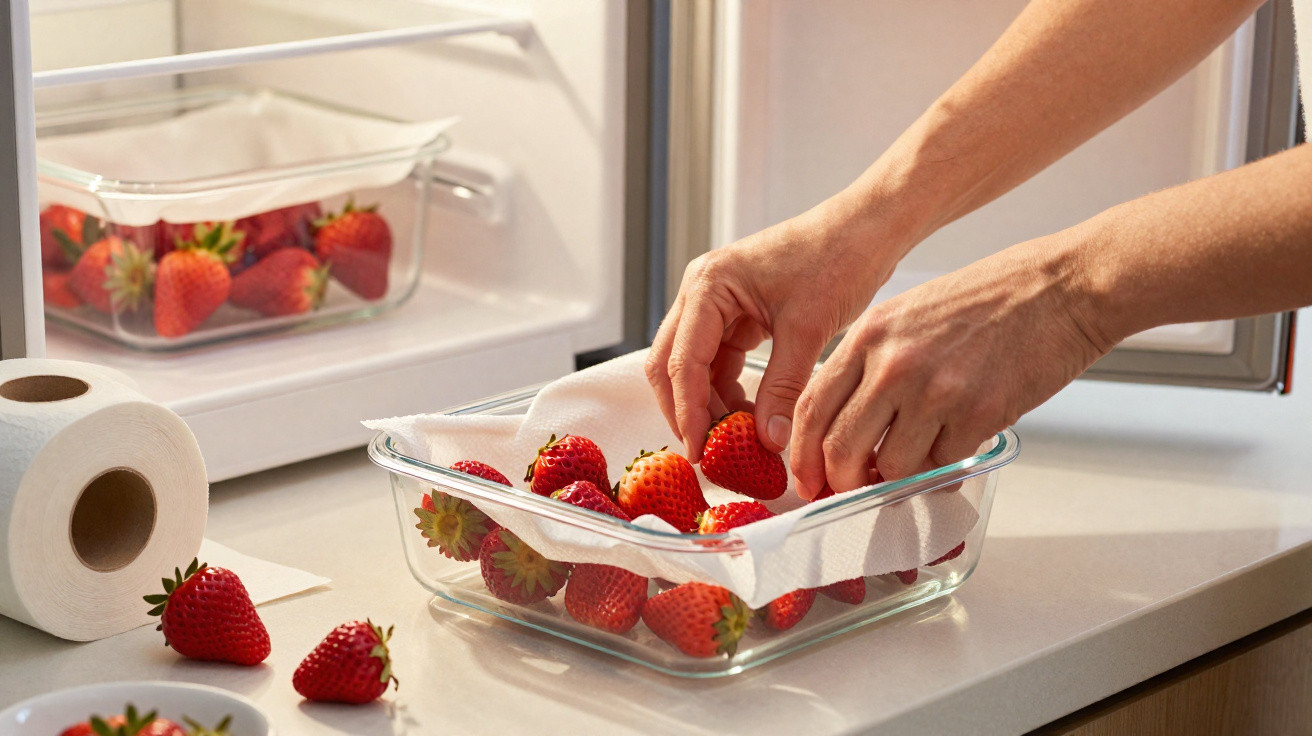
The answer is found in almost every kitchen: a sheet of kitchen paper. The idea is simple. Kitchen paper absorbs excess moisture rather than allowing it to remain on the fruit's surface. This removes the conditions that mould prefers.
A dry, absorbent sheet at the bottom of the punnet works like an invisible umbrella between the strawberries and condensation.
How the kitchen paper method works, step by step
- After shopping, do not wash the strawberries; simply remove any damaged fruit.
- Cut a sheet of kitchen paper to size and place it in the base of the punnet or a shallow container.
- Arrange the strawberries in a single layer on the paper, avoiding stacking wherever possible.
- If desired, place another sheet loosely on top without crushing the fruit.
- Close the container, or cover the original punnet lightly, and refrigerate at 0 to 4°C.
Regular checks matter: if the paper becomes visibly damp, replace it. A completely soaked sheet acts like a small swamp and reverses the intended effect.
Three common mistakes that ruin strawberries unnecessarily
Mistake 1: washing strawberries straight after shopping
Many people rinse the fruit immediately for hygiene reasons. This is exactly what can start the breakdown process. Water enters the porous texture, lingers in the indentations and significantly reduces how long the strawberries keep.
Tests show that unwashed strawberries stored on kitchen paper last several days longer in the fridge on average than fruit washed in advance. The best approach is to wash them gently just before eating, then serve them straight away.
Mistake 2: the wrong fridge neighbours
Very different fruits often end up together in the fruit drawer. What many people do not realise is that some varieties release ethylene, a ripening gas – especially apples and bananas. Strawberries are sensitive to it.
- Apples: a strong ethylene source that speeds up ripening and over-ripening
- Bananas: particularly troublesome for delicate fruit when ripe
- Strawberries: respond by softening faster and developing mould sooner
To keep strawberries fresh for longer, store them away from these gas-producing fruits, ideally in their own compartment or separate container.
Mistake 3: removing the stems too early
Taking off the green tops may seem harmless, but it opens up the fruit. Air, bacteria and fungal spores can enter more easily through the cut area. The strawberry then becomes soft and mushy sooner.
A better option is to leave the stems attached until the fruit is actually ready to go on the plate. Only then should they be removed with a knife or a small huller.
For hygiene enthusiasts: the vinegar-water method
Anyone particularly concerned with cleanliness, or wanting to store strawberries for more than a week, can use another trick: a brief soak in a vinegar-water mixture.
Mixing ratio:
- 1 part household vinegar
- 3 parts water
Soak the strawberries for around five minutes, move them gently through the liquid, then rinse under running water and allow them to dry thoroughly. The vinegar noticeably reduces the number of germs on the surface without permanently affecting the flavour.
Combining a short vinegar bath with subsequent storage on kitchen paper can extend shelf life to up to two weeks under ideal conditions.
Once dry, place the fruit in the fridge in a container with an absorbent base, as described for the kitchen paper method.
The daily 30-second check
Strawberries behave a little like dominoes: one mouldy fruit can rapidly affect those beside it. That is why it is worth taking a quick look in the punnet each day.
- Remove any fruit with visible mould immediately.
- Use very soft strawberries soon, for example in yoghurt or a smoothie.
- Check the kitchen paper and replace it when necessary.
This brief inspection takes less than half a minute, yet it can mean the difference between a week of enjoyment and food waste.
How well-stored strawberries taste their best
Strawberries straight from the fridge may feel firm, but they often have less aroma. Cold temperatures mute both their fragrance and flavour. Leaving the fruit at room temperature for 15 to 20 minutes makes the same plateful taste noticeably more intense.
A practical routine:
- Take the strawberries out of the fridge.
- Wash and hull them only at this point.
- Leave them on a plate briefly at room temperature.
- Serve them as desired: plain, with sugar, cream or yoghurt.
What this whole technique is based on
At the heart of all these strawberry tricks are three factors: moisture, temperature and germs. Kitchen paper manages dampness, the fridge slows biological processes, and vinegar lowers the microbial load. Keeping these three controls in mind helps you get considerably more from every punnet.
There is also an important benefit for both your budget and food waste. Fewer mouldy strawberries mean less frustration, less need to buy replacements and less fruit going into the bin. A considered system is especially worthwhile in households with children, where strawberries are often eaten in bursts.
Some of these methods can also be applied to other delicate berries, including raspberries and blackberries. They too benefit from dry storage, careful handling and regular checks. The quiet star remains the same: a simple sheet of kitchen paper that becomes an understated freshness aid in the fridge.





Comments
No comments yet. Be the first to comment!
Leave a Comment