
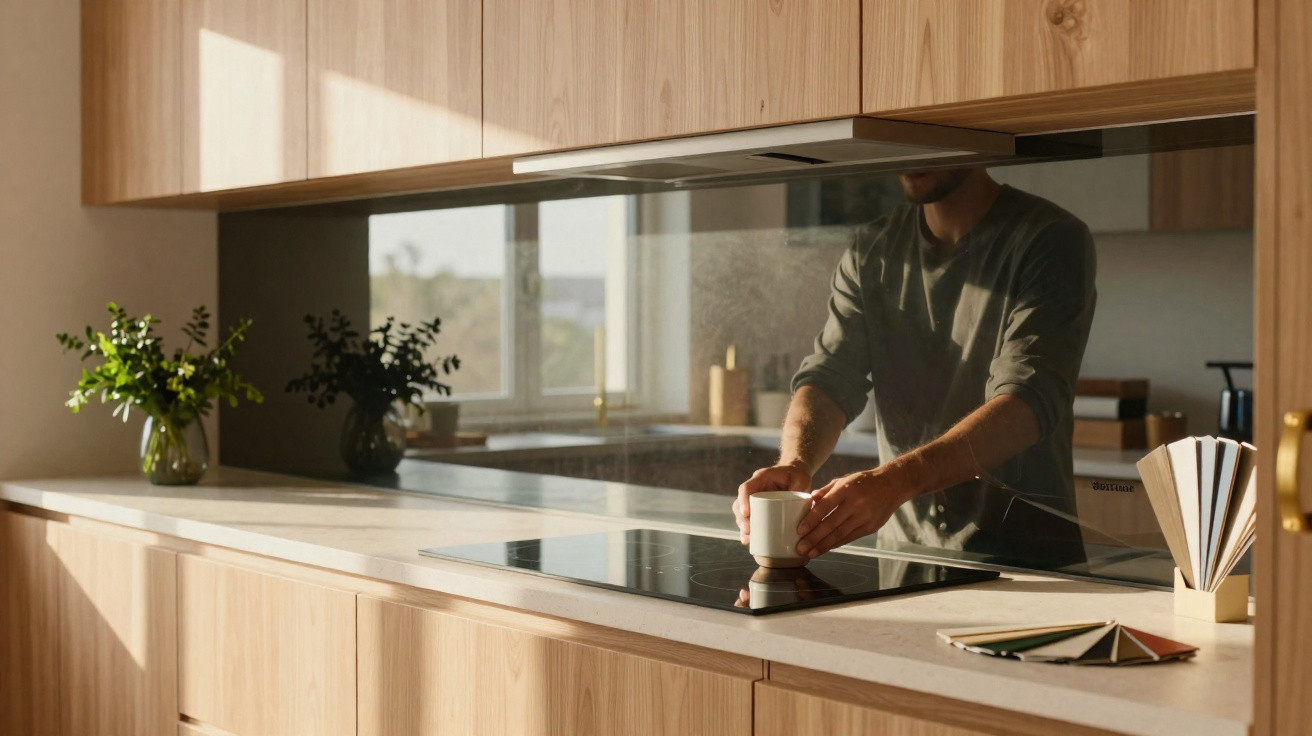
The unassuming splashback, once little more than an afterthought behind the hob, is rapidly becoming the focal point of renovation schemes. Fed up with white metro tiles and clinical stainless steel, homeowners are looking for a fast update that feels glamorous yet grounded, without having to replace the whole kitchen.
The controversial comeback of smoked glass
One material dismissed for years as a 1970s leftover is discreetly returning to prominence: the smoked glass splashback. To some, it still brings to mind brown-tinted lounges and dark dining nooks. To others, it is among the most understatedly luxurious kitchen upgrades available in 2026.
Smoked glass divides opinion, yet its return says a lot about how we want our homes to feel: warm, timeless and just a bit dramatic.
This is not the cloudy brown glass you may recall from a grandparent’s home. Today’s versions favour restrained shades, including soft anthracite grey, bronze with golden undertones and rich almost-black glass that still allows light through.
Designers link the revived interest to two major changes: a desire for long-lasting materials and a rejection of trend-led decorating. Rather than repainting cupboards every couple of years, more people want a single distinctive feature with enough character to last for a decade or longer.
A smoked glass splashback answers that need. It can lend a rustic kitchen a crisper, more architectural finish, while in an ultra-minimal white room it takes away the clinical edge without sacrificing a contemporary feel.
Why are people so divided by smoked glass?
The response to smoked glass is partly rooted in emotion. Anyone who experienced its original popularity may immediately regard it as dated. Younger homeowners, however, often see it as retro in the most appealing way: a reference to the past used with greater subtlety.
The main disagreement concerns atmosphere. Some welcome the slightly shadowy, lounge-inspired mood it brings to a kitchen. Others fear it could make an already compact kitchen darker or sit awkwardly beside pale cabinetry.
- Supporters value its softer appearance over stark mirrored surfaces.
- Critics worry it signals a return to “old-fashioned” interiors.
- Designers maintain that contemporary tints and formats are what set it apart.
The crucial difference is the level of control. Modern smoked glass is available in precisely balanced hues and finishes, rather than only as plain brown sheets. That refinement allows it to move beyond kitsch and into quietly sophisticated territory.
Light, depth and the “soft mirror” effect
Kitchen specialists are returning to this material less because of nostalgia than because of its visual properties. During winter, every bit of daylight matters, and a splashback that only absorbs light can leave a small room feeling enclosed.
Once-fashionable fully mirrored splashbacks reflect light forcefully while revealing every splash and smear. Smoked glass occupies the middle ground: reflective enough to bring life to a room, but soft enough not to resemble a dressing-room mirror.
Think of it as a soft-focus mirror: it catches light, hints at reflections, and gives the wall a subtle, cinematic glow.
Its gentle translucency can deceive the eye. It makes walls seem slightly more distant, creating extra depth in narrow galley kitchens and small rental homes. Although it does not show a sharp reflection of clutter, it catches silhouettes, colour and shadows, preventing the surface from looking flat.
It also performs well in daily use. The tinted finish disguises ordinary mess effectively, with water marks, light grease stains and limescale generally less obvious than they are on clear glass or polished steel. For many busy homes, this benefit alone makes a compelling case.
Cost, installation and day-to-day reality
A further reason for the splashback’s growing appeal is that it offers a balance between luxurious appearance and comparatively moderate cost. It is commonly supplied as large made-to-measure panels, resulting in fewer joins and grout lines.
| Aspect | Smoked glass splashback |
|---|---|
| Visual impact | High-end look, subtle reflections, depth |
| Budget | Typically mid-range, cheaper than many stones |
| Maintenance | Wipes clean easily; marks less visible than on clear glass |
| Installation | Requires accurate measuring; usually fitted by a professional |
Most panels are toughened for safety and may be fitted behind hobs as long as the manufacturer’s recommended distances are observed. In most cases, cleaning requires nothing more than a microfibre cloth and non-abrasive spray.
There is one important consideration: panels are frequently large, so the measurements need to be exact. Openings for sockets, corners and window reveals all require precision. As a result, homeowners commonly choose professional fitting over a DIY installation.
How smoked glass works with today’s favourite materials
Smoked glass is not making its return alone. Its comeback closely matches other kitchen-design changes, including a preference for rawer, more tactile surfaces and a step away from high-gloss finishes everywhere.
Smoked glass really comes alive when it sits next to something rougher, warmer or more textured.
Designers often match it with:
- Light oak or ash worktops – the warmth of the grain balances the glass’s cooler sheen.
- Walnut cabinetry – dark timber with tinted glass creates a bar-like mood without becoming weighty.
- Polished concrete – a matt worktop or floor allows the glass to introduce a measured touch of shine.
- Natural stone – marble or limestone receives a modern contrast from an inky translucent background.
To prevent the scheme from feeling cluttered, stylists generally minimise what is placed in front of the splashback. A few carefully selected ceramic objects, a weathered wooden chopping board and perhaps a small lamp or plant are usually enough.
Design choices that stop it feeling dated
If you are concerned about turning the kitchen into a 1970s time capsule, the details matter enormously. Thoughtful framing and restrained colour selection can transform the overall effect.
Picking the right tint
Colour establishes the atmosphere, but it also influences how bright the room feels. Deep black tints are dramatic, though they require strong natural or artificial lighting. In small city flats or north-facing spaces, pale grey or lightly bronzed glass is often a better choice.
A straightforward guide is this: the darker the splashback, the paler the surrounding finishes should be. White, cream and light timber cabinetry help ensure the full scheme does not feel overwhelming.
Finishes and formats
Gloss is the standard finish for most smoked glass splashbacks, although certain suppliers provide satin or etched alternatives that soften reflections. These can be particularly useful in bright, sun-filled kitchens where glare could be an issue.
Shape offers another opportunity for variation. A full-height panel extending to the ceiling behind the hob creates a dramatic centrepiece. Shorter sections ending just above the worktop are more understated and are frequently preferred for rental homes or smaller refurbishments.
When smoked glass makes sense – and when it doesn’t
This trend will not suit every kitchen. The material has clear strengths, but it comes with limitations too.
- Ideal for small kitchens needing greater depth; minimalist schemes at risk of feeling cold; rooms with varied materials that require one element to tie them together.
- Less suited to spaces already short on daylight; strongly patterned walls where the glass would conceal an expensive finish; highly traditional homes where ornate tiles are intended to remain a feature.
There is a psychological consideration as well. Smoked glass usually produces a more intimate, enveloping atmosphere, closer to a living room than a practical workspace. If your preference is for a bright, clinical and “professional” kitchen, it may not suit your style.
Practical questions homeowners often ask
People weighing up the change tend to return to the same concerns. The three most common are cleaning, safety and scratches.
Toughened glass is hard to scratch during normal use, but repeatedly knocking knives or heavy cast-iron pans against it will eventually cause marks. Preparing food and chopping on boards, rather than directly against the splashback, greatly limits that risk.
On safety, most established suppliers offer heat-resistant toughened glass suitable for use behind induction or ceramic hobs. With gas hobs, observing minimum flame clearances and using heatproof glass are essential; installers normally confirm these requirements before fitting.
Cleaning is more straightforward than many people anticipate. Tinted glass reveals fingerprints less readily than mirrors do. A basic routine of a quick daily wipe and a deeper degrease every week or two will keep it looking smart without constant polishing.
How designers use smoked glass to reshape a space
Professionals often use a glass splashback to subtly adjust perceived proportions. In a long, slim kitchen, placing a dark smoked panel along the worktop length can visually anchor the room, making the upper part appear lighter through contrast.
Within an open-plan living space, smoked glass behind the hob can make the kitchen area read as an extension of the living room rather than a solely practical corner. Its reflective finish picks up hues from lamps, artwork and sofas, visually connecting the zones.
Even rental properties, where structural alterations are not possible, can benefit from a made-to-measure panel installed over existing tiles. It can significantly alter the atmosphere while preserving the original surface beneath. Landlords are increasingly open to this reversible update, particularly where it raises perceived value.
Key terms and combinations worth knowing
Two terms appear often in discussions of this trend: “toughened” and “tinted”. Toughened glass is heat-treated to improve its strength and, if it breaks, to shatter into smaller and less hazardous pieces. Tinted describes colour incorporated into the glass itself, rather than a film placed over its surface.
Designers also sometimes pair smoked glass with under-cabinet LED strip lighting. The source stays concealed, while its glow runs across the glass and creates an evening ambience reminiscent of a bar. Warm white LEDs are most effective with bronze or brownish tints, whereas cooler whites complement black and grey shades.
Another developing combination pairs smoked glass with fluted finishes. Vertical grooves introduce rhythm and diffuse reflections more gently. This treatment further reduces the mirror-like quality, appealing to people who want depth without seeing recognisable forms reflected in the surface.
For those planning a renovation this year, a smoked glass splashback is less about following a short-lived fashion than indicating a wider change: kitchens no longer need to appear purely functional. They can become atmospheric, gently theatrical rooms in which material, reflection and light quietly establish the mood long after cooking has ended.






Comments
No comments yet. Be the first to comment!
Leave a Comment