
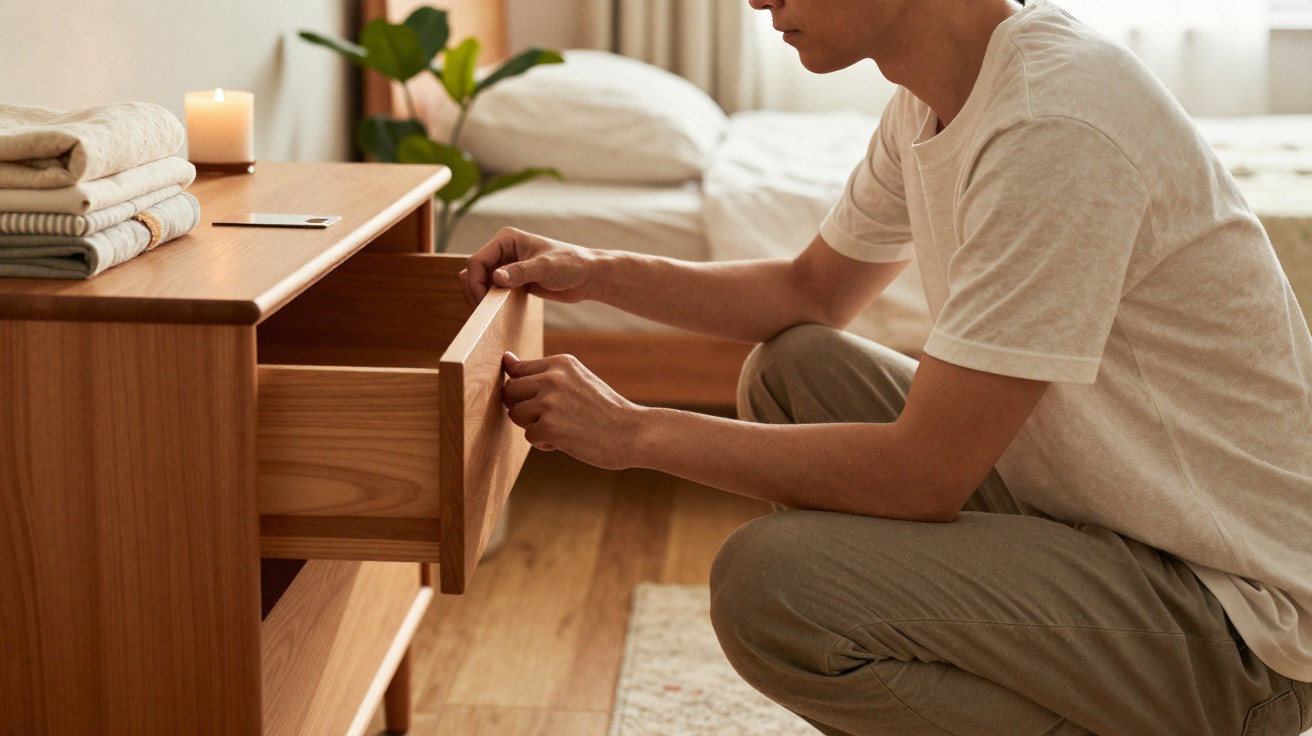
One Tuesday morning, just as you are about to leave, the kitchen drawer refuses to open. It moves forward by two centimetres, squeaks, then stops dead, as though it has decided to hold the cutlery hostage. We all know that slightly ridiculous moment: you pull harder, sigh, and wonder whether the whole unit somehow became delicate overnight. The reassuring news is that a stuck drawer does not necessarily mean a major repair or an afternoon spent with a toolbox. The cause is often something tiny: a crumb, a protruding screw, swollen wood or an item put away at an angle. You can usually deal with it without taking the entire piece of furniture apart. Sometimes, all it takes is looking at the problem differently.
Before forcing it, work out what the drawer is telling you
A drawer is rarely jammed for no reason, even when the issue appears suddenly. In a bedroom, it is often clothing trapped behind the back panel; in a kitchen, a spoon that has slipped into the gap; in an old chest of drawers, wood that has shifted with humidity. When you are in a hurry, the instinct is to yank it sharply, but that can push the drawer further out of position or bend a runner. Instead, place one hand on the front and the other beneath the drawer, then gently try several positions: upwards, downwards, slightly left, then slightly right. This quick check can reveal a great deal.
Léa had a basic sock drawer that began catching every morning. She planned to empty the chest of drawers, remove the runners and even replace the handles, convinced that everything had worn out. In fact, a rolled-up sock had slipped behind the drawer and was rubbing against the furniture rail. Two minutes after removing the protruding item, the drawer slid normally again. The most satisfying repairs are sometimes the least dramatic. A study by the retailer Castorama also found that minor household jams are often caused by overcrowding or poor alignment rather than an actual breakage.
The nature of the friction can point to the cause. When the drawer squeaks throughout its movement, the problem is usually at the sides or in the runners; if it catches only at the very end, inspect the area behind it, where dust, small objects and forgotten papers collect. A drawer that sits slightly crooked may also scrape because a screw has loosened or because it is overloaded. Let us be honest: hardly anyone cleans the inside of furniture runners every day. Yet a light coating of dust mixed with grease can be enough to turn an ordinary opening into an arm-wrestling match.
Simple ways to unstick a drawer without reaching for the toolbox
First, empty as much of the drawer as you can without removing it. If it opens only a little, reach inside and take out heavy items or anything that could tip towards the back. Next, use your phone torch to light up the edges, the bottom and the visible space beneath the drawer. A flat ruler, wooden spatula or spoon handle can help you gently push back an item lodged behind it. Do not use a knife, however tempting it may be: the blade can damage veneer, scratch metal or injure the hand holding the unit. In this case, patience works better than force.
If there is nothing caught at the back, run a dry cloth or your vacuum cleaner's narrow nozzle along the accessible runners. With wooden furniture, then rub a white candle or dry bar of soap very lightly over the contact points, before opening and closing the drawer several times. This traditional method forms a subtle sliding layer without soaking the material. For metal runners, use a small amount of silicone lubricant on a cloth, never sprayed generously straight into the furniture. Too much product attracts dust, and the issue returns sooner than you might expect.
A drawer scraping on one side may simply need a slight adjustment. Open it as far as possible, locate the visible screws on the inner face of the front panel or on the runners, then tighten only those that appear loose. A quarter turn may be enough; there is no need to tighten them as though you were repairing a gate. If the front panel touches the furniture frame, gently lift the drawer while opening it: this often helps you identify where it is misaligned.
“When a drawer resists, look for what is holding it back before trying to defeat it.”
- Shine your phone torch along the sides and at the back.
- Remove heavy or poorly stored items before handling the drawer.
- Clean the runners using a dry cloth or vacuum cleaner.
- Apply wax, dry soap or silicone only in very small quantities.
- Tighten accessible screws without dismantling the furniture structure.
Mistakes that make a stuck drawer worse, and small habits that help afterwards
The worst approach is to pull hard on the handle while bracing the furniture with your knee. That movement can tear off the front panel, distort a runner or crack the base, particularly on chipboard furniture. Avoid cooking oil as well: it may appear to solve the problem for a few days, but it then becomes sticky, can turn rancid and holds on to dust. Water is rarely helpful for swollen wood either. If an old drawer sticks after several humid days, air out the room instead and heat it gently. The material may naturally regain a few millimetres of clearance.
It is also worth reviewing what is inside the drawer once it has been repaired. Overly tall stacks of tea towels, upright files wedged in place and rolling toys are everyday little saboteurs. Keeping contents lower and more stable reduces the chance of another jam without requiring a perfect home reorganisation. You could fit a cut-to-size non-slip mat in the base, or use a small box to hold items that tend to travel. This is not another chore: it is a way to avoid that familiar moment when you are looking for a spoon, document or charger and your impatience rises far too quickly.
If the drawer remains completely stuck after these steps, do not persist. A runner may have come off its track, the base may have detached, or a component may genuinely be broken. These faults can require removing the drawer, rather than dismantling the entire piece of furniture. On some modern models, a discreet tab beneath the runners releases it in seconds. The right approach is to photograph any visible runner mechanisms before doing anything, particularly if the furniture is old or has unusual fixings. Keeping a record prevents plenty of uncertainty when it is time to put every part back in place.
| Key point | Detail | Benefit for the reader |
|---|---|---|
| Inspect before pulling | Identify a trapped object, a rubbing side or a misaligned front panel | Prevents a broken handle or a bent runner |
| Clean accessible areas | Remove dust, crumbs and residue from the runners | Restores smoother opening with minimal equipment |
| Lubricate sparingly | Use dry soap, wax or suitable silicone | Extends smooth operation without making the furniture dirty |

Comments
No comments yet. Be the first to comment!
Leave a Comment