
It is 7:42 am, the train leaves at 7:47 am, and your keys are somewhere in the flat. You know you had them “absolutely certainly” in your hand last night. Perhaps. The jacket comes off the hook, pockets are turned inside out, rucksack open, rucksack shut, and you are seconds away from overturning the sofa. Your pulse races, and the coffee suddenly feels like a bad joke. As you run barefoot along the hallway, you quietly, yet very clearly, ask yourself: “Why do I never learn?”
We all know that sort of morning. We also know the embarrassment of arriving late and muttering the same excuse for the third time. Yet the cycle repeats itself, always when we need it least.
The good news is that there is a ridiculously simple principle that can remove almost all of this chaos from your life.
The real reason your keys keep disappearing
People who lose their keys are rarely just “scatterbrained”. More often, something deeply human collides with an especially stressful daily routine. We get home while our minds are still in a meeting or already focused on dinner, the phone buzzes and the shopping bag cuts into our hand. The keys are put down briefly, “just for a moment”. That is precisely where tomorrow morning’s drama begins.
Our brains do not store this moment as anything significant. There is no clear image and no definite location, just an incidental movement performed on autopilot. By the following morning, the pieces that make up the memory are missing. All that remains is the vague feeling: “I know I put them down somewhere around here.”
A young mother from Cologne told me that she eventually began counting how often she was late. On average, she arrived at nursery five to ten minutes late twice a week, simply because her keys had disappeared. Twice a week did not sound like much - until she calculated it. Around eight hours a year spent searching: an entire working day buried in sofa crevices and jacket pockets.
Her turning point was not a new app or a smart key fob. It was a hook board placed directly by her flat door: an inconspicuous, inexpensive piece of wood from a DIY shop, fixed in place with three screws. “Since then,” she says, “I may have searched for my keys only twice. In two years.”
We are not designed to keep dozens of minor details in our heads. Memory thrives on stories and rituals, rather than exceptions and temporary storage spots. The moment an object such as a key has no permanent home, every day becomes a fresh experiment. One day it stays in your trousers, the next in your handbag, then on the kitchen table.
The sobering truth is that anyone searching for their keys in the morning is really fighting their own habits - not their intelligence or organisational ability, but the absence of a system. And systems beat willpower almost every time.
The One-Place Principle: the simplest hack for everyday life
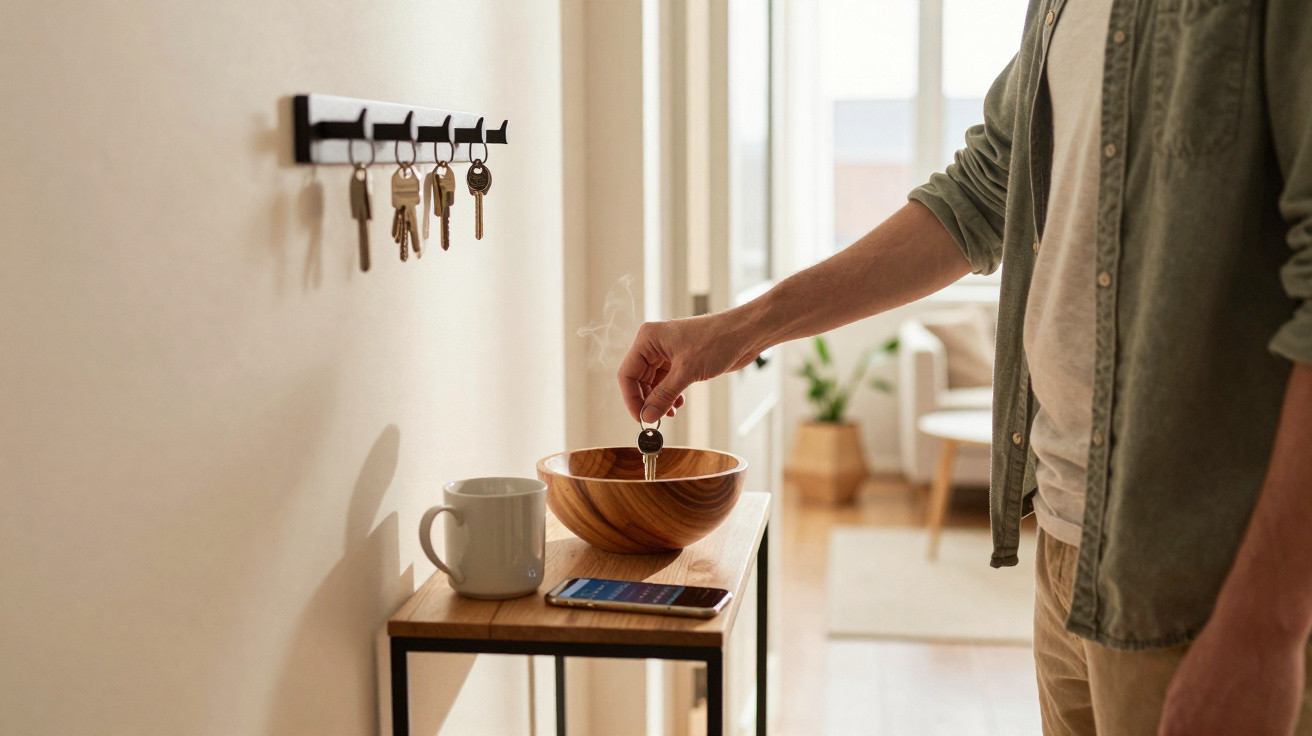
The easiest way to stop searching for your keys for good sounds almost laughably basic: give them one single, unchanging place. One. Not three. Not “usually in my bag, sometimes in the hallway”. Choose one dedicated compartment, small bowl or hook immediately beside the door. Then follow one rule: the keys go there EVERY time you enter the flat.
The One-Place Principle is so effective because it removes the decision altogether. You do not need to think about it or start an internal conversation such as, “Where shall I put them for a moment?” Eventually, your body carries out the movement on its own - like fastening your seatbelt in the car or turning off the light when you leave a room. The brain loves these small everyday motorways because they save energy.
Let us be honest: nobody enjoys meticulously putting everything away every evening. No one willingly walks back to the living room merely to put a key away “properly”. That is exactly why the location must be so convenient that you can almost trip over it. It should be right beside the door, at hand height, with no drawer, lid or fiddling involved. The less effort it requires, the more likely you are to do it every day.
The classic mistake looks like this: you create a “perfect” home for your keys, perhaps in a pretty basket on the sideboard three steps from the door. It works for the first three days. Then you arrive home soaked by rain, your bag is slipping from your shoulder, and you are still balancing a shopping bag. At that moment, the nearest place will always beat the perfect one.
A second obstacle is having too many “official” locations: a hook by the door, a little dish in the kitchen and, sometimes, the jacket pocket. It feels flexible, but it is really just a collection of compromises. The more places there are, the less you remember. The less you remember, the more searches you start.
“Order is not about making sure everything is always neatly arranged. Order is about taking the stage away from tomorrow’s stress,” a professional organiser who earns a living untangling chaotic homes told me recently.
For the One-Place Principle to hold up in real life, it needs a few small but highly practical choices:
- Select a location no more than an arm’s length from the flat door.
- Make sure you can put down the keys without looking, using a bowl, board or hook.
- Connect putting them down to a fixed moment: door shut - keys away.
- Avoid drawers or lidded boxes that delay you “just briefly”.
- Keep the space visibly clear, so that nothing else accumulates there.
What changes when you no longer search in the morning
When people are asked what frustrates them most about stressful mornings, many say: “It is not the stress, but the feeling that I do not have my life under control.” A missing key becomes a symbol of that feeling: a small object revealing how fragile our carefully constructed system of appointments, plans and to-do lists can be.
Anyone who takes the One-Place Principle seriously notices something unusual after a few days. It is not only about the keys. Over time, other things begin to find permanent places too: sunglasses, wallets and headphones. Suddenly, the number of “Where is…?” moments falls noticeably. Not to zero - we are not robots - but to a level that feels as if you can breathe.
The mood in the morning shifts quietly. You walk to the door, reach almost absent-mindedly for the designated spot and feel the familiar weight of the key in your hand. No adrenaline rush from panicked searching, no irritated eye-rolling, no “Me again, honestly”. That tiny moment of reliability carries over into the rest of the day.
It is striking how often this small principle also eases relationships. There are no more accusations such as, “But you locked the door yesterday - where did you put the key?” No shared ten-minute search ballet before everyone can leave the house. Just a quick reach: a quiet, unremarkable moment of, “Okay, we have this under control.”
| Key point | Detail | Benefit for the reader |
|---|---|---|
| One-Place Principle | The key has one fixed location directly by the door | Less stress from searching, greater everyday reliability |
| Routines instead of willpower | Putting the key away becomes an automatic action | Less mental strain, more energy for more important things |
| Everyday effect | Organisation spreads to other belongings and habits | More structure, less rush on hectic days |
FAQ
- How long does it take for the One-Place Principle to become a habit? Most people report a clear sense of automation after one to two weeks. At first, you need a conscious reminder, but then the movement happens almost by itself.
- What if I live with several other people? Set up a shared place with a clear allocation, such as a hook board with names or fixed positions. That means fewer mix-ups and no arguments over “your” hook.
- Doesn’t a key tracker, such as AirTag or Tile, work just as well? A tracker can save you in an emergency, but it does not replace a system. It is the fire brigade, not the fire-safety regulations. The useful combination is a fixed place plus emergency technology.
- What should I do if I still forget to use the fixed location? Link the key moment to something you do anyway: closing the door, taking off your shoes or hanging up your jacket. If necessary, put a small note on the door to nudge you for a few days.
- Does the principle work while travelling too? Yes. As soon as you arrive at a hotel room or holiday flat, immediately create a “home port” for the key, such as a corner of the bedside table or a hook on the wardrobe.


Comments
No comments yet. Be the first to comment!
Leave a Comment