
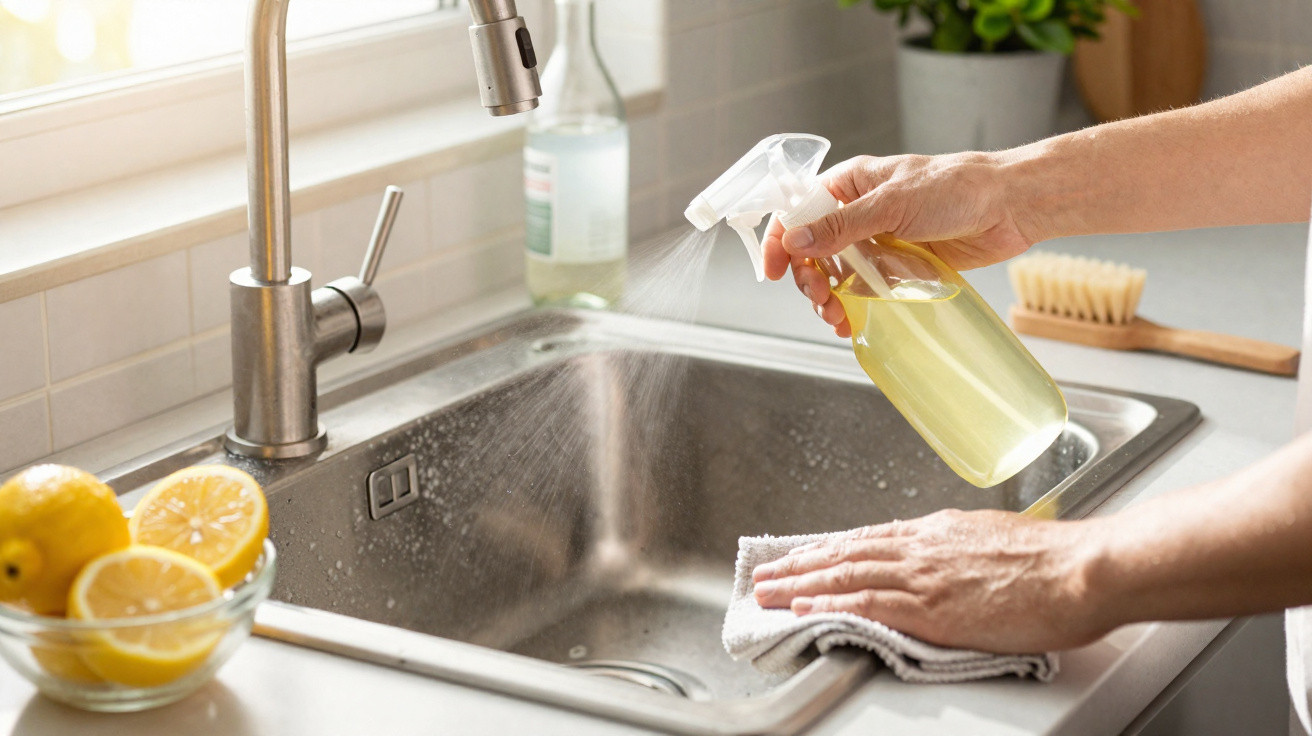
Stubborn limescale marks around the kitchen sink are frustrating, make the kitchen look grimy and can often seem impossible to remove.
However, a simple homemade mixture deals with them ruthlessly.
Limescale deposits on taps and in the kitchen sink are a recurring nuisance in many homes. Expensive specialist cleaners, harsh chemical smells and prolonged scrubbing soon become tiresome. Yet many grandmothers already relied on an uncomplicated answer that needs neither strenuous effort nor aggressive chemicals: a warm, homemade blend of kitchen ingredients that effectively eats through limescale.
Why limescale is particularly stubborn in the kitchen
The cause is in the mains water. In many areas, it contains high levels of dissolved minerals such as calcium and magnesium. Although these substances are harmless in themselves, they settle on surfaces.
When water runs across stainless steel, ceramic or chrome taps, a fine mineral residue remains once the liquid has evaporated. Every wash-up, every burst of hot water from the kitchen tap and every cloud of steam adds a little more to the layer, eventually creating the familiar rough, white crust.
The hotter the water, the more quickly the minerals crystallise and form solid limescale layers.
Areas where water collects are especially prone to it:
- The join between the tap and kitchen sink
- Edges around the plughole
- Grout lines and tiny gaps around the sink rim
- The tap aerator
Many people then reach for powerful chemical descalers. While these do dissolve limescale, they also bring several drawbacks: a pungent smell, irritation to skin and airways, plus the need for gloves and ventilation. Some products can even damage delicate surfaces, including copper, brushed metals and thin coatings.
There is another consideration: the chemical cocktail ultimately ends up in the wastewater. Anyone wanting to keep the kitchen clean without placing unnecessary strain on their health or the environment is better served by a gentler but smart alternative.
The homemade vinegar and lemon mixture
The blend trusted by many grandmothers contains three items that almost everyone already has at home: white vinegar, water and fresh lemon. There is no magic involved, merely straightforward chemistry.
White vinegar contains acetic acid, while lemon provides citric acid. Both acids attack the alkaline minerals in limescale and break their bond with the surface. Used together, they work more powerfully than either ingredient used alone.
How to prepare the limescale remover correctly
For a standard quantity sufficient for a kitchen sink and tap, proceed as follows:
- Pour 250 ml of white vinegar and 250 ml of water into a heatproof container.
- Squeeze the juice from one medium-sized fresh lemon and add it.
- Stir briefly to combine the ingredients thoroughly.
- Warm the mixture in the microwave for around 30 seconds, until it is noticeably warm but not boiling.
- Transfer it to an empty spray bottle.
Heating is not an insignificant detail; it is a genuine booster. Warmer acid molecules move faster and penetrate the limescale structure more effectively. As a result, the deposit lifts more easily and evenly.
Using the vinegar and lemon mixture on the kitchen sink
Before applying the mixture, remove any heavy soiling. Vinegar and lemon can only work directly on limescale, not on grease residues or food crumbs.
Preparing the surface
- Wipe food residue from the kitchen sink and tap with a damp cloth.
- Remove loose crumbs from around the plughole.
- Briefly dry the surface with a cloth so that the acidic mixture is not immediately diluted.
Spray, leave and wipe
Now it is time for the grandmother's trick:
- Spray the warm mixture generously over every limescaled area, including narrow gaps and grout lines.
- Allow it to work for at least 20 minutes; do not wipe it away too soon.
- Once the contact time has passed, wipe the surfaces with a damp microfibre cloth.
After about 20 minutes, even stubborn limescale can usually be wiped away easily without any effort.
For tight spots, such as the join between the tap and kitchen sink or the aerator, an old soft toothbrush is suitable. It reaches into crevices without scratching the surface.
Finally, rinse everything thoroughly with clean water. Acid residues should not be left permanently on metal or ceramic, as this could cause slight etching. Then dry all surfaces carefully, ideally using a clean tea towel or dry microfibre cloth.
Why drying makes such a difference
Many people simply leave the sink to air-dry after cleaning. That is precisely when the next layer of limescale begins. Every individual drop that evaporates leaves minerals behind again.
Those who quickly wipe over the surface with a cloth after washing up or cleaning will keep it clear for considerably longer. Shiny finishes, especially stainless steel and chrome taps, remain visibly free from marks for longer.
Regular care rather than emergency cleaning
The homemade vinegar and lemon mixture is useful not only as an emergency remedy for thick crusts. It is most effective as part of everyday cleaning when used regularly.
- Spray on the mixture once a week.
- Leave it to work for a few minutes; 10 minutes is often enough for light deposits.
- Rinse, dry and the job is done.
Following this routine prevents a hard layer from forming in the first place. In the long term, it saves considerable time and frustration because vigorous scrubbing becomes virtually unnecessary.
Does the trick work elsewhere in the home?
The mixture is also suitable for many other places where limescale is an issue, for example:
- Limescaled shower heads, when unscrewed and placed in the warm solution
- Limescale rings on stainless-steel sinks
- Light deposits on tiles around the kitchen sink
- Limescale marks on glass carafes or vases
Care is needed with sensitive natural stone, such as marble or limestone. Acid can damage these surfaces. Test the mixture on an inconspicuous area first, or preferably choose another product.
When limescale is an issue throughout the home
Anyone noticing hard water in many places, including the kettle, shower screen and toilet, may wish to consider a water filter or water softener. These systems reduce the calcium and magnesium content of mains water, protecting pipes, appliances and taps.
Even with softened water, basic care is still required. Softer water also leaves marks, just more slowly. A brief weekly use of the grandmother's mixture keeps the kitchen and bathroom looking well maintained.
Health, cost and the environment: why the homemade mixture stands out
The vinegar and lemon mixture offers several tangible advantages over many ready-made products:
| Aspect | Homemade mixture | Chemical descaler |
|---|---|---|
| Ingredients | Vinegar, lemon, water | Often aggressive acids and additives |
| Smell | A brief vinegar note, followed by a lemon scent | Often pungent and irritating |
| Surface protection | Gentle when used correctly | Can damage coatings |
| Cost | Very low; ingredients are inexpensive | Considerably more expensive per use |
| Environmental impact | Readily biodegradable | More chemical residues in wastewater |
For families with children or pets, avoiding strong chemicals can feel reassuring. Those who do not want to put on gloves constantly or open the window wide while cleaning may find the homemade mixture more pleasant to use.
Common practical questions
Can I use a different type of vinegar?
White household vinegar is best because it is colourless and contains no added flavourings or colourings. Apple cider vinegar also works in principle, but may leave slight discolouration on very pale materials.
How strong can the vinegar be?
Standard household vinegar contains around 5 to 10 per cent acid. Combined with water and lemon, this concentration is sufficient. Highly concentrated vinegar essence should be diluted further, otherwise delicate surfaces could be damaged.
What should I do with extremely thick crusts?
In these cases, extend the contact time and repeat the treatment. Kitchen paper soaked in the mixture can be placed on the affected area and left in place for 30 to 40 minutes. Then wipe again and rinse thoroughly.
An old tip with a modern effect
This mixture of vinegar, lemon and water draws on the knowledge of earlier generations, yet fits perfectly into modern life: fewer chemicals, less packaging waste, lower costs and still a visible result.
Anyone wishing to keep their kitchen free from limescale with simple ingredients will find a powerful ally in this homemade recipe. After using it once, the result is often clear with the first wipe: grandmother was right.



Comments
No comments yet. Be the first to comment!
Leave a Comment