
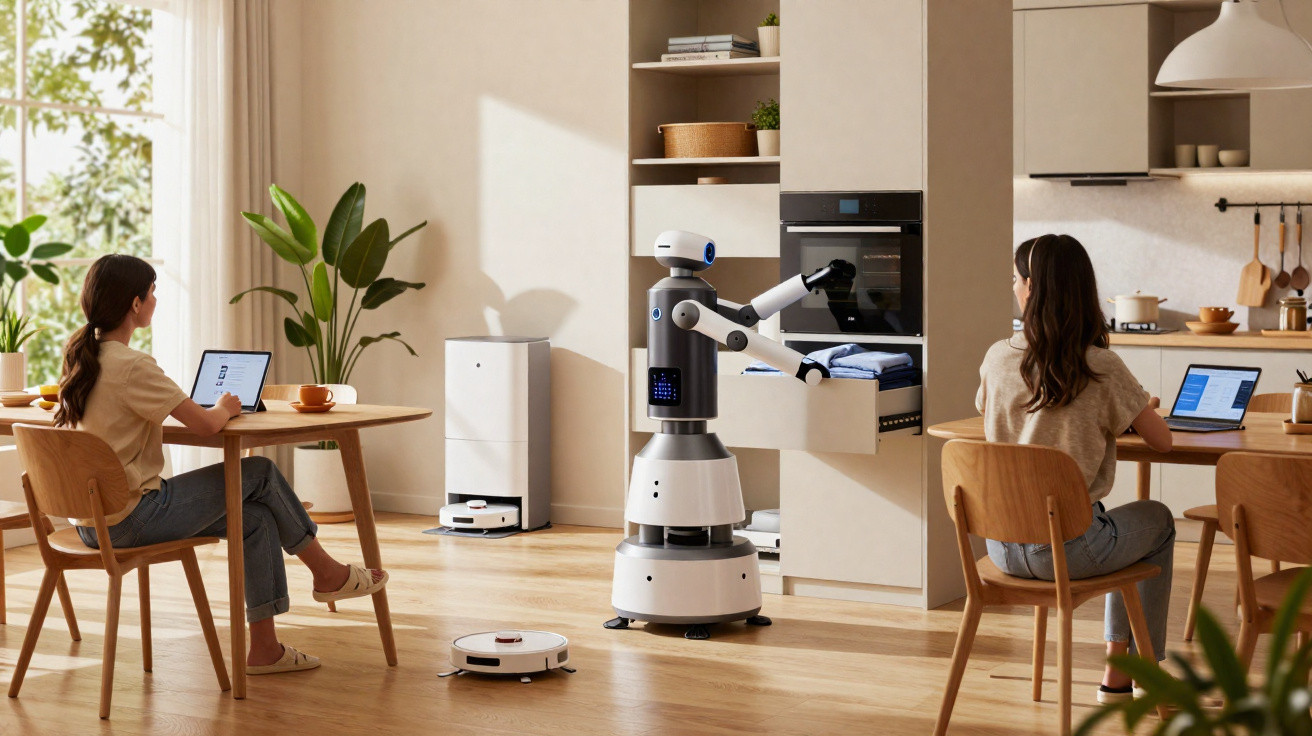
At CES 2026, the technology industry is demonstrating just how far the vision of a self-running home has progressed. Among televisions, electric cars and VR headsets, a new category of robot is drawing attention: machines that do more than vacuum, taking on genuine household chores from folding laundry to handling hot baking trays.
How CES 2026 is reimagining the home
For years, CES in Las Vegas has been regarded as a barometer of technology trends to come. In 2026, one subject is particularly prominent: artificial intelligence in the home. Rather than simply unveiling individual smart appliances, manufacturers are presenting complete household ecosystems that communicate and respond to one another.
The central idea is a living space that is not merely connected, but able to anticipate needs. Fridges identify food and recommend recipes. Washing machines automatically adjust water and electricity use. Vacuum cleaners remember floor plans and furniture locations. Many of these appliances use large AI models, such as Google Gemini, to spot patterns in day-to-day life.
The vision: A home that handles routine tasks quietly in the background – before they are even perceived as “work”.
This development is giving technology a new role. Manufacturers no longer talk about “smart gadgets”, but about a digital household assistant made up of numerous devices. The most compelling part of this shift, however, comes on wheels: the latest generation of household robots.
The show star: a robot that reaches into kitchen cupboards
LG ClOiD folds laundry and reaches into the oven
LG’s humanoid robot, called ClOiD, delivers the biggest wow factor. In the trade-show demonstration, it stands in front of a pile of laundry, picks up a T-shirt, shakes it out and folds it neatly. Soon afterwards, it rolls over to the dishwasher, opens the door, removes plates and arranges them in a kitchen cupboard.
To do this, ClOiD combines cameras, depth sensors and AI software. Its sensors detect the shape, position and material of objects. The AI interprets this information in real time, calculating the required grasping and movement sequences. As a result, the robot can handle laundry as well as unload delicate glasses or remove heavy casserole dishes from the oven.
The trade-show prototype demonstrates that robots can now manage tasks that previously required human fine motor skills – such as lifting hot baking dishes or sorting crockery.
ClOiD also learns continuously in the background. Its AI stores information about new objects and situations, refines its movements, and can adapt to different kitchens, furnishings and routines. It is this learning process that makes the robot relevant for everyday use rather than only for perfectly staged trade-show displays.
SwitchBot Onero H1: the quiet organiser in the background
Another eye-catching machine comes from SwitchBot. The Onero H1 places less emphasis on humanoid styling and more on practical function. It is chiefly designed to recognise, pick up and rearrange everyday items. For instance, it is intended to load a washing machine, collect toys from the floor or unpack shopping from boxes.
The AI in the Onero H1 examines household habits: when is washing usually done? Which items are regularly left lying around? Which cupboards are opened often? It builds a pattern from this information, which the robot uses to proactively suggest tasks. It may, for example, remind users about the next wash load or propose tidying the hallway when shoes and bags begin piling up again.
Beyond vacuuming: cleanliness as a connected system
Alongside the striking humanoids, many exhibitors are showing specialist assistants that appear substantially more practical and closer to market readiness. They rely on a clearly divided set of tasks, while working together through a shared AI platform.
- Intelligent robot vacuum cleaners no longer simply travel in set patterns. They identify cables, socks or pet mess, specifically target rarely used corners, and can even clean steps or raised platforms.
- Surface-cleaning robots mop floors, clean windows or maintain swimming pools using 3D maps and adaptive navigation that responds to furniture, carpets and weather.
- AI-powered organisation systems locate misplaced household items and report through an app where keys, a remote control or a favourite toy were last found.
- Connected large appliances, including washing machines, tumble dryers and vacuum cleaners, coordinate their timings to avoid peaks in noise and make the best use of electricity tariffs.
Where earlier robot models largely followed their programmes rigidly, new systems react to what is actually happening in the home. A robot vacuum does not set off while children are playing on the floor. The dishwasher starts when electricity is particularly cheap. The aim is to reduce the stress of everyday tasks without requiring users to constantly operate apps.
How these household robots could work together day to day
It becomes especially interesting when the devices are considered as part of a shared scenario. A typical family evening could look like this:
| Time | Situation | Household AI response |
|---|---|---|
| 18:30 | The family arrives home and puts down the shopping. | Onero H1 puts some of the shopping away in the fridge and cupboards. |
| 19:15 | Dinner is in the oven and the kitchen is in use. | ClOiD lays the table and prepares the crockery. |
| 20:00 | The meal is ready. | The robot takes the casserole dish out of the oven, while the robot vacuum postpones its cleaning. |
| 20:45 | The family is sitting in the living room. | ClOiD clears the table and loads the dishwasher; the robot vacuum cleans the kitchen and hallway. |
| 21:30 | The children are asleep and laundry is piling up. | Onero H1 starts a wash load, while ClOiD folds the dry laundry from the previous day. |
Such scenarios illustrate how many small jobs could combine into an almost automated household routine, without a button press and guided by pattern recognition and learning algorithms.
Opportunities and unanswered questions for households in the German-speaking region
Households in Germany, Austria and Switzerland face several practical questions. Many homes are smaller than houses in the United States, furniture is positioned more closely together, and doors and thresholds vary. Manufacturers will need to train their robots to cope with these differences. There are also legal requirements around data storage and safety, which are stricter in Europe.
Even so, the concept is appealing. Those who work shifts, care for children or support relatives with care needs could gain meaningful relief from automated household chores. In ageing societies in particular, industry observers expect rising demand for robots that help with day-to-day domestic life without replacing care staff.
Household robots could, in the medium term, become a form of “infrastructure” – as commonplace as washing machines or Wi-Fi.
Cost remains an open question at the same time. The first fully capable all-rounders are more likely to launch in the premium segment. One possible route is subscription models, in which users rent the hardware and receive software updates as part of the package. For the wider public, specialist devices that perform one task particularly well, such as laundry management or kitchen assistance, are likely to become established first.
What the buzzwords really mean
Many terms sound like marketing language, yet they have a specific technical basis. “Object recognition” means that an AI has been trained on video or sensor data and learns from millions of examples what plates, pots or T-shirts look like. When “grasping”, the robot uses that recognition to calculate where its fingers or gripper need to make contact without slipping or breaking anything.
“Adaptive learning” means that the system learns from mistakes. If a robot grips a glass too firmly and the pressure sensor reports unusual readings, the AI will adjust the pressure in future. These changes largely take place in the background, but mean that the device becomes slightly better suited to its own home with each passing week.
Risks, real-world testing and the question of control
As autonomy increases, so do safety requirements. A robot lifting hot trays from an oven must reliably recognise whether a child is in its path. Manufacturers are working with safety zones, emergency stop switches, and limits on force and speed. These measures can reduce accidents, but cannot eliminate them entirely. Users will therefore need to adopt new routines, such as keeping certain areas clear for children while robots are working.
Data protection is another concern: cameras and microphones in the home can capture sensitive information. For the European market, clear retention periods, local processing and transparent settings are essential. People using these devices need understandable menus and straightforward ways to switch off particular functions.
A sensible approach is to trial such robots with individual tasks first. Someone who has had positive experiences with an intelligent robot vacuum cleaner is more likely to move on to more complex systems later. This makes it possible to determine step by step what people genuinely want to hand over – and which jobs they may actually prefer to keep doing themselves.

Comments
No comments yet. Be the first to comment!
Leave a Comment