
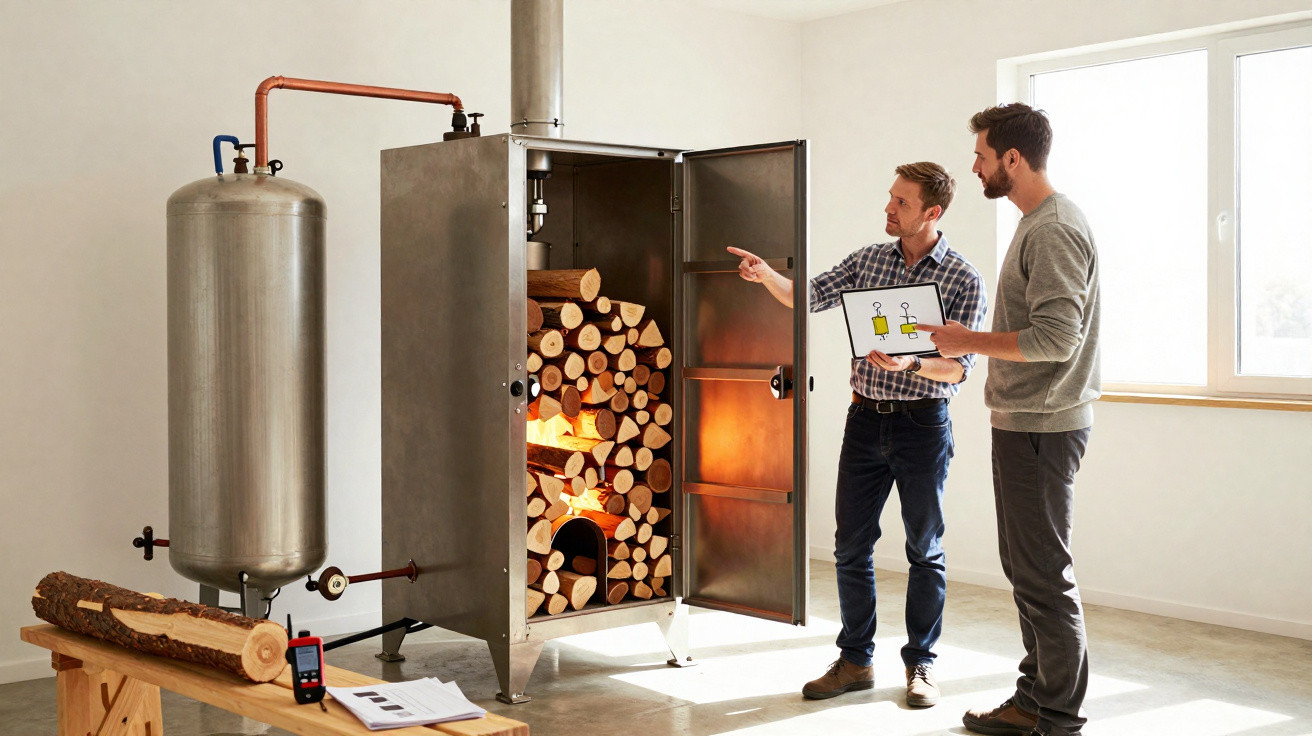
On cold winter evenings, an increasing number of households are discreetly returning to wood heating – though with technology far more sophisticated than a basic stove.
Higher energy bills and tighter air-quality requirements are encouraging homeowners to reconsider their heating arrangements, placing wood-gasification boilers on many shortlists. They can offer inexpensive operation and cleaner burning, but they also require practical involvement and a sound grasp of their operation.
What a wood-gasification boiler actually is
At first sight, a wood-gasification boiler resembles a large, contemporary solid-fuel boiler. Its internal process, however, differs greatly from that of a conventional log burner.
Rather than burning logs directly in one chamber, it initially transforms the wood into a combustible gas. That gas is subsequently burned at high temperature in a separate chamber, extracting considerably more usable heat from each log.
In gasification mode, wood stops being just a fuel and becomes a source of gas that is burned almost completely.
The technology has long been established in Central and Eastern Europe, where timber is readily available and gas costs may fluctuate sharply. It is now attracting attention in the UK and US, particularly from rural householders who can obtain low-cost or free wood.
How wood gasification works, step by step
The two-chamber design
The boiler’s internal arrangement is central to understanding it. Most models contain two principal sections:
- Upper chamber: the area where logs are loaded, dried and partly burned.
- Lower chamber: the section in which wood gas combines with air and combusts at high temperature.
As logs warm in the upper chamber, they give off a blend of gases – mainly carbon monoxide, hydrogen and different hydrocarbons. Rather than allowing this smoke to leave through the chimney, the boiler draws it down through a narrow nozzle into the lower chamber.
In that chamber, the controlled supply of air and high operating temperature allow the gas to burn almost entirely. This “reverse flame” or “down-draft” combustion is what enables efficiency far beyond that of a standard log boiler.
Role of the fan and controls
Most current models incorporate a small electric fan alongside an electronic controller. The fan pulls gas through the nozzle while maintaining a stable flame. Using water temperature, and sometimes flue-gas readings, the controller regulates the air supply.
Without a fan and proper control, gasification is unstable and the boiler behaves much more like a conventional log burner.
If the heating system requires less heat, the controller may reduce the rate of combustion or pause it for a time. Maximum efficiency, however, is achieved when the boiler operates continuously at full output.
When a wood-gasification boiler performs best
A wood-gasification boiler operates most effectively at high temperatures. Repeated stop-start running with small loads of timber reduces efficiency and can shorten the appliance’s working life.
Specialists generally advise filling the boiler fully, running it at its rated output, then storing excess heat in a buffer tank – effectively a large, highly insulated cylinder containing hot water.
A properly sized buffer tank turns an on–off, manual boiler into a flexible heat source that can follow the home’s needs.
The buffer tank: why it matters
A buffer, also known as an accumulator tank or thermal store, functions as a heat battery. While the boiler is firing, it heats the tank. The central-heating system and hot-water taps can then take heat from it when required, including well after the fire has gone out.
Important advantages of combining a gasification boiler with a buffer include:
- Improved combustion efficiency and cleaner flue gases.
- Less frequent firing each day, reducing the work involved in loading logs.
- More consistent internal temperatures and greater comfort.
- Suitability for low-temperature heating systems, including underfloor heating.
How often you actually need to load wood
The everyday loading pattern is determined by three factors: the boiler’s output, buffer-tank capacity, and the property’s heating demand.
In a properly insulated, medium-sized home with an adequately sized buffer, many owners need only one firing a day during milder periods and two on the coldest days. Older, draughtier properties may require more frequent trips to the boiler room.
A gasification boiler is not a “set and forget” device; it suits people willing to plan their heating around loading times.
Dry timber is essential. Depending on the species, logs need seasoning for at least one to two years to achieve a moisture content below 20%. Damp wood severely reduces efficiency, causes tar deposits and raises emissions.
Costs, subsidies and running economics
Upfront price versus fuel costs
Wood-gasification boilers usually cost more than simple log boilers or stoves, in part because their internal design and controls are more complex. Installation commonly also involves a buffer tank, replacement pipework and, in some cases, chimney improvements.
| Item | Typical impact on budget |
|---|---|
| Boiler unit | Largest single cost; rises with output and brand reputation |
| Buffer tank | Significant cost but critical for performance and comfort |
| Chimney and flue | May need lining or height adjustment for safety and draft |
| Controls and pumps | Add reliability and automation; modest share of total |
| Labour and design | Professional installation is strongly recommended |
Savings on fuel provide the return. Where wood is inexpensive or comes from the homeowner’s own land, operating costs may be lower than gas, oil and electricity, especially where grid-energy prices are high.
Public funding and incentives
Across Central and Eastern Europe, gasification boilers can often receive grants intended to reduce air pollution from ageing, smoky stoves. In the UK and US, available support differs by region and is becoming increasingly linked to emissions requirements and efficiency ratings.
Schemes generally stipulate professional installation and may, in certain cases, require connection to thermal storage. Reviewing local building regulations and incentive conditions before buying can prevent expensive changes to the design.
Environmental footprint: cleaner, but not neutral
Advocates maintain that wood is renewable and that gasification boilers, provided they use dry timber and are operated properly, emit comparatively low amounts of particulate matter and carbon monoxide when measured against open fires or basic log boilers.
Clean combustion depends less on marketing labels and more on fuel quality, design, and how the boiler is actually operated.
Even high-quality equipment can create considerable local pollution if used badly – for example, by burning waste timber containing paint or glue, or by using wet logs. Debate also continues over whether widespread use of wood heating can align with long-term climate objectives.
For individual rural properties, however, a responsibly managed wood supply from well-managed woodland may have a lower-carbon profile than oil or coal heating, especially when paired with energy-efficiency improvements to the home.
Advantages and drawbacks, side by side
Main benefits for homeowners
- Greater efficiency than traditional log boilers, meaning less timber is needed for the same heat output.
- Potentially reduced heating costs, particularly where affordable wood is available.
- Cleaner burning and less visible smoke when the system is used correctly.
- Works with buffer tanks, underfloor heating and modern control systems.
- Some independence from gas and electricity pricing.
The downsides you cannot ignore
- A larger initial investment, particularly when a buffer tank and installation are included.
- Everyday manual tasks: adding logs, removing ash and checking the system’s condition.
- A requirement for dry storage space for at least a full season’s supply of logs.
- Dependence on electricity for fans and controls, meaning power cuts can stop the boiler.
- Potential for tar accumulation and chimney problems where a system is undersized or operated incorrectly.
What heating engineers look for in real installations
When designing these systems, specialists focus closely on three figures: boiler output, buffer volume and the home’s heat-loss calculation. An oversized boiler can cause brief, inefficient firing cycles, whereas an undersized one leaves owners continually reloading it.
A common expert rule of thumb is generous buffer capacity – often several dozen litres per kilowatt of boiler output.
They will also consider whether the owner’s day-to-day routine suits this technology. A retired couple living close to the boiler room may manage daily firing more readily than a commuter who is away for twelve hours each day.
Practical scenarios and combinations with other systems
Many households now combine a wood-gasification boiler with another heat source. For example, a compact air-source heat pump can provide low-level background heating on mild days, with the boiler taking over during cold spells.
Another frequent arrangement uses solar thermal panels to warm the buffer tank in advance. On bright days beyond the heating season, solar equipment can meet domestic hot-water demand without the boiler being lit.
Viewed as part of a hybrid set-up, the gasification boiler becomes the heavy lifter for deep winter rather than the sole workhorse year-round.
A basic understanding of key terminology is useful for anyone considering this type of system. “Gasification” describes the managed creation of combustible gas from solid fuel. “Lambda control” indicates that the boiler uses an oxygen sensor in the flue to refine combustion and improve efficiency. A “mixing valve” shields the boiler from low return-water temperatures that may result in corrosion.
Although these points may seem complicated, they influence everyday comfort and long-term expenditure. Homeowners who take time at the outset to understand a wood-gasification boiler’s operation are generally able to use it more cleanly, reduce fuel spending, and remain on good terms with neighbours – and local regulators.






Comments
No comments yet. Be the first to comment!
Leave a Comment