
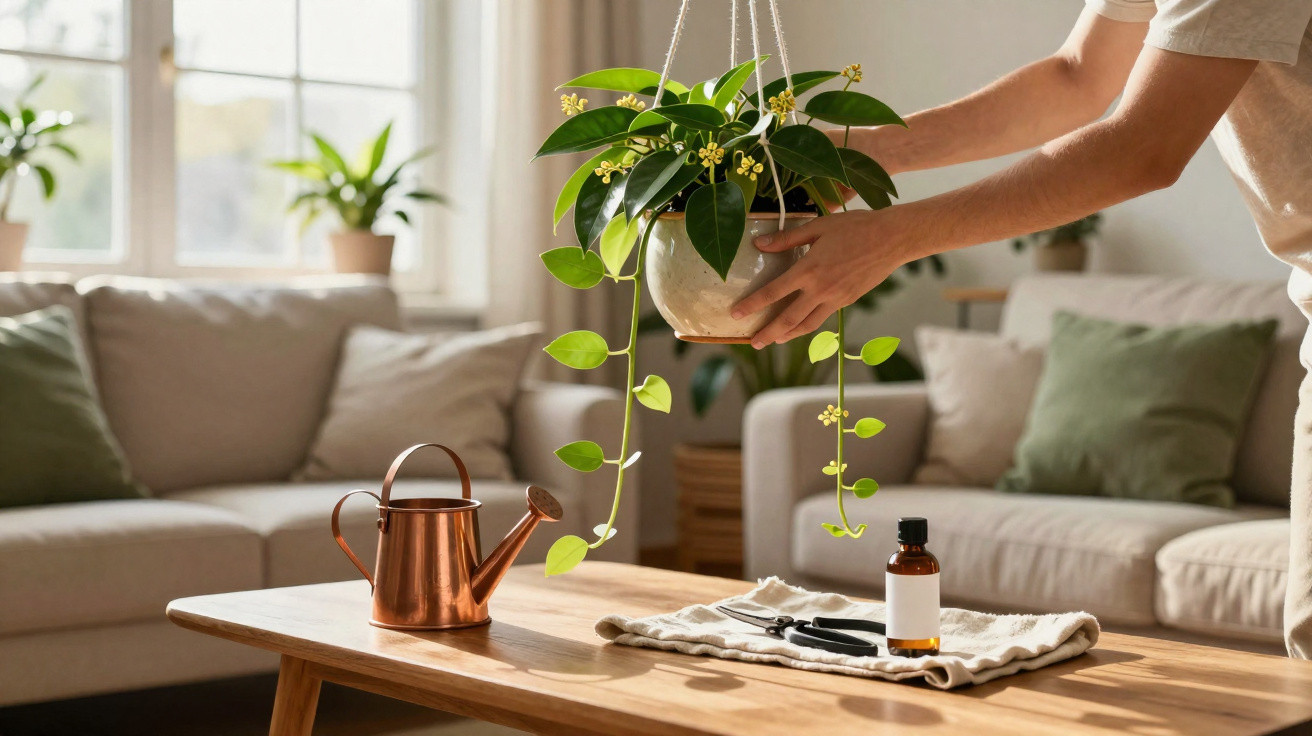
Anyone who thinks their Hoya is merely “quite nice” has usually overlooked one small detail – a few simple routines can turn it into the star of the living room.
Its waxy leaves shine as though they have been polished, while its flowers can look almost artificial – yet the plant may still seem to be going nowhere. Many Hoya owners give up in frustration, even though the answer is rarely complicated. Get the light, watering and position right, and you will be rewarded with a spectacular display of scented, star-shaped flowers.
Why the Hoya is so popular in the living room
The Hoya, also widely known as the porcelain flower or wax plant, has a distinctly unusual character. Its thick, glossy foliage can look more like an artificial plant than a real houseplant. That is precisely why it appeals to people who are “not very good with plants”.
Its greatest strength is that it tolerates minor care mistakes. Because the leaves retain water, it copes well with short dry spells. It is therefore an excellent choice for anyone who does not remember the watering can every other day.
It also suits a typical urban lifestyle particularly well:
- it usually copes well with dry air from central heating
- it thrives in bright flats without needing direct midday sun
- it can trail or climb, making it suitable for shelves, windowsills and plant arches
Problems generally arise when it is placed in the wrong spot or watered with excessive enthusiasm. The issue is not complicated care routines, but small everyday errors.
Once you understand the Hoya’s basic needs, it requires very little effort for years – while regularly filling the room with clouds of scented star flowers.
Light: the key to a flowering Hoya
A Hoya can survive in partial shade, but it needs energy to flower. That energy comes from light – not from a dark shelf in the corner of the room, but from a bright position away from intense direct sun.
The ideal position by a window
East- or west-facing windows are ideal. They provide plenty of brightness without exposing the plant to scorching midday heat. A south-facing window can work too, but the Hoya should be set slightly back so that strong sunlight does not scorch its leaves.
Signs of insufficient light include:
- the plant grows but produces few or no flowers
- long, weak shoots stretching towards the light source
- healthy-looking leaves, but no sign of the well-known clusters of flowers
This is what frustrates many owners: the Hoya appears healthy but produces no blooms. Moving it to a brighter place will often help, along with some patience, as the plant needs time to respond to improved conditions.
Watering correctly: less often, but with purpose
The most common cause of an unhealthy Hoya is not drought, but overwatering. Reaching for the watering can constantly out of concern puts its roots under permanent stress.
Watering frequency by season
During the growing period, from spring to late summer, watering every 10 to 15 days is sufficient for many plants. In winter, when it is effectively running in low-power mode, the interval extends to two to four weeks, depending on room temperature and pot size.
Rather than watering rigidly according to the calendar, use a simple hands-on check:
- use a finger to see whether the top few centimetres of compost are dry
- lift the pot: if it feels very light, it is usually time to water
A useful quick-reference guide:
- yellow leaves + wet compost → very likely too much water
- wrinkled leaves + an exceptionally light pot → clearly thirsty
- soft, limp leaves → check the roots immediately, as rot may be present
It is better to water once too late than three times too early – Hoya roots are far more sensitive to waterlogging than to brief dry periods.
Pot and compost: the basis for healthy roots
Hoya roots prefer plenty of air. A pot without a drainage hole is a recipe for trouble, as water must be able to escape; otherwise, the roots will slowly rot.
Which compost suits a Hoya?
A free-draining, coarse-textured mix is ideal. Suitable options include:
- houseplant compost mixed with perlite or clay pebbles
- compost combined with orchid bark for extra air around the roots
- lightly mineral-based mixes similar to those used for succulents
Dense, all-purpose compost on its own often holds moisture for too long. This then calls for an exceptionally careful approach to watering.
It may seem surprising, but it is tried and tested: a Hoya prefers a relatively snug pot. Continually repotting it into larger containers encourages it to direct energy into roots and foliage rather than buds. A slightly larger pot is only worthwhile once the roots visibly fill the existing one.
How to fertilise a Hoya properly
The plant needs nutrients for strong leaves and flowers, but too much fertiliser weakens it. A balanced liquid fertiliser for houseplants is entirely adequate. Half the recommended dose once a month from spring to late summer is a good schedule.
During winter, the Hoya enters a resting period. This is when the fertiliser should be put away in the cupboard. It uses this time to recover, store energy and prepare for the next growing and flowering season.
Regular, small amounts of fertiliser work better than occasional heavy feeds – the Hoya prefers consistency to nutrient shocks.
Pruning and training without losing flowers
Hoya plants can be styled in very different ways. In a hanging basket, their shoots can cascade decoratively, while on an arch or trellis they will climb upwards. Light pruning creates a fuller plant and prevents individual stems from becoming metres long and bare.
The biggest pruning mistake
One detail is crucial: flower clusters develop on small specialised nubs known as peduncles. These points can produce flowers repeatedly over many years.
Cutting off these areas permanently removes potential flowers from the plant. It is better to trim only the green shoot tips and leave the thickened flower-stalk bases untouched.
Common mistakes that stop a Hoya from flowering
When a plant looks healthy but simply will not flower, the cause is usually a combination of three factors:
- too little light – the plant survives, but lacks the energy to produce buds
- a pot that is too large – root growth takes priority over flower formation
- constant repositioning – the Hoya needs stability, otherwise it enters “standstill” mode
Another familiar issue is excessive watering in winter. During its resting phase, a very restrained approach to watering is much more suitable. The plant can “catch its breath” and will start spring stronger and more willing to flower.
Propagating a Hoya: easier than you might think
Anyone with a well-growing Hoya can easily raise new plants from it. This is done using tip cuttings.
To do this, cut off a section of stem with two to three nodes, or leaf attachment points. Remove the lower leaves, then place the cutting in a glass of water or in an airy, lightly moist compost mix. The important thing is not to soak it, as the cut surfaces may otherwise rot.
Fine roots will form after several weeks. The cutting can then be moved into a small pot. With very little effort, this creates a new plant – ideal as a gift or for a second spot in the flat.
The small care ritual for a permanently strong Hoya
If you would rather not care for your Hoya using complicated charts, follow this simple three-step routine:
- choose a bright, sheltered position
- water only when the upper layer of compost has dried out
- change the pot only when necessary, rather than moving up in size too soon
With this straightforward routine, the plant will usually remain robust and glossy. After a few months to years, it rewards patience with dense balls of flowers scented like honey or vanilla, depending on the species. By then, it is easy to understand why so many Hoya enthusiasts turn one unassuming plant into half a collection.
Those wishing to explore further can look into the different species. Some prefer slightly brighter conditions, others tolerate cooler rooms, while others impress with unusually shaped foliage. They all share one thing: with light, calm conditions and moderate watering, they can transform even a plain shelf into a remarkably striking feature.



Comments
No comments yet. Be the first to comment!
Leave a Comment