
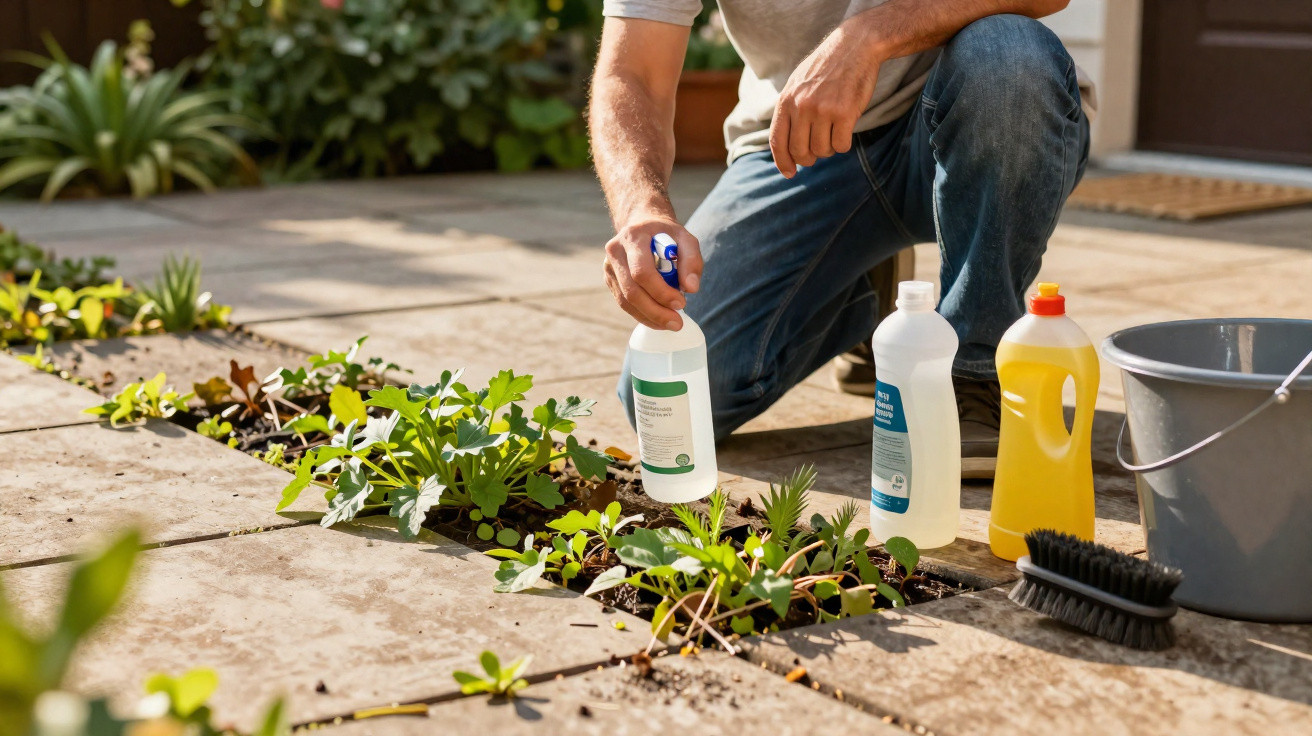
Anyone who has spent hours on their knees pulling weeds from paving joints knows the frustrating pattern: no sooner is everything tidy than green clumps start pushing through again. Many people therefore turn to kitchen cupboard remedies, with vinegar at the top of the list. Yet its effect is often short-lived. Another product, found beside almost every kitchen sink, can prove surprisingly more persistent in the garden.
Why vinegar alone fails against weeds in paving joints
In recent years, vinegar has become a go-to trick for tackling weeds. It acts quickly, produces visible results and initially looks impressive: leaves wilt, stems discolour and the plant appears dead. Even so, the greenery generally returns after only a few weeks.
The reason lies in how it works. The acid mainly attacks the parts above ground. Leaves dry out, cells burst and the plant collapses at the surface. Beneath the paving stones, however, very little often happens.
“With vinegar treatment alone, the roots often remain intact and sprout again a short time later.”
As long as the root system is alive, it can keep producing fresh shoots. On paths, driveways or between patio slabs, where plants force their way through narrow gaps, this “surface attack” is usually insufficient. Anyone wanting lasting peace from weeds would need to keep spraying repeatedly.
That level of effort leads many gardeners to look for something that boosts the effect, ideally another household product that does not involve conventional garden chemicals.
Washing-up liquid as a secret weapon: why it is so effective in the garden
This is where a product designed for dirty dishes comes in: washing-up liquid. Its main action does not come from acid or salt, but from surfactants. These are cleansing substances that dissolve grease and alter surface tension.
Plant leaves have a natural protective coating containing wax. It makes water bead up and prevents droplets from staying in place for long. This is useful in the rain, but less helpful when trying to control weeds.
Washing-up liquid partly breaks down this protective film. The liquid adheres more effectively to the leaves, spreads more evenly and penetrates the plant tissue more thoroughly.
“With washing-up liquid, the mixture stays on the leaves for longer – the plant gradually loses its ability to retain water and dries out.”
Used on its own, washing-up liquid can dry out the above-ground parts of plants. Combined with vinegar, the effect is intensified: the acid damages cells, while the surfactants ensure that sufficient quantities actually come into contact with the plants.
The most popular mixture: how gardeners use washing-up liquid against weeds
A straightforward basic recipe has become established in many gardens and requires no specialist equipment. It is particularly suitable for joints in paved areas, steps, patios and gravel paths.
Basic recipe for a mild weed treatment
For light growth, such as individual young plants in joints, a gentle mixture is usually enough. Most households already have the necessary ingredients:
- 1 tablespoon of washing-up liquid, preferably an environmentally friendly product
- 1 litre of water
- optional: 1 cup of vinegar
Mix everything thoroughly, or pour it into a spray bottle and shake briefly. Then spray it directly onto the leaves of the unwanted plants. A warm, dry and sunny day is the best time for treatment. The plants should not be watered immediately afterwards.
When weeds are stubborn: stronger versions
For heavily overgrown areas or tougher species, many amateur gardeners move on to stronger mixtures. Three common strengths have become established:
| Situation | Mixture | Suitable area |
|---|---|---|
| Young, delicate plants in joints | 1 litre of water + 1 tbsp washing-up liquid | Patio joints, kerbs, steps |
| Clearly overgrown areas | 1 litre of vinegar + 2 tsp washing-up liquid | Gravel paths, heavily overgrown paving |
| Permanently bare areas required | 1 litre of vinegar + 40 g salt + 10 ml washing-up liquid | Stone-only surfaces with no plants nearby |
The final version is considered “radical” and should only be used on areas where no plants are guaranteed to be wanted, either now or in the future. This is because it also contains salt, which alters the soil over the long term.
Where washing-up liquid is useful – and where it is not
It may seem that washing-up liquid has no place in the garden. For beds containing edible crops and for lawns, that is largely true. In certain locations, however, it can be effective without harming the entire surrounding area.
“It is ideal for use on purely mineral areas: paving, slabs, gravel surfaces and driveways that are not intended to be planted.”
These include, among others:
- patios made from concrete or natural stone slabs
- paths laid with paving blocks or brick pavers
- gravel areas alongside garages or carports
- kerb edges around driveways
The product should not be used in vegetable beds, perennial borders or on lawns. There, washing-up liquid can alter soil structure, disrupt water absorption and harm soil organisms. Anyone wishing to keep their soil healthy should stick to mechanical removal in these areas, or use ground cover such as mulch or low-growing ground-cover plants.
The risks that washing-up liquid and salt pose to soil
Useful as the mixture may initially appear, it is not a harmless magic solution. Many washing-up liquids contain substances that are unproblematic on dishes but can remain in soil for longer. Although surfactants are partly broken down, they may still put pressure on soil bacteria and earthworms.
Adding salt is even more problematic. It builds up underground and gradually leaves the soil “exhausted”. Plant roots suffer osmotic stress, water is absorbed less effectively and microfauna declines.
“Highly saline mixtures can deplete areas for years to the point where hardly anything wants to grow there – even if you later want to replant them.”
For this reason, recipes containing salt should be used only very rarely and with care. Allowing weeds to grow regularly and then repeatedly applying salt-and-washing-up-liquid mixtures creates a long-term problem below the surface.
Alternatives and additions for a well-kept driveway
Anyone aiming to keep joints and paths under control in the long term should not rely solely on liquid mixtures. Several methods can be combined effectively to keep the workload low:
- Joint scrapers and brushes: Particularly suitable for small areas; physically demanding, but highly precise.
- Gas torches or hot-air tools: These burn or heat plants briefly so that the leaves die off. Roots may remain, so repeated treatment can be needed.
- Pressure washers: These remove loose plants and moss, but can wash jointing material away, so they should be used carefully.
- Renewing joints with sand or grit: Porous joint mortar or soil between stones practically invites weeds in. Harder material makes it more difficult for roots to establish themselves.
In practice, a combination often works best: treat stubborn spots precisely with a washing-up-liquid-and-water solution, keep the rest of the area clean mechanically, and repair joints regularly.
Legal and practical advice on using washing-up liquid against weeds
One point that is often underestimated is that many local authorities take a critical view of using weed-control products on sealed surfaces, as residues can enter drainage systems or surface water through rainwater. This also applies to home-made mixtures containing household products.
Washing-up liquid and vinegar should not be introduced into soil in large quantities, and certainly not into surface-water drains. Anyone who sprays should therefore work sparingly and accurately, avoid creating puddles, and steer clear of heavily used driveways where the next downpour could wash everything straight into a drain.
It is also worth considering the underlying cause. Very wide joints, jointing material made from soil or sand, and permanently damp areas provide ideal germination conditions. Those who make structural improvements, for example through narrower joints, drainage or specialist joint mortar, will need less intervention later on – with or without washing-up liquid.
The trend in everyday gardening ultimately shows that many amateur gardeners would rather reach for a kitchen bottle than a chemical canister. Used in moderation, washing-up liquid can be a useful tool on stone and gravel surfaces, but it does not replace attention to soil quality, water drainage and a willingness to pick up a joint scraper from time to time.


Comments
No comments yet. Be the first to comment!
Leave a Comment