
One of the world's most widely used plastics, found in food packaging, plastic wrap, storage tubs, and takeaway cups, could be partly contributing to the risk of fatty liver disease.
Fatty liver disease as it is understood today was first described in 1980. Yet doctors had known since the 19th century that fat accumulating in the liver was connected with diet, well before formal studies were undertaken.
Now, research in mice indicates that modern food conveniences may be worsening the issue.
Fatty liver disease and its risk factors
People often do not realise they have non-alcoholic fatty liver disease until it is discovered incidentally during a scan for an unrelated condition.
For those who do have symptoms, these can include tiredness, a general sense of being unwell, and discomfort beneath the ribs on the right-hand side.
Fat can build up inside liver cells and, without treatment, may ultimately cause inflammation, fibrosis - a build-up of scar tissue - and even cirrhosis, which involves severe damage.

The stages of fatty liver disease, now called metabolic dysfunction–associated steatotic liver disease, move from healthy liver tissue to steatosis (fat accumulation), inflammation, fibrosis, and cirrhosis. (National Institute of Diabetes and Digestive and Kidney Diseases/NIH)
The likelihood of fatty liver disease is higher for people carrying excess weight, particularly around their waist.
Further risk factors are raised blood fat levels, including LDL cholesterol or triglycerides; type 2 diabetes or prediabetes; and high blood pressure.
All these factors are linked to food and metabolism. However, the new mouse study points to a potentially overlooked feature of people's diets: exposure to microplastics, and polyethylene in particular.
Polyethylene microplastics and liver health
Polyethylene is among the plastics most central to convenient food consumption: it is used to package takeaways, wrap leftover food, and prevent a single-use cup from dissolving in your hand.
Compared with many other polymers, however, polyethylene has generally been regarded as less concerning.
"No studies have really looked into polyethylene's effect on liver health, and it's the most widely produced plastic," explains molecular pharmacologist Adi Joshi of Texas A&M University.
"What we now know is that these microplastics, especially polyethylene, affect our liver's natural defense and repair mechanisms."
The work by Joshi and colleagues, published in Science Advances, rests on experiments in mice. Further research is therefore needed before it can be established whether polyethylene causes the same, or similar, effects in the human liver.
The mouse sample was also fairly small, although the effects observed were still concerning.
How the mouse experiment was conducted
The researchers divided twenty male mice into four groups.
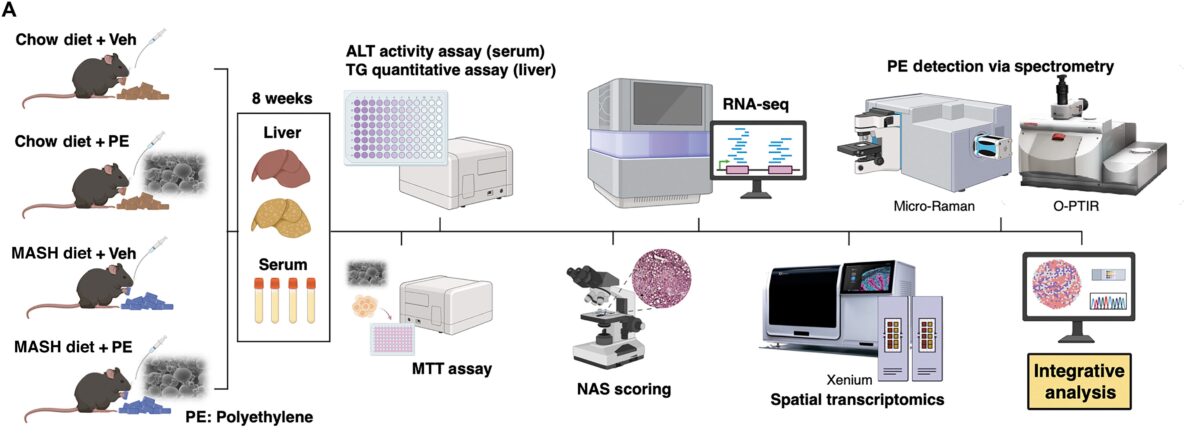
A schematic summary of the experimental design, including its treatment groups and analysis techniques. (Jung et al., Science Advances, 2026)
Groups 1 and 2 received standard laboratory mouse chow. Groups 3 and 4 instead received a diet high in fat, sugar, and cholesterol, known to induce metabolic dysfunction-associated steatohepatitis, or MASH - the medical name for this form of fatty liver disease.
Mice in groups 2 and 4 were additionally given water dosed with two milligrams of polyethylene particles measuring between 10 and 150 nanometres across every day.
The treatments ran for eight weeks. Afterwards, the mice were euthanised and their liver tissue and blood serum were collected for detailed examination.
The findings indicate that microscopic polyethylene can prompt signs of fatty liver disease, including in mice on a standard diet.
As anticipated, the two mouse groups on the MASH diet recorded much higher scores for markers of fatty liver disease than the groups eating standard chow.
However, adding microplastics seemed to aggravate the condition irrespective of diet, including in mice that had eaten a comparatively healthy diet.
Both groups given diets containing microplastics had higher concentrations of ALT - an enzyme that indicates poor liver health - and liver triglycerides than animals eating the equivalent diet without polyethylene.
The pattern was also seen in inflammation and ballooning of liver cells, as well as steatosis, the accumulation of fat in the liver.
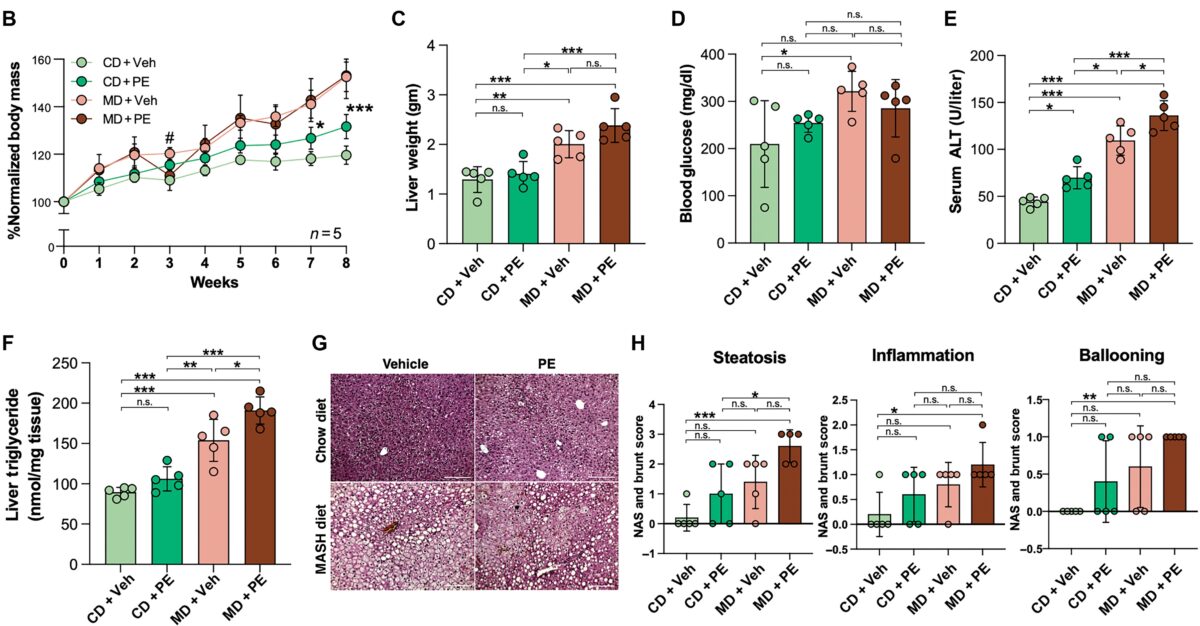
Molecular and histopathological effects of polyethylene microplastics in mouse liver with or without a high-fat diet. (CD = control diet, Veh = vehicle [water with no microplastics], MD = MASH diet, PE = polyethylene). (Jung et al., Science Advances, 2026)
Using spatial transcriptomics on the mouse liver samples, Joshi's team assessed genetic readouts of proteins produced in response to the microplastics.
Genes that encode the proteins PPAR-alpha, which controls liver fat production, and Annexin A2, which contributes to tissue repair in the liver, were both highly active in livers affected by microplastics.
Research involving larger samples is clearly necessary. Still, the evidence available so far suggests that polyethylene microplastics and an unhealthy diet may each contribute to fatty liver disease, especially when they occur together, as they frequently do.
Related: A Common Cholesterol Treatment May Also Remove PFAS And Microplastics From Blood
"Those who have a more Western-style diet, including foods like burgers and sodas, may have a greater chance of progressing to fatty liver disease if they are also exposed to polyethylene," Joshi says.
The research appeared in Science Advances.
This article was fact-checked by Rachel Garner and edited by Clare Watson. Although we take pride in our process, we are only human. If you notice an error, please let us know.





Comments
No comments yet. Be the first to comment!
Leave a Comment