
Between empty food tins, coffee grounds and discarded packaging, there is often more potential than we notice in everyday life. One keen gardener put precisely this kind of supposed waste to use, creating a simple watering system that keeps plants going through dry spells – without expensive equipment, electricity or much effort.
Why gardens are increasingly struggling in summer
Heatwaves, prolonged dry weather and hosepipe restrictions mean that the familiar summer rain which once somehow saved everything is becoming less reliable. Many home gardeners know the sight all too well: drooping leaves, limp lettuce and dried-up flowers. Anyone tending a vegetable patch, rose beds or container plants faces the same question every year: how can plants be kept alive without sending the water meter into overdrive?
The usual methods seem straightforward at first. Turn on the hose, use the spray attachment, water generously – job done. In reality, though, this often means:
- Spending evenings watering rather than relaxing on the patio
- Water running across the surface instead of reaching the roots
- Wildly fluctuating soil moisture, from bone-dry to soaking wet
- Stress for plants that cannot establish a stable root system undisturbed
There is also the problem of being away. Anyone leaving for a weekend during hot weather often returns to a garden that is half scorched. Automated systems with timers can soon become expensive, and they do not appeal to everyone.
“The real challenge in summer is not ‘watering a lot’, but ‘watering consistently and precisely’.”
The bright idea: an empty food tin does not go in the bin
The crucial moment is surprisingly ordinary: in the kitchen, above the recycling bin. A tin of beans or ravioli has been emptied and quickly rinsed – and would normally go straight into recycling. This time, it does not.
Why use a food tin of all things?
At first glance, it is the ultimate disposable item: remove the contents, soak the label, put it in the recycling container. Look more closely, however, and it offers rather more. A food tin is:
- sturdy and durable
- waterproof and sealed
- easy to place in the soil
- readily available in almost every household
Those qualities make it an ideal miniature water reservoir for garden soil. Once the label and any greasy residue have been removed, all that remains is a plain metal cylinder that can easily be repurposed.
From waste to irrigation reservoir
Rather than ending up in metal recycling, the tin goes to the tool area. With just a few simple steps, it becomes a basic drip-irrigation system that delivers water exactly where plants need it most: directly at their roots.
“The idea is brutally simple: a small reservoir in the ground that empties slowly, steadily and with minimal loss.”
How to make drip irrigation from a tin
No workshop or costly equipment is needed to make it. Most of the required items are already lying around at home.
Materials for the DIY system
- 1 empty food tin (400–800 g capacity)
- 1 hammer
- 1 sturdy nail or pointed metal tool
- Work gloves to protect against sharp edges
Step 1: Prepare the tin
Start by cleaning it. Empty out all remnants, rinse the tin thoroughly and remove the label. Carefully bend over any sharp edges around the top or smooth them with a file. This reduces the risk of injury while installing it in a bed.
Step 2: Make holes for the drips
The tin now becomes a water dispenser. Use the hammer and nail to make five to ten small holes across its base. The key is to create several very small holes rather than a few large ones. This allows the water to drip out more slowly and evenly.
“Small holes mean slow dripping and steady soil moisture – so the roots receive what they need without drowning.”
Step 3: Find the right position in the bed
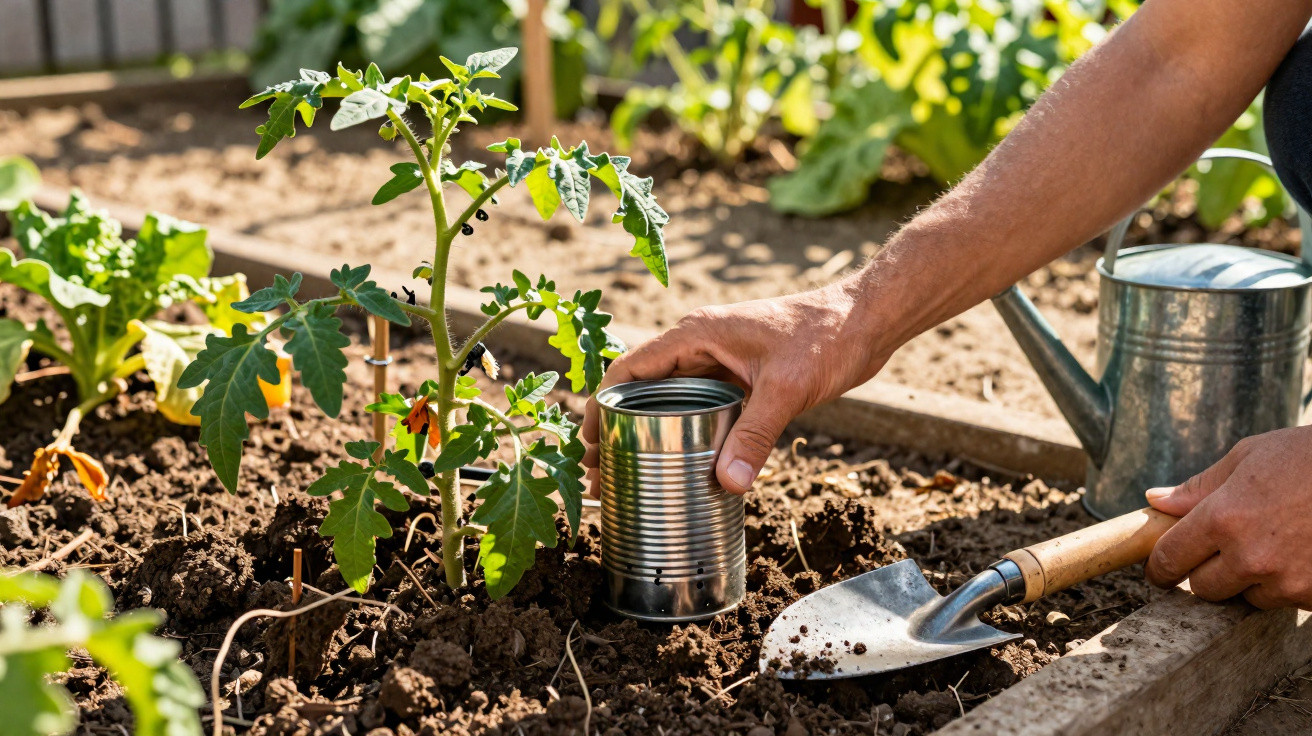
Next, make a hole in the bed or pot for the tin. A distance of roughly 15 to 25 centimetres from the plant stem is ideal. Bury the tin upright, with its perforated base facing downwards. Leave only the top rim visible, so it can be refilled easily later on.
Firm the surrounding soil well, ensuring there are no large air pockets between the tin and the ground. This lets the water spread directly through the root zone.
Step 4: Test it and fine-tune the flow
For a trial run, fill the tin with water right to the brim. Over the next few hours, watch how quickly the water level drops. If it empties too rapidly, the holes are too large or too numerous. If it is still almost full after a day, make a few more holes in the next tin.
What happens below ground: gradual moisture rather than heat shock
Once buried, the tin does its work quietly. Water slowly escapes through the holes in the base and seeps directly into deeper soil layers. This brings several benefits for plants.
Stronger roots, less stress above the surface
Leaves are less likely to wilt in the afternoon because the plant no longer has to continually adapt between being “too dry” and “too wet”. The root system can grow purposefully downwards, towards the moisture. After a few days, many gardeners report noticeably firmer leaves and flowers that last longer.
Adding a top layer of grass clippings, bark mulch or straw also keeps the soil surface shaded. This further reduces evaporation significantly.
A buffer for several days – ideal for heat and short breaks
Depending on the tin size, soil type and number of holes, plants can benefit from a single refill for two to three days. Before a long weekend away, every tin in the bed can be topped up. Placing several around a vegetable garden is an easy way to create a close network of water reservoirs.
Why this food tin trick benefits more than the garden
The food tin trick tackles several problems at once: drought stress, lack of time and wasted resources.
Less plastic, less technology, lower costs
Instead of buying costly hoses, plastic tanks or electronic systems, existing metal containers are put into the soil. This saves money as well as a great deal of newly manufactured material. In the spirit of zero waste, an apparently disposable product is given a useful second life.
Anyone who regularly uses tinned food can gradually build a complete watering network – from tomato beds and raised beds to large containers on the patio.
Noticeably lower water use
Traditional watering with a hose or watering can can quickly use 10 to 15 litres per square metre. Some of this evaporates before reaching the soil, while another portion simply runs off the dry surface. With the tin method, most of the water reaches the root area directly, without major losses.
“Targeted watering rather than a watering frenzy: anyone who supplies plants from below will notice the benefit on their water bill too.”
How the trick can develop in everyday gardening
At first, a bed filled with buried tins may draw puzzled looks from over the garden fence. It soon becomes a conversation about what is happening there – and why the neighbouring tomatoes are suddenly doing so well.
Variations for different plants
Over time, gardeners develop systems of their own. Some use larger tins for particularly thirsty courgettes and pumpkins. Others place smaller tins in balcony planters. Combinations are possible too:
- Two tins for each especially large plant
- A row of tins between densely planted beds
- Tins positioned along the edges of raised beds
This makes it possible to tailor the water flow ever more closely to the needs of each plant.
What to keep in mind
A few details need attention to ensure the system works over the longer term:
- Rust: The metal will corrode over time. Simply replace the tin with a new one – also sourced from household waste.
- Blockages: Soil or limescale can clog the holes. Flush them through with water from time to time, or briefly remove and clean the tin.
- Safety: Always bend over or smooth sharp edges before installation, especially in gardens where children play.
What this trick reveals about modern gardening
There is more behind this simple idea than a way to save money. It demonstrates how gardening attitudes are changing: away from using as much technology as possible, and towards practical solutions made from materials already at hand.
Anyone who has seen a handful of opened tins reliably supply tomatoes, peppers or roses with water throughout an entire summer will automatically start viewing everyday objects differently. Many people now deliberately choose tinned food rather than jars – not only for what is inside, but also because of how the container can later be used in the garden bed.
While frost and drizzle may still prevail outdoors, the next gardening season can already be planned. Those who start collecting empty tins now will have a small arsenal of homemade watering devices ready for spring planting time – and can face the next hot summer far more calmly.



Comments
No comments yet. Be the first to comment!
Leave a Comment