
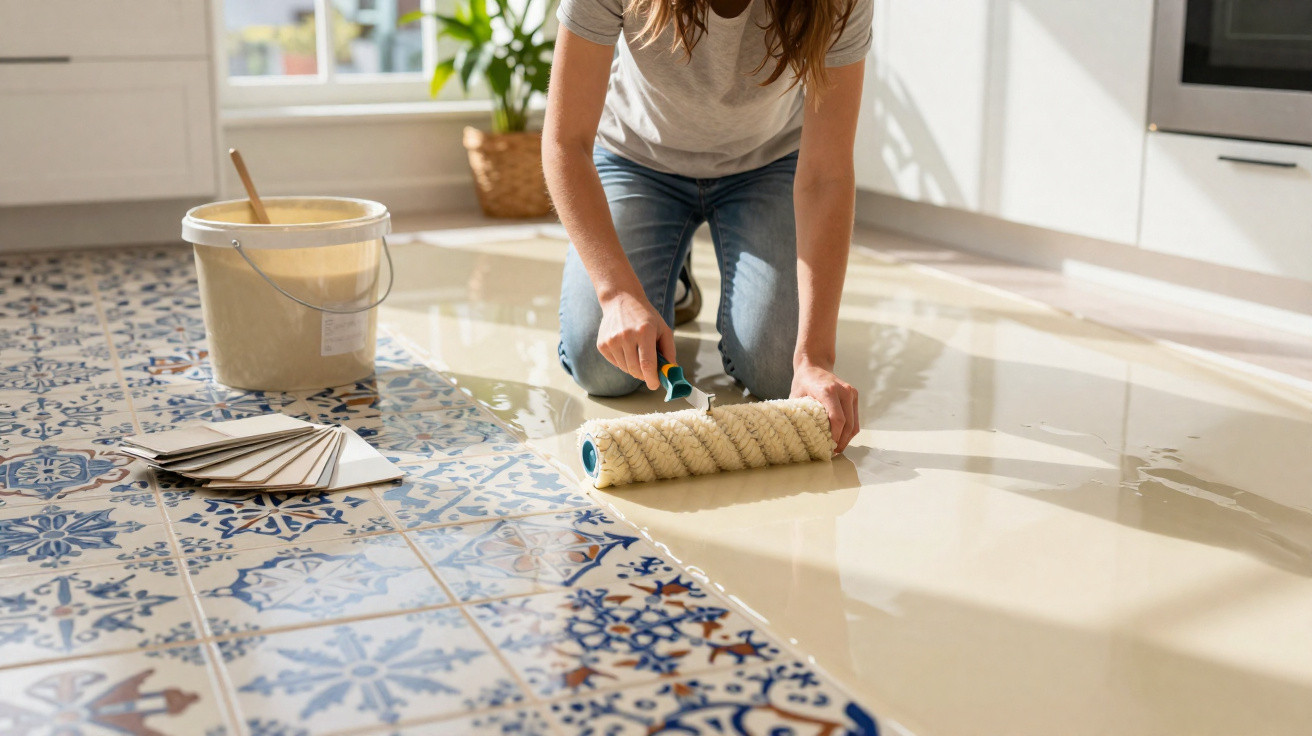
Your tiles are still in excellent condition, but look as though they came from a 1994 furniture catalogue?
There is a solution that can transform everything – without any demolition work.
Many homeowners and tenants face the same issue: floor tiles that are technically sound yet hopelessly dated. Small beige tiles with dark grout can instantly make a home feel older than it really is. When people then picture pneumatic drills, clouds of dust and days of building work in their own home, they often abandon the refurbishment idea altogether. This is exactly where a floor covering applied directly over the existing tiled surface can create an entirely fresh look.
Why a new floor without demolition is so appealing
Replacing conventional tiles usually means removing the old ones, disposing of rubble, rebuilding the subfloor and only then installing the new finish. It takes time, costs money and causes disruption, while making the kitchen, bathroom or hallway unusable for several days.
A coating system applied directly to an existing tiled floor saves noise, dust and often several thousand euros.
Rather than taking out the entire floor structure, the current surface remains as the foundation. A new finish is installed over the tiles, concealing the tile shapes, grout lines and mixed colours. The result is a continuous, grout-free surface that looks more contemporary and is easier to keep clean.
The key benefit is that this new layer is waterproof, scratch-resistant and available in a wide range of colours and finishes, from minimalist matt to high gloss. It is a decorative resin-based floor coating, commonly made from epoxy or polyurethane resin.
Resin flooring over old tiles: how the transformation works
The resin coating is poured onto the existing tiled floor as a liquid or applied with a roller and trowel. It levels out into a sealed, smooth surface, visually covering the old grout lines completely. The room immediately appears calmer, larger and more up to date.
Modern formulations offer numerous design options, including warm sand shades, cool concrete-effect finishes, traditional white and bold accent colours. This makes the floor suitable for a family kitchen, a stylish bathroom or an open-plan living and dining area alike.
Once cured, the coating forms a hard and highly durable layer. In heavily used spaces such as hallways, kitchens and home offices, this type of floor shows its advantages: it withstands office chairs on castors, heeled shoes, children's ride-on toys and frequent mopping.
Requirements: when a resin coating is worthwhile
For the coating to last over time, the subfloor must meet certain conditions:
- The tiled floor must be securely fixed; no tile should sound hollow or move.
- The surface needs to be dry, clean and free from grease or wax residues.
- Any badly damaged areas must be repaired beforehand.
- Wide grout joints should be levelled so that no depressions show through later.
Where tiles are very smooth and glossy, a specialist primer is advisable to ensure secure adhesion. Professional installers use bonding primers chemically matched to ceramic and natural stone surfaces.
Everyday benefits of a resin coating on tiles: less grout, less cleaning
Many people underestimate how much grout affects cleaning. Old grout lines are frequently rough, yellowed and prone to collecting dirt. A surface with little or no grout makes household cleaning noticeably easier.
The fewer visible grout lines there are, the more easily a mop glides across the floor – a genuine comfort benefit, particularly in kitchens and bathrooms.
Typical advantages of applying a resin coating over tiles include:
- An almost seamless look where very little dirt can become trapped
- Simple mopping with a mild cleaner is usually sufficient
- Suitable for wet rooms such as bathrooms, WCs and utility rooms
- A choice of sheen levels: matt, satin matt or glossy
- Faster installation than fully removing a tiled floor
- Long-lasting and durable when preparation is done properly
People with allergies and pet owners particularly value the sealed surface. Hair, dust and crumbs do not get caught in grout lines, but can be removed easily with a broom or vacuum cleaner.
Preparation is essential for a successful new floor
Even the most attractive designer floor will not perform if the base has been prepared carelessly. Work should always start with thorough cleaning: remove dust, degrease the floor and allow it to dry fully. Loose tiles need to be replaced or securely bonded back in place.
Grout joints, cracks and shallow dips can be evened out with suitable fillers. The aim is to achieve a surface that is as level as possible, without pronounced edges. In many cases, a primer is then applied to help the resin adhere more effectively.
Only after this does the actual coating go on. Depending on the system, rollers, trowels or a pouring method are used. Each layer requires waiting periods for the material to cure. In a standard living space, it can quickly take two to three days before the floor can carry full loads again.
Do it yourself or hire a professional?
Many DIY enthusiasts are confident tackling smaller, relatively straightforward areas, such as a guest WC or a small hallway. DIY shops and specialist retailers sell kits designed specifically for tiled floors, with prices starting at approximately 18 euros per square metre.
The situation is different in the following cases:
- Large open-plan rooms with several doorways and transitions
- Complete bathrooms, including showers and recesses
- Very high design expectations involving special effects or colour gradients
In these situations, using a specialist installer is worthwhile. Depending on the system, colour choice and surface texture, professionals often charge 100 to 150 euros per square metre. In return, they understand the precise layer thicknesses, minimise tool marks and can advise on slip-resistant or particularly easy-care options.
Where a new resin floor makes particular sense
Resin coatings are especially effective where old tiles are visually intrusive but remain structurally sound. Common applications include:
- Kitchens with small-format tiles from the 1990s
- Bathrooms with dark grout and slippery tiles
- Hallways with different floor finishes that need to be unified
- Basements, hobby rooms or laundry rooms, where practicality matters more than a natural-stone appearance
In rented homes, it is worth checking the tenancy agreement. Some landlords welcome a high-quality modernisation, while others want the original condition retained. In that case, a coating should be selected that could theoretically be removed again, and it is helpful to agree this in advance.
Choosing colour and surface finish
Light shades make spaces feel larger and brighter, but are less forgiving if outdoor shoes are frequently worn indoors. Mid-grey with a concrete effect is considered a classic because it works equally well with white kitchen units and wood, while showing dirt less noticeably.
It is worth considering the sheen level carefully:
- Matt: creates a modern effect, reduces reflections and is ideal for living areas
- Satin matt: offers a subtle sheen and is easier to clean than very matt surfaces
- Glossy: brings light into the room, but reveals scratches and streaks more quickly
A slip-resistant texture is recommended for shower areas and bathrooms. This can be achieved with specialist additives or a lightly textured topcoat. In living or dining rooms, many people prefer a smoother satin-matt option that feels pleasant under bare feet.
Risks, maintenance and service life
Cutting costs on materials or failing to prepare the subfloor thoroughly can lead to flaking, cracks or dull patches. Unsuitable cleaners can also cause issues: strongly alkaline or solvent-based products can damage certain coatings.
The floor usually lasts for many years if the subfloor is stable, the layers have been applied professionally and mild cleaners are used.
In terms of maintenance, a resin floor is similar to a high-quality vinyl or designer floor: vacuum or sweep regularly, then follow with a barely damp mop. Neutral household cleaners are generally enough for stubborn marks.
Anyone who is unsure can make a test sample first, for example on an old tile in the basement. This allows the colour, sheen and feel underfoot to be assessed realistically before transforming an entire kitchen.


Comments
No comments yet. Be the first to comment!
Leave a Comment