
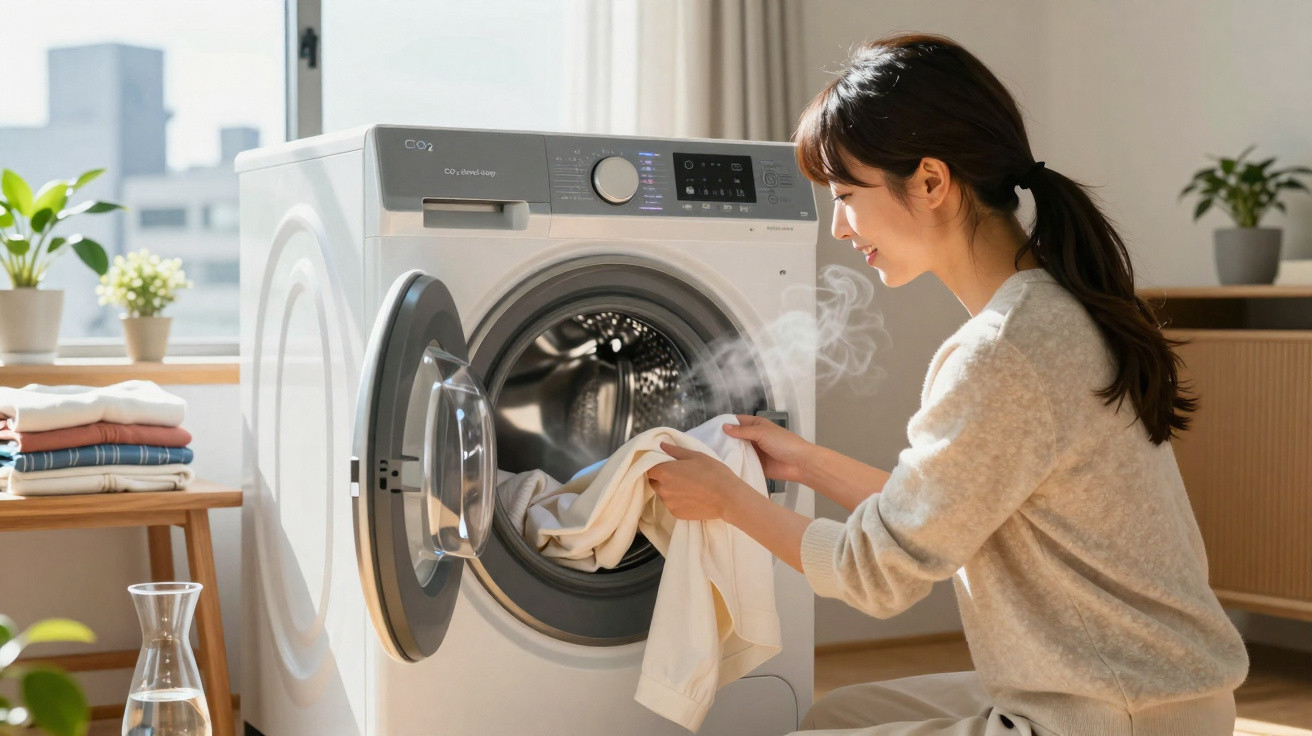
In a country where technology is treated as a craft, this is not some showy prototype. It is a product that can be purchased, wheeled into your home and put to work that same evening. Its proposition is both straightforward and extraordinary: cleaner clothes without using a drop of water.
On an overcast afternoon in Shibuya, people clustered around a box about the size of a countertop appliance, its gentle hum resembling that of a carefully boiling kettle. A representative placed a lipstick-marked shirt into the sealed drum, touched the display, and a soft hiss filled the chamber. Ten minutes later, the cotton shirt emerged dry, slightly cool and unexpectedly light to hold. It seemed like a science-fiction prop that had finally become real.
Visitors bent closer to smell it. There was no trace of dampness or perfumed fragrance, only a neutral absence of scent, like a shirt that had never been worn. One grandmother spoke quietly to her granddaughter about forgotten launderettes and wet seasons. The representative grinned and showed the empty water drawer. As people reached for their phones, one phrase stayed with them: no water, no lie.
The waterless CO2 laundry machine
The mind-bending part is that the drum is never flooded. It seals instead. Pressurised, recycled CO2 is introduced into the unit, while micro-pulses aerate the textiles to loosen oils, smells and tiny particles. Soil dissolves into the CO2 flow, where an internal filter captures it as the gas circulates repeatedly. The washing process uses zero water, and garments leave the machine dry.
At a Tokyo flat I visited, a young couple put through a “post-park” load: toddler T-shirts, a cardigan and a scarf that had made it through a noodle lunch. The programme lasted 18 minutes. They emptied the filter cup to find grey fluff rather than sludge, then photographed it with the pride of new parents. Everyone knows how washing can feel like a chore that keeps breeding more chores. This made it feel as though the burden had been cut in two.
If this sounds like dry cleaning, that is almost right, but not entirely. Conventional dry cleaning relies on solvents; this is a closed-loop CO2 system, more usually associated with premium industrial cleaning and decaffeinated coffee. The breakthrough for consumers is the miniaturisation and safety engineering. Sensors track temperature and pressure, a carbon cassette captures microscopic soils, and the gas is condensed for reuse. It is quieter, cleaner and, at least on paper, gentler on fabrics.
Living with a waterless CO2 laundry machine every day
Use it as an “everyday refresh” appliance and it should meet expectations. Lightweight tops, work shirts, knitwear, denim and sportswear can be combined in loads of 1–2 kg. Choose “Odor + Oil” for sweat and food, “Pollen” during spring allergy season, or “Office” for shirts and blouses. Most programmes take 12–25 minutes. Because there is no washing bath, colours do not need separating to prevent dye running. Remove clothes as soon as the cycle ends, then hang them for a minute so the material can settle.
Heavily soiled items are another matter. Mud, blood and thick sauces can bond to fibres in ways that gas does not always release, so rub-in marks should be pre-treated with the manufacturer’s stick or a small amount of eco-gel. Denim and cotton chinos emerge crisp, while terry towels occasionally need a conventional wash to restore their fluffiness. Let’s be honest: nobody does that every day. Retain the existing washer for bedding and deep-cleaning weekends, and let this compact unit deal with the daily accumulation.
Early users in Osaka praise it for school uniforms and gym clothing. An engineer I spoke to, smiling like a magician, summed it up neatly.
“The win isn’t magic. It’s friction we took out of your week,” he said. “Shorter cycles, no drying, less waiting, fewer excuses.”
- Best for: odours, oils, city dust, pollen, smoke and everyday sweat.
- Less ideal: dried-on mud, heavy make-up transfer and pet accidents.
- Load size: the 1–2 kg sweet spot; roughly five shirts or a lightweight mixed load.
- Noise: a quiet hum, approximately comparable with a quiet conversation.
- Care: empty the filter cup every week and replace the carbon cartridge every quarter.
Why it is more than a glossy gadget
Laundry consumes water as well as time. A standard household washing machine uses 50–100 litres per load, and urban homes may run four washes each week. Scale that across a city, then across a world facing worsening drought conditions. A waterless appliance can reduce that demand, one dry shirt at a time, while also avoiding the energy required for drying. Already on sale in Japan, the initial rollout is limited to selected retailers and a direct website, yet it points to the future direction of home garment care. Company material states that each cycle uses 0.3–0.5 kWh and that CO2 is recaptured almost entirely. Independent laboratories will scrutinise those claims, as they should. Even so, the central case remains: less water, less waiting, fewer microfibre releases and more years of use from the clothes already in your wardrobe.
The limitation is largely one of habit. A normal washing machine will still be wanted for bedding and muddy seasons. Problem stains may mean changing to pre-treatment sticks. The filter needs emptying, much like a vacuum cleaner. In return, a Tuesday-night 9 p.m. panic wash turns into a 15-minute dry-to-wardrobe routine. It is a small benefit, but one repeated frequently.
As for cost, launch models in Japan begin at around ¥148,000, broadly comparable with a premium front-loading washing machine. Running costs are low: CO2 circulates within a sealed loop; the capture cartridge is changed after dozens of cycles, while the filter cup simply needs rinsing. There is no detergent to dose, no hoses that can leak and no lint being baked onto a heater. Clothes are also spared hot-water shock and rough tumble action. Fabrics wear for longer, colours remain accurate and linings do not distort. That may be the greenest element of the whole proposition.
There are boundaries. It will not eliminate grass marks from a child’s football slide or barbecue charcoal from a summer cookout in a single pass. It is a companion appliance rather than a complete replacement, at least for now. The company has suggested “wet-assist” pods for severe messes: an optional attachment that sprays microlitres of water to activate particular enzymes. Let’s be honest: nobody really does that every day.
Safety concerns are understandable. CO2 is non-flammable and is already used in food and drink applications; the chamber has multiple valves and pressure-release systems. Should a sensor raise an alert, the appliance vents into a capture tank rather than into the room. Odours are not an issue unless the filter is left unrinsed for a month. Its footprint is smaller than that of a standard washing machine, its weight is closer to a compact tumble dryer, and installation is plug-and-play.
Why begin in Japan? The match is both practical and cultural. Homes are small, the design culture values discreet efficiency, and consumers are already familiar with air-purifying and deodorising technology. Combine that with convenience-store thinking - fast, clean and always available - and this becomes an appliance that makes sense beside a rice cooker. International launches will need time, as certification, local servicing and customer education cannot be arranged overnight.
There is another less obvious factor: microfibres. In the absence of a water bath, the shedding pattern changes, while any fibres that do come away are caught by the internal filter rather than flowing towards a river. Laboratory evidence is still at an early stage, but the concept is encouraging. That could mean fewer invisible fibres in the sea and fewer synthetics in fish: a significant downstream gain from a small appliance in a kitchen.
What changes when laundry no longer needs to be wet
Picture a weekday evening when “I’ll wash it now” no longer also means “I’ll hang it up, wait and forget about it.” The rhythm of the home shifts. Everyday washing becomes quicker and lighter, while the heavy-duty session retreats into a small corner of the weekend. Friends will ask whether it is genuine, give it a go, then shrug because it simply does its job. The environmental argument is practical - reduced water use, less heat and longer-lasting clothing - but the human benefit is simpler: less hassle, fewer smells and fewer reasons to put washing off. Technology generally disappears into the background when it has found its purpose. This feels as though it has. The remaining question is how quickly it will spread, and how “clean” will be redefined once “wet” is no longer the default.
| Key point | Detail | Why it matters to the reader |
|---|---|---|
| Waterless cleaning | Closed-loop CO2 dislodges oils, odours and fine particles | Saves water and leaves clothes dry and ready to wear within minutes |
| Real-world use | Best suited to everyday loads; retain a conventional washer for heavy soil | Cuts daily effort without demanding a complete lifestyle change |
| Cost and upkeep | Launch price around ¥148,000; rinse the filter and replace a carbon cartridge | Predictable operating costs and minimal maintenance |
FAQ:
- Does it genuinely use zero water? For the washing action, yes. The system uses recirculated CO2 rather than a water bath. A very small rinse supports internal self-cleaning, not the washing of your clothing.
- Can it remove stubborn stains such as mud or wine? Light food oils, sweat, smoke and city dust are removed quickly. Dense mud and dye-heavy marks may require a pre-treatment stick or a conventional wash.
- Are special detergents required? No liquid detergent is needed. The process uses pressure, CO2 and a capture cartridge. Optional pre-treatment pens can help with difficult spots.
- What does it cost and where is it available? In Japan, it starts at around ¥148,000 through selected retailers and the manufacturer’s website. Broader availability will follow regional certification.
- Is it safe for use at home? It is designed with sealed chambers, pressure sensors and fail-safe vents leading to a capture tank. It runs quietly, with no hot drum or exhaust steam.




Comments
No comments yet. Be the first to comment!
Leave a Comment