
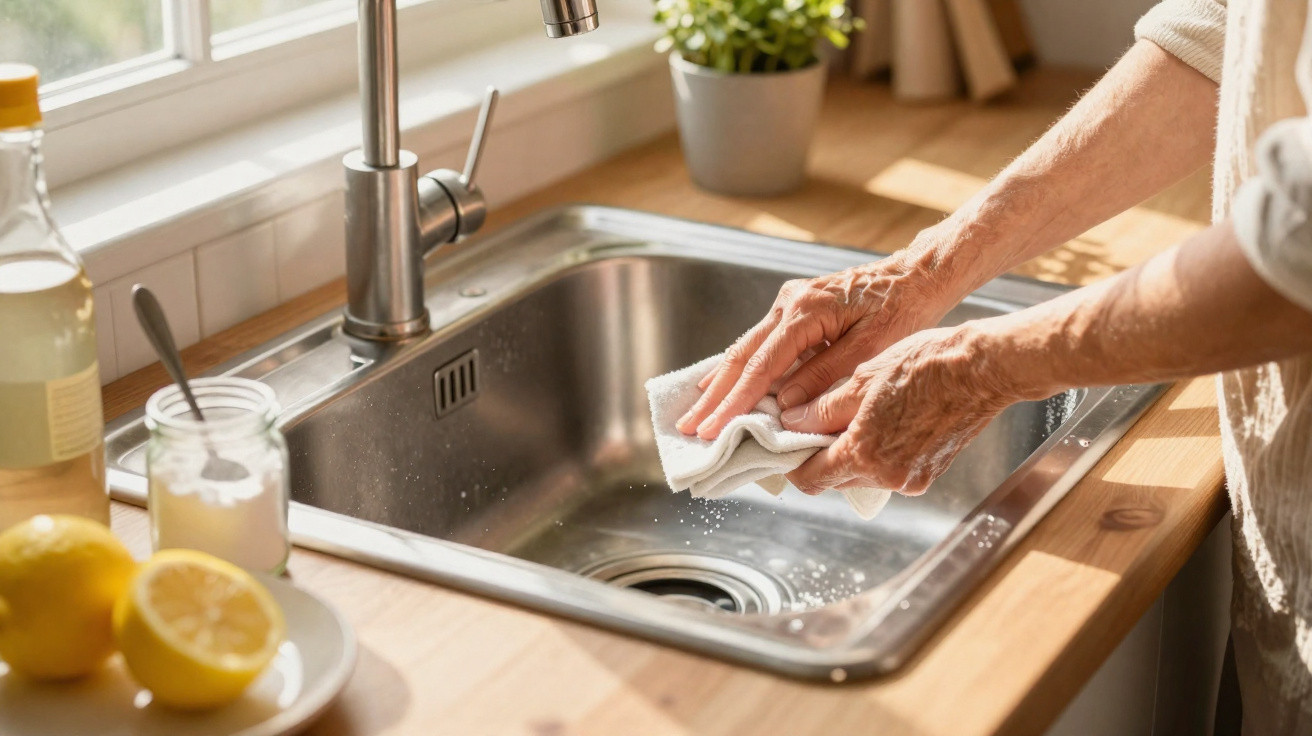
A lifeless sink seems to swallow the light. You wipe it down, spray it, grumble… yet the limescale returns by teatime. But there is a speedy, traditional technique that brings stainless steel back to a gleam and removes those chalky rings without elbow grease or expensive products. It was always in front of us, until we stopped using it.
One wet Thursday, in a small flat above a corner shop, I saw my neighbour clean her sink with the effortless confidence of somebody who had done it all her life. There were no rubber gloves and no overpowering fumes, just an unhurried routine, rather like preparing a sandwich. Her tap was covered in grey hard-water speckles when she started, but five minutes later it shone like a mirror. Seeing my surprise, she laughed and said, “My gran would tell you off for buying fancy sprays.” The kettle clicked in the background, and the entire kitchen somehow looked brighter.
Why stainless steel loses its shine
Stainless steel is meant to reflect light. If it becomes dull and uneven, it is seldom dirty in the conventional sense. Hard water deposits mineral salts wherever water touches it, particularly around taps, sink edges and hob surrounds. Soap leaves behind a thin film that holds on to those minerals. Eventually, this creates a chalky pattern that ordinary wiping barely shifts. The surface can look worn out, even immediately after cleaning.
Much of the UK has hard water. Limescale builds up quickly in the South and East, although kitchens in softer-water areas can still develop that familiar cloudy ring. A plumber once told me that he had replaced a tap simply because its owner thought the metal had “gone off”. It had not: limescale had simply won the contest. We have all faced that situation when visitors are coming, the lighting shows every mark, and the sink refuses to shine.
Scratches are another part of the problem. Abrasive scouring pads and harsh powders leave tiny lines in the steel. They may not be obvious, but they diffuse the light and make the finish appear dull. Combine them with dried mineral deposits and the surface never seems completely clean. The answer is not to scrub harder. Instead, use gentle chemistry followed by dry polishing to restore the steel’s finish. That final stage is what many people miss.
The grandmother’s two-step stainless steel shine trick
This approach has two parts: dissolve the limescale first, then polish the surface while dry. You will need white vinegar, a lemon wedge, a soft microfibre cloth, kitchen paper, hot water and a small amount of plain flour. Gently warm 200 ml of vinegar until it is comfortably warm rather than boiling. First, wash the steel with a little washing-up liquid and hot water to remove grease. Then soak a cloth or piece of kitchen paper in the warm vinegar, place it over taps, sink rims and cloudy areas, and leave it there for 8–12 minutes. For a tap spout, secure a sandwich bag filled with vinegar around it. Rinse using hot water, then dry the area fully.
Now for the overlooked finishing touch: scatter a thin layer of flour over the dry steel. One tablespoon is enough for a sink. Using a fresh, dry microfibre cloth, buff it with small circular movements. Flour works as an exceptionally fine polish, removing the last trace of film and bringing back an even shine. Wipe up the flour with kitchen paper and, if desired, apply one drop of olive oil to one corner of the cloth before quickly wiping along the grain. It feels almost silly how fast the surface shifts from “meh” to “wow”.
A few easy mistakes can be avoided. Do not leave vinegar on silicone sealant or natural stone near the sink; apply it only to the metal and promptly wipe away splashes. Avoid abrasive pads and gritty cleaners, as they cause scratches. Proper drying is more important than it sounds, because flour buffed on to a damp area becomes paste-like. Realistically, nobody needs to do this every day. For high-use areas, once weekly is enough, while once a month suits everywhere else in most working kitchens.
“Wet cleans. Dry shines,” said my neighbour, tapping the cloth like a conductor. “Do both and your steel will sing.”
- Warm vinegar releases limescale without the need for scrubbing.
- Use the bag-and-soak method for tap spouts and difficult edges.
- Ensure the surface is fully dry before polishing with flour.
- Use a small pinch of flour, buff lightly in circles, then remove it.
- Optional: finish with one drop of oil for a quick final sheen.
A small ritual with a big reward
There is something reassuringly simple about this routine: dissolve, dry and shine. There are no buzzwords and no “miracle gel”, only common household ingredients working with the everyday chemistry of hard water. Instead of drawing attention for all the wrong reasons, the steel reflects the room as it should. It is a small reset with a noticeably bigger lift in mood.
People often look for the newest solution. Yet old methods survive because they are gentle on both materials and time. This two-step method is quick, quiet and suitable for sinks, hobs, splashback trims, extractor fronts and even stainless steel bins. Pass it on to a friend who is always fighting tap rings, or show it to a teenager when they “help” with the washing-up. Little routines can become lasting household habits.
Where the water is especially hard, keep a small spray bottle of diluted vinegar beside the sink for midweek touch-ups, then complete the full routine once the surface begins to look cloudy. When guests are on their way, it is one of the fastest visual improvements you can make in a kitchen. It is not really a chore, but a minute of care that keeps paying off through the week.
| Key point | Detail | Benefit for the reader |
|---|---|---|
| Limescale causes the dull finish | Mineral deposits and soap film scatter light across stainless steel | Shows why wiping alone does not bring back the shine |
| Two-step solution | Soak with warm vinegar, rinse and dry, then buff with flour | A straightforward, repeatable method using items already in the home |
| Longer-lasting finish | Optionally apply a tiny drop of oil along the grain after polishing | Helps slow fresh marks and maintain the shine for longer |
FAQ:
- Will vinegar damage stainless steel? No, provided it is used briefly and rinsed away. Keep it only on the metal, avoid nearby natural stone or marble, and do not leave it soaking for a long time. Always dry the surface afterwards.
- Can I use bicarbonate of soda instead of flour? Bicarbonate of soda is mildly abrasive and works better on greasy pans. Flour is finer, producing a smoother, streak-free finish on sinks and taps. If you use bicarbonate of soda, apply it very lightly and rinse thoroughly.
- How often should I do the full routine? In hard-water areas, once a week is sufficient for sinks and taps. With softer water, or in areas used less often, once or twice a month will keep surfaces bright.
- Which cloth works best? Use a tight-weave microfibre cloth for buffing and an ordinary dish cloth for the wet stage. Keep one microfibre cloth solely for polishing so that it remains dry and lint-free.
- Does this work on kettles, shower heads, and appliances? Yes, for exterior stainless steel surfaces. For descaling inside kettles and shower heads, soak with vinegar and rinse thoroughly; never use flour inside appliances.

Comments
No comments yet. Be the first to comment!
Leave a Comment