
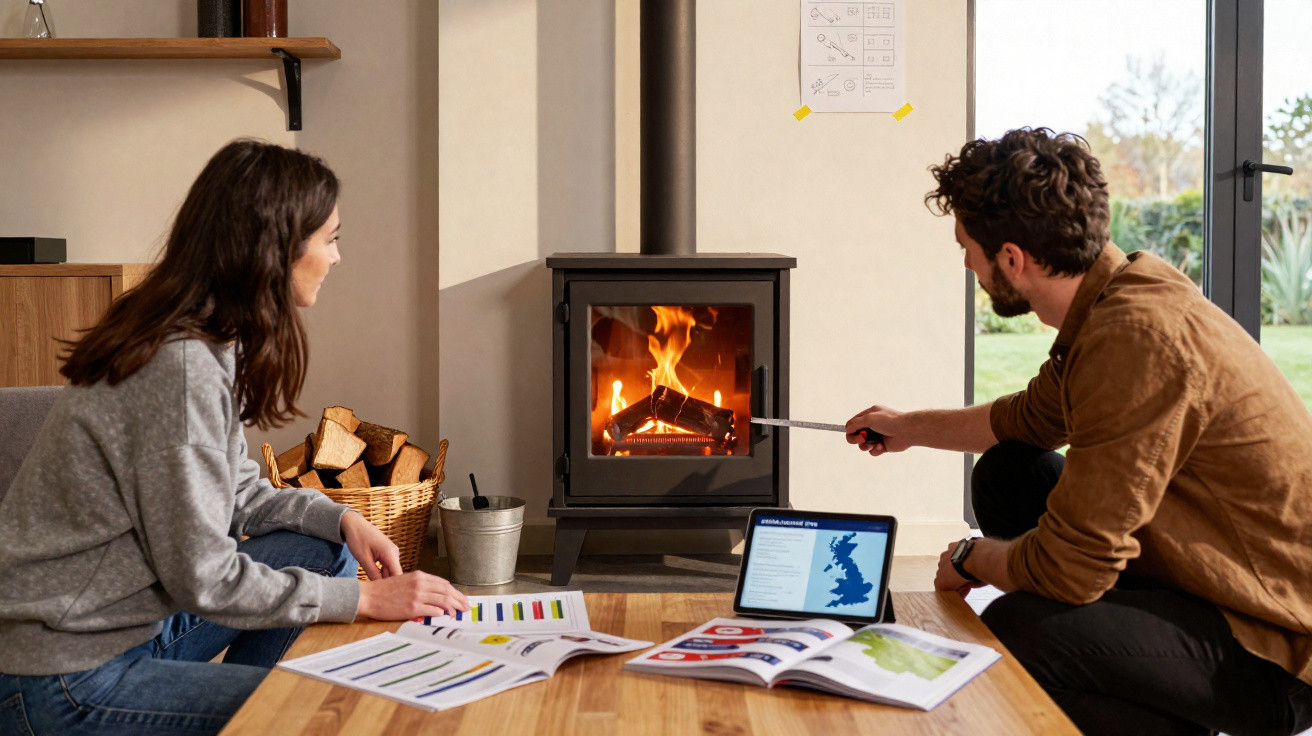
The glass gleams, the cast iron is immaculate, and the air carries a faint scent of metal and dust. Around the walls, vivid labels proclaim “ECO DESIGN”, “ULTRA EFFICIENT”, “LOW EMISSIONS”, and you agree as though every term is perfectly clear.
The salesperson asks for the size of your living room. You reply, “uh… normal-sized?”. With a courteous smile, he begins talking about kilowatts, safety clearances and flue diameters. Your thoughts drift to another winter: wet socks, an old heater clattering away, and that Sunday when the entire house was finally warm. That is what you truly want to buy, although no label ever says so.
You are standing before three wood stoves that all seem ideal – yet you already sense that at least one would be the wrong choice. Then comes the question that changes everything.
1. Power and size: the danger of “the bigger, the better”
Most buyers initially choose the wood stove they like the look of, only afterwards wondering whether it will genuinely heat their home. The first point to understand is output: those familiar kW figures that appear so reassuringly technical in a brochure. Choose too little power and you will be cold. Choose too much and you will overheat for ten minutes… before opening every window.
Selecting the right wood stove is about balance rather than brute force. It is like clothing: a ski jacket is not sensible office wear simply because it is “warmer”. A stove suited to the volume of your room provides gentle, even heat, without making you adjust the air vents like a thermostat every half-hour.
A couple I met had confidently fitted a 12 kW stove in a small, well-insulated home. “We wanted to be safe,” they said. By December, they were keeping a tiny, air-starved fire going merely to stop the living room becoming a sauna. The glass blackened, while tar built up in the chimney at an alarming rate. Their dream stove turned into costly decoration that they were afraid to operate properly.
They had followed the most common impulse: purchasing more heat than they needed, much like ordering the biggest popcorn at the cinema. A straightforward rule of thumb often used by professionals is around 1 kW per 10 m² in a normally insulated property, and slightly less for a highly insulated modern home. It is not an exact calculation, but it offers a useful reality check.
With an output that suits the space, a stove can operate in its ideal range: bright flames, enough heat for clean combustion, but not so much that you are wearing a T-shirt in January. That is where comfort and efficiency meet. An oversized model forces an unfavourable compromise: slow, smouldering fires that create more pollution, block up the chimney and waste money. An underpowered stove simply leaves you piling on jumpers and blaming the logs.
2. Wood stove efficiency, fuel and the true price of every flame
In a showroom, every salesperson will mention efficiency. Figures such as 75%, 80% and 85% fill the brochures, each sounding vaguely impressive. Yet this one number influences much of the next ten winters: the amount of wood you carry, the ash you remove and the smoke your neighbours really see.
A high-efficiency, certified modern stove extracts more useful warmth from the same log. As a result, the chimney remains cleaner, the glass stays clearer and the air along your street is a little less grey. A cheap, old-fashioned box that “burns everything” will often just send your money up into the sky.
Everyone knows somebody who insists their 30-year-old “beast” is the finest stove ever made. Ask how much wood they use each winter. One family in a medium-sized house in a rural village replaced a worn, inefficient stove with a correctly sized modern model. They kept the same region, wood supplier and habits. In that first year, their stack of wood lasted almost one month longer.
They did not feel “greener”. They simply found themselves stacking less fuel, cleaning less often, and no longer watching the living room fluctuate between icy and furnace-like. Broadly speaking, moving from 60% to 80% efficiency is more than an attractive figure on paper. It may mean using a quarter less wood for the same level of comfort. Across five or ten winters, that matters.
When reading the specification sheet, give three details a careful second look: nominal output, meaning the “average” power when the stove is used correctly; the efficiency percentage; and emissions. The real difference comes from combining an efficient stove with genuinely dry wood, ideally below 20% moisture. The best stove in the world will be disappointing if you feed it wet logs and run it on a lazy, half-closed flame.
So you are choosing more than a metal box. You are deciding the future pattern of your winters: how frequently you stack logs, sweep the chimney and look at the fire thinking, “Yes, that was worth the money.”
3. Safety, installation and the important “boring” details
There is a still moment after the technician has left, the wood stove is fitted, the room is tidy and everything appears perfect. That is when real life begins: the first lighting, the smell of paint curing and the first crackle from the logs. Well before that day, however, the essential work should already have happened on paper: safety distances, floor protection, wall construction and flue height.
These points seem theoretical on a drawing. In an actual living room, they become very real. The corner you loved for the stove may sit too near a timber wall. The old chimney that seemed “probably fine” could require a liner. A properly installed wood stove is not an ornament; it is a controlled fire at the centre of your home. Small errors at this stage can create major consequences later.
One installer told me about a customer who wanted a stove almost against a painted plasterboard wall “for design reasons”. Following one winter of heavy use, the paint had changed colour and the wall was worryingly warm to the touch. They paid twice: first for the original installation, then again to move the stove and add proper protection.
Standards and clearances exist for good reason: minimum gaps from combustible materials, particular flue diameters and ventilation requirements. It may sound like mere paperwork, until you consider that a stove can run for hours while you sleep, go out or children play close by. A good installation is unnoticed when it is done correctly. A rushed job or one carried out “off the books” usually reveals itself later in the worst way possible.
Using a certified professional also safeguards something many buyers overlook: home insurance. Should anything go wrong, and an investigation uncovers a DIY flue or non-compliant installation, the financial consequences can be severe. Observing the dull details lets you enjoy the flames without that lingering question: “Is this really safe?”
4. Everyday life with a stove: cleaning, glass, ash and routines
After the novelty has faded, the routines remain. Lighting a fire with nearly frozen fingers. Adding a log before a film. Opening the door too quickly and receiving a small puff of smoke in the face. The best stove is not the one that photographs beautifully in a catalogue, but the one that works with your real, untidy daily life.
Examine the way the door opens. Will it swing in the “wrong” direction for your room? Is the handle easy to hold when it is hot? Kneel in front of it and picture yourself clearing ash while half-awake on a Tuesday morning. Let’s be honest: nobody really does that every day. You need a design that allows for laziness rather than punishing it.
On a busy weekday evening, you will not create a flawless textbook fire. You will use the nearest kindling, perhaps some newspaper, and hope it catches without delay. A stove with well-designed air intake and a clear route for the flames to rise makes imperfect lighting attempts less frustrating. At times, the most useful feature is not elaborate technology, but a smoothly closing door and a firebox that is simple to load without spilling embers.
One homeowner said that their favourite feature was not the high-tech secondary burn, but the ash drawer. Previously, they had to shovel ash cautiously into a metal bucket while trying not to leave a grey trail through the living room. Their new stove had a sealed drawer that slid out neatly and took ten seconds to empty outdoors. It was a small feature, but made a major difference when it was snowing and they were in slippers.
Consider the glass as well. Many current stoves use an “airwash” system to keep it clear for longer. This is not merely a gimmick: if you chose a stove for the enjoyment of watching flames, a brown, soot-covered window soon becomes tiresome. With dry wood and a good draw, you may only need to wipe it occasionally with a damp cloth and a small amount of ash.
The stoves that age most successfully in lived-in homes are the ones that simplify these tasks. They do not have to be perfect. They simply need to be easy enough that, after a long day, you do not start avoiding the fire because it feels like another chore.
5. Design, emotion and how a stove transforms a room
One installer told me, partly in jest and partly seriously:
“People think they’re buying a heating appliance. Most of the time, they’re actually buying a new heart for their home.”
That is why design and emotion deserve as much attention as the figures on a specification sheet. A stove is not a toaster to be stored in a cupboard. It becomes the room’s visual focal point, where people, memories and stories gather.
On a cold night, the eye naturally follows warmth and movement. A tall, narrow stove with vertical glass creates a different presence from a low, broad model that works almost like a compact fireplace. Installing one in a corner gives a more secluded, intimate atmosphere. A central freestanding stove on a glass hearth plate becomes a statement piece, almost like furniture.
We have all experienced the point when everyone gathers in the same three square metres near the warmest place in the house. When a stove is wedged into a dim corner between two pieces of furniture, the surrounding area does not encourage anyone to linger. Some planning – a bench, a spark-resistant rug and a reading chair at an appropriate distance – can alter the entire feel of the room.
Style matters too. Cast iron with exposed bolts and curved forms suggests “cabin in the woods”. Clean-lined, minimalist steel complements bright contemporary interiors. Neither is superior; the key is that the stove should not seem like a stranger in your home. You will look at it for years, including in cold, unused July.
Keep this short checklist in mind as you walk around the showroom:
- Does this stove visually suit the room I actually live in, rather than the one shown in the brochure?
- Can people sit or gather around it safely and comfortably?
- Will I still appreciate its form and colour in ten winters?
When the answers match the technical requirements, you are no longer buying only metal and glass. You are selecting the future setting for long chats, quiet mornings and those rare occasions when the whole house finally feels right.
The five things to remember before you sign anything
Buying a wood stove resembles choosing a long-term travelling companion. You may not notice every feature on the first day, but the small details accumulate over time. The raw output stated on the label matters less than how the stove performs with the size of your home, its insulation, the climate and your routines.
Approach the decision in layers. Start with the technical fit: output, efficiency, emissions and flue. Next comes practicality: cleaning, loading, glass and ash. Finally, consider the emotional and social aspect: how the stove will influence your evenings, furniture and winter habits. Each layer answers a separate question, from “Will it heat?” to “Will I love living with it?”
Speak openly to the installer about your actual circumstances. Explain how often you are at home, whether you work in the living room and how much room you have to store logs. These factors guide the choice much more effectively than saying “We want it cozy.” Cosy means one thing in a draughty stone farmhouse and something entirely different in a new, airtight suburban home.
No single model is perfect for everyone. Somewhere, though, there is a stove that suits your life almost as if it had been made for it. The right one will not demand attention. It will simply remain there year after year, quietly doing its work as the seasons – and your life – change around it.
| Key point | Detail | Benefit for the reader |
|---|---|---|
| Correct output sizing | Match kW output to room volume and insulation level | Prevents overheating, wasted money and constantly opening windows |
| High efficiency | Choose certified, modern stoves with strong efficiency ratings | Uses less wood, saves money and keeps the chimney and glass cleaner |
| Safe professional installation | Follow clearances, use a suitable flue and choose work that supports insurance requirements | Lowers fire risk and provides long-term peace of mind |
FAQ:
- How do I know what power (kW) stove I need? As a rough guide, allow around 1 kW per 10 m² in an average home, then account for insulation and ceiling height; a professional can refine this during a site visit.
- Is a wood stove really cheaper than other heating systems? It can be, particularly when wood is reasonably priced and the stove is efficient, but you must still include installation, chimney sweeping and your own time.
- Can I install a wood stove myself? In some places you technically can, but a certified installer helps protect your safety, warranty and, often, your home insurance.
- What kind of wood should I use? Well-seasoned hardwood, ideally below 20% moisture, is most effective; wet or green wood produces more smoke, soils the flue and provides less heat.
- How often should I have the chimney swept? Most regulations and insurers require a sweep at least once a year, sometimes twice when the stove is heavily used; always retain the certificates.






Comments
No comments yet. Be the first to comment!
Leave a Comment