
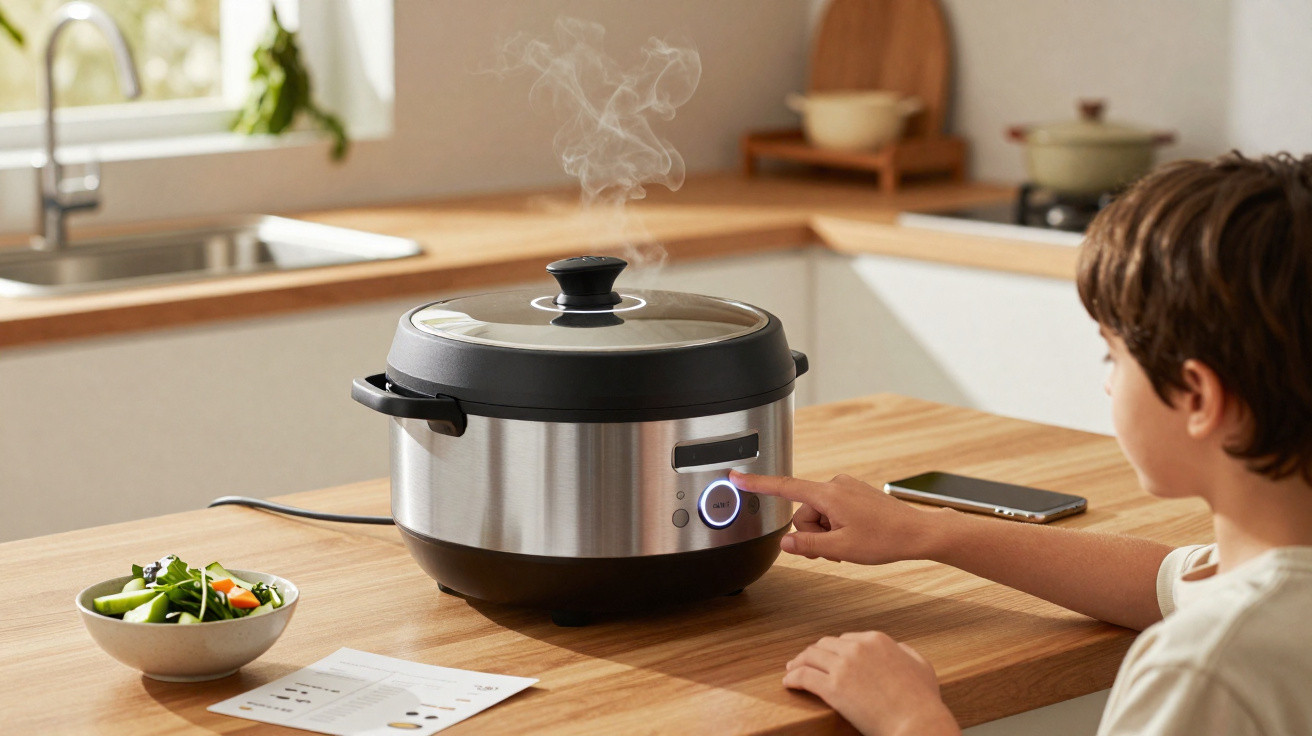
The old pressure cooker lurks at the back of the cupboard: weighty, slightly daunting and much like a relic from your grandmother’s kitchen.
Beside it sits a gleaming, self-satisfied new appliance, promising the same results with barely any stress. Families are gradually changing over, not only for convenience but also for safety, time and a more peaceful kitchen life.
On a Tuesday evening in a compact London flat, Emma taps her phone, adds chopped vegetables, a handful of lentils and two frozen chicken thighs, then shuts the lid on a small countertop machine. There is no hissing, no estimating cooking times and no worry that it could explode if opened at the wrong time. While she helps her son with his homework, the appliance display quietly says: “Smart stew – 24 minutes – auto pressure & release”.
Emma’s mother used to speak of “respecting the pressure cooker”, as though it were a dangerous creature. Emma, meanwhile, scarcely presses a button. The appliance measures the ingredients, adapts the cooking time, chooses its own temperature and releases steam independently. Once dinner is cooked, it keeps the meal warm without scorching it. The kitchen remains almost quiet: no fuss, no racket, only the aroma of slow-cooked food made in record time.
After eating, as she stacks dishes and loads the dishwasher, Emma looks towards the old aluminium pot tucked behind the baking trays. For a moment, she wonders: donate it, or keep it for sentimental reasons? The appliance revolution is not noisy; it begins in small, private moments of uncertainty such as this.
The discreet end of the pressure cooker era
Visit any contemporary kitchen shop and the change is clear. Pressure cookers have not vanished, but they no longer dominate the shelves. Instead, the focus is on chunky, rounded, almost charming smart cookers, complete with touchscreens and Wi-Fi symbols. Plugged into a single socket, they claim to sauté, steam, slow-cook, pressure-cook and even air-fry.
For people raised on tales of lids launching off and soup splashing across the ceiling, an appliance that manages pressure by itself is hugely appealing. These newer machines lock automatically, check the pressure and vent steam in a measured, near-silent manner. A few even alert your phone when the lid can safely be opened. Here, safety is not merely a marketing phrase; it is the central emotional draw.
During 2023, market research firms recorded a double-digit rise in smart multi-cooker sales across Europe and North America, whereas sales of conventional pressure cookers either stalled or fell. Social media reflects the trend, with viral “dump recipe” videos in which every ingredient is added at once, the lid is closed and the creator simply walks away smiling. The old routine of monitoring the valve, changing the heat and supervising a loud pan is disappearing. Its replacement is straightforward: push a button, rely on the machine and carry on with your day.
A family in Paris called their pivotal moment “the night we stopped fearing dinner”. After a minor incident in which a manual pressure cooker expelled hot steam because it was opened too early, they purchased a smart cooker with automated pressure release. The first time it opened alone with a soft hiss, they laughed with relief. Their teenage daughter, once nervous about cooking anything more complicated than pasta, now hosts curry evenings using pre-set recipes and screen-guided instructions.
Similar stories play out in city flats and suburban homes alike. In a small Indian town, one household uses a smart cooker to prepare dal and rice together, leaving the gas hob free for rotis. In a New York studio flat, a nurse on late shifts depends on delayed-start and auto-warm settings, ensuring a hot meal is ready on arrival. This is not technology enthusiasts showing off; it is weary people seeking one less concern at 7.30 pm.
The reasoning behind this transition is uncomplicated. Pressure cookers have always offered two major benefits: speed and flavour. They can make tough meat tender and dried beans soft in a fraction of the usual time. Their weakness was their lack of forgiveness. Misjudge the timing and food was either mushy or undercooked. Fail to monitor the heat and the kitchen could smell of burnt stew for days. Smart pressure appliances retain the speed and flavour, while adding sensors, timers and algorithms that discreetly compensate for human mistakes.
By placing recipes within the appliance, these machines take much of the uncertainty out of everyday meals. Steam readings allow them to gauge moisture, they alter pressure for altitude and they add cooking time when food is not quite ready. Your grandmother may describe that as cheating; your tired, hungry self at 8 pm may call it a lifesaver. The real revolution isn’t the tech; it’s the way it shrinks the mental load of feeding a household.
How smart cooking works in everyday life
The appeal of these newer appliances is not confined to what is inside the unit. It lies in how they suit lives that already feel overfull. The process is remarkably simple: collect the ingredients, select a recipe on the display or app, follow the clear prompts and then leave it alone. It is effectively the reverse of “chef mode”. There is no need to manage five pans or understand the Maillard reaction.
For households, one particularly useful approach is to prepare in batches once and cook several times. On Sunday, chop onions, garlic and staple vegetables for three or four meals, divide them between containers and allow the appliance to do the rest throughout the week. On Wednesday, the vegetables can be added to a “one-pot pasta” setting. On Thursday, they can become the foundation for a creamy risotto that does not require constant stirring. Let’s be honest: nobody really does that every day in a saucepan.
Parents often mention one modest but important routine: setting the appliance just before collecting the children. Load the food, choose “delayed start” and head out. By the time you return from school runs, traffic or late meetings, the home smells of a properly cooked meal. There is no trying to balance pans while replying to emails, and no emergency frozen pizza. Instead, there is a hot dinner that does not feel like a last-minute crisis.
Mistakes and disappointments still happen, naturally. Users may overfill the pot, disregard the minimum liquid marker or approach every meal as a “throw it all in and hope” exercise. Some purchase the largest and most expensive version, then realise they repeatedly use only one or two settings. Others anticipate restaurant-standard food from supermarket ingredients and twenty minutes of work. A learning curve remains, however simple the appliance may appear.
There is also a more personal kind of guilt: guilt about not chopping every ingredient by hand, about allowing a machine to “do the cooking”, or about feeling relieved rather than proud. On difficult days, Instagram-perfect batch-cooking posts can hurt. On better days, the same machine that removes an hour from dinner preparation can create time for a walk, a long shower or simply a quiet moment around the table. One owner of a popular model expressed it plainly:
“The first night I used it, I sat on the sofa for 25 minutes while it cooked the curry. I didn’t know what to do with myself… so I just breathed.”
For many people, the change works best with a handful of simple rules:
- Begin with three “house recipes” repeated every week, rather than trying twenty unfamiliar dishes.
- Follow the liquid markers; these appliances cannot magically prevent burning.
- Treat the app as guidance, not as an inflexible command from above.
- Retain your old pans, as you may still want to sear or sauté on the hob.
- Let children press the buttons: it makes cooking a shared activity instead of one person’s task.
Those small routines are what make a glossy gadget into a genuine kitchen partner. The aim is not flawless cooking; it is fewer mishaps and more evenings that feel at least somewhat manageable.
A different relationship with cooking, not merely a new gadget
Viewed from further back, a larger shift becomes apparent. Moving from traditional pressure cookers to smart appliances reveals much about what people now expect from cooking: less heroics and greater dependability, less performance and more presence. The desire for home-cooked food has not disappeared; instead, the conditions under which it is prepared are being renegotiated.
For some people, these appliances restore possibilities that had gradually been lost. Older cooks who enjoyed their traditional pressure cookers but became less confident with age can find reassurance in automatic safety locks and legible displays. Young adults whose cooking experience extends little beyond takeaways may find on-screen prompts less daunting than a lengthy recipe blog. Even experienced home cooks value being able to set beans, stock or tough cuts of meat cooking without having to supervise them.
Everyone has faced a moment when dinner seems like a test they are failing. These machines do not eliminate that sensation entirely, but they make it less sharp. They change “What on earth are we going to eat?” into “What can the pot handle tonight?”. They cannot solve damaged food systems, time poverty or the emotional burden attached to meals. Quietly, though, they can provide one less thing to fear in a kitchen that ought to be a secure part of daily life.
Perhaps that is why the old pressure cooker is gradually passing into history. It has not ceased to function; people simply no longer want to negotiate with it. The appliance revolution is not about pursuing the latest gadget. It is about a generation quietly saying: I still want real food, just without the anxiety, the noise, and the stories about lids hitting the ceiling.
| Key point | Detail | Benefit for the reader |
|---|---|---|
| From fear to trust | Smart cookers automate pressure, timing and release for safer everyday use. | Reduces anxiety and makes pressure-style cooking accessible to more people. |
| Real-life time saving | Pre-programmed recipes and delayed start turn “watching the pot” into free time. | Returns valuable minutes on busy evenings without giving up home-cooked meals. |
| A simpler cooking mindset | Guided steps and sensor-based adjustments reduce guesswork and burnt dinners. | Helps beginners and tired cooks achieve consistent results with less effort. |
FAQ:
- Are smart pressure appliances really safer than old pressure cookers? Most contemporary smart cookers include several safety features: automatic lid locks, controlled steam release, overheating protection and pressure sensors. Nothing is entirely risk-free, but there is far less room for human error than with traditional hob-top models.
- Will food taste as good as in a traditional pressure cooker? For stews, beans, curries and broths, flavour is generally at least as rich, and can sometimes be better, because the machine maintains consistent pressure and temperature. Browning ingredients beforehand, using the sauté setting or a pan, still makes a major difference.
- Do I need Wi-Fi features for this to be useful? No. Wi-Fi and apps provide added convenience, but the main advantages-safe pressure cooking, pre-sets and auto-warm-function perfectly without an internet connection. Many owners never connect their appliance and remain pleased with it.
- Can a smart cooker replace all my other kitchen tools? It can take the place of several appliances: a standard pressure cooker, slow cooker and often a rice cooker. You will probably still want a frying pan, a baking tray and perhaps a basic saucepan. Think “fewer gadgets”, rather than “only one gadget forever”.
- Is it worth upgrading if my old pressure cooker works fine? If using your existing cooker feels comfortable, safe and relaxed, there is no pressing reason to replace it. Upgrading has the greatest impact for people who avoid pressure cooking through fear, or who feel overwhelmed by weekday dinners and would like to automate more of the work.




Comments
Дверные коробки: как выбрать правильную коробку для межкомнатных дверей https://profildoors-center.ru/sertifikaty
Кол-во отзывов в сети: 236 https://profildoors-center.ru/peregorodki
Процесс производства межкомнатных дверей включает в себя ряд этапов, начиная с разработки дизайна и заканчивая контролем качества готовой продукции https://profildoors-center.ru/dostavka
Сотрудничество с компанией BPDOORS, предлагающей широкий ассортимент качественных товаров по доступным ценам, является ключевым фактором успеха для владельцев магазинов дверей https://profildoors-center.ru/magic-uniq
Стеновая панель в искусственной отделке Лесной орех https://profildoors-center.ru/matovye-dveri
Кухня в цвете https://profildoors-center.ru/zerkalnye-dveri
© 2005-2025 https://profildoors-center.ru/dostavka
Интернет магазин фабрики дверей «Браво» https://profildoors-center.ru/wave
Входные и межкомнатные двери от производителя https://profildoors-center.ru/compack
Материалы сайта защищены законом РФ об авторских и смежных правах https://profildoors-center.ru/kupe-invisible
Копирование запрещено https://profildoors-center.ru/sertifikaty
Сайт не является договором оферты https://profildoors-center.ru/emalevye-dveri
Горнолыжный отдых Достопримечательности Оздоровление Памятники истории Пляжный отдых Тихий / Спокойный https://akademy21.ru/model
Корпоративным клиентам https://akademy21.ru/master_electrolog
Достопримечательности Животный мир Памятники истории Пляжный отдых Прогулки по городу Современная архитектура https://akademy21.ru/hudojnik_po_pricheskam
Palm Beach Resort & Spa https://akademy21.ru/contacts/tbilisi
1 dd https://akademy21.ru/contacts/vladivostok
mm https://akademy21.ru/apparatniy_pedecur
yy Воскресенье Понедельник Вторник Среда Четверг Пятница Суббота Вс Пн Вт Ср Чт Пт Сб Вос Пон Вто Сре Чет Пят Суб Январь Февраль Март Апрель Май Июнь Июль Август Сентябрь Октябрь Ноябрь Декабрь Янв Фев Мар Апр Май Июн Июл Авг Сен Окт Ноя Дек Предыдущий месяц Следующий месяц https://akademy21.ru/osnovinutriciolog
Видео о Китае https://akademy21.ru/courses/nailservice
С клиникой на Ямской решать проблемы со здоровьем стало гораздо проще — в медучреждении работают квалифицированные специалисты с зарубежным опытом, владеющие современными методами диагностики и терапии https://giacintn.ru/service/konsultaciya-gastroehnterologa/
Врач оториноларинголог, ЛОР-хирург, доктор медицинских наук, профессор https://giacintn.ru/services/terapiya/
Стаж работы более 35 лет https://giacintn.ru/service/piling-prx-t33/
Сходненская https://giacintn.ru/service/udalenie-piogennoj-granulemy/
Профессионализм https://giacintn.ru/doctors/popov-stepan-valerevich/
Luxury Lifestyle Awards 2021 https://giacintn.ru/service/kosmeticheskij-massazh/
м https://giacintn.ru/service/lazernaja-jepiljacija/
Чертановская https://giacintn.ru/service/udalenie-sterzhnevoj-mozoli/
Leave a Comment