
You crack open the window, flap your hand about like a human fan and even wipe the glass with your sleeve. Ten minutes later, the bathroom still carries a faint whiff of wet dog and yesterday’s shampoo.
A friend insists pricey dehumidifiers are the answer. Your neighbour follows an elaborate routine involving opening the door to a precise angle. Somebody on TikTok says you should wipe away every drop after every shower. Let’s be honest: nobody actually does that every day.
Then you spot it: an unremarkable household item hanging quietly beside the shower, succeeding where every gadget has failed. No cables, no sound and no app. Just one slightly odd trick that seems almost too straightforward to work.
Yet it does.
Why your bathroom stays damp long after you’ve finished showering
Step into a compact bathroom 30 minutes after a hot shower and the air practically feels drinkable. It is warm, humid and slightly stale, rather like a greenhouse that has forgotten it is meant to grow plants. Condensation settles everywhere: on mirrors, along grout lines and even on that smart wooden bath mat bought during a “new home, new me” phase.
This is about more than comfort. Humidity trapped indoors slowly transforms clean walls into speckled mould artwork. Towels fail to dry completely, shower curtains begin to smell “off”, and silicone seals around the bath gradually turn darker. You open the window and switch on the extractor fan, but moisture still seems to win over time.
A London-based landlord told me he can tell who enjoys long, hot showers simply from the bathroom smell when a tenancy ends. He is not the only one. UK and US surveys consistently identify bathrooms as the leading “problem room” for damp and mould complaints. Tenants point to ageing buildings, owners blame lengthy showers, and everyone discreetly avoids drawing back the shower curtain to inspect what is growing behind it.
We spend plenty of time discussing cleaning products, but not enough considering physics. Hot showers fill the air with water vapour. In a small room with cool tiles and limited airflow, that vapour has nowhere to escape. It meets colder surfaces, becomes liquid again and settles into every gap available. Extractor fans can help, although many are underpowered, poorly fitted or simply not left running for long enough.
What people often overlook is that air movement alone is not enough. You also need something in the room to actively capture moisture before it works its way into walls and fabrics. That is where the “hang it by the shower” hack helps: it places a quiet, low-tech humidity sponge precisely where the issue starts.
Hang it by the shower: the low-tech moisture sponge nobody took seriously
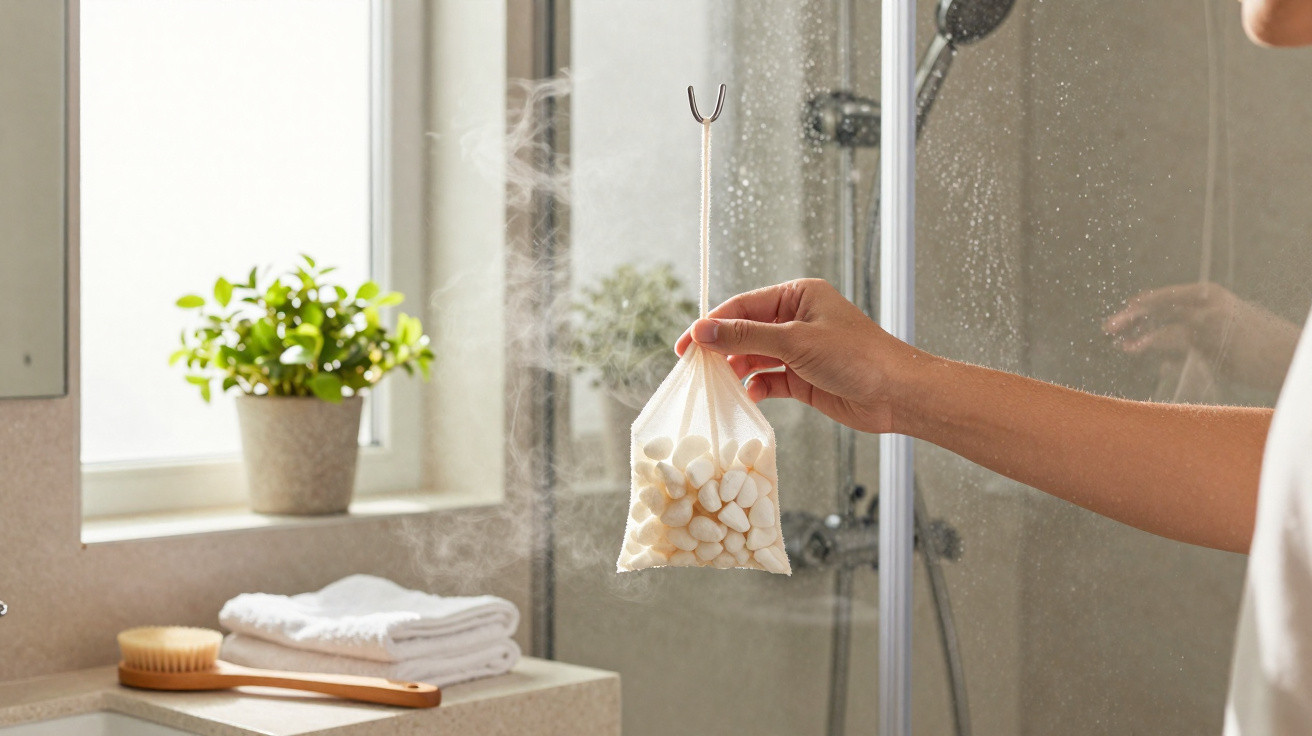
The idea sounds almost comical: suspend a fabric shoe organiser or mesh caddy from the shower rail, then put small moisture absorbers into every pocket. That is all. No drilling and no electrician needed. It is simply a vertical row of pockets silently taking in humidity whenever anyone showers.
The supposed “magic” depends on what goes into the pockets. Some people choose silica gel refill packs, reusable bamboo charcoal bags or compact calcium chloride dehumidifier pods made for wardrobes. Hang the organiser at the steamy end of the bath or immediately outside the shower curtain, then allow physics to do the rest.
A couple in Manchester gave it a try after black mould repeatedly appeared along the upper edge of their shower tiles. As renters, they could not replace tiles or fit a more powerful extractor fan. They picked up an inexpensive over-the-door fabric shoe rack, filled it with six small moisture-absorber bags and hooked it over the shower screen.
After a week, they noticed something unexpected: the mirror cleared more quickly. Towels on hooks beside the shower no longer felt damp in the morning. A month later, the familiar grey trace in the grout simply… had not come back.
They continued to use the extractor fan and opened the window whenever possible. The change was that the air had gained another route out: directly into those suspended pockets. They joked that it looked absurd, as though their shower had sprouted a fabric spine. Still, it became the one “ugly” item they would not remove.
The reasoning behind the hack is reassuringly straightforward. Hot, humid air rises around the shower and creates a pocket of moisture that usually lingers in the upper half of the room. Suspending a vertical line of absorbers at this exact level gives water vapour an easy destination. Rather than condensing solely on cool tiles and mirrors, some of it is captured in the silica, charcoal or salt crystals.
Standard moisture traps are generally placed on the floor or tucked into a corner. They can work, but they are distant from the concentrated cloud of steam above the bath. Suspending them at breathing height allows the absorbers to act more rapidly and effectively, particularly in small bathrooms with restricted airflow.
This does not replace ventilation; it supports it. Think of it as putting up a towel for the air. The fan draws out some humidity, an open window lets some out, and the organiser gathers what remains. Your bathroom is suddenly tackling damp on three fronts rather than one.
How to set up the shower moisture sponge so it actually works
Begin with a simple, narrow and breathable organiser that can tolerate a little moisture on its exterior. Fabric or mesh works best. Steer clear of thick plastic pockets that hold water: air needs to circulate through and around the organiser. Suspend it from the shower rail, a tension rod or hooks mounted high on the wall, positioning it as near as possible to gathering steam without placing it directly in the water’s path.
Then select your “fillers”. For a very low-cost option, reuse larger silica gel packs from electronics and shoes, putting several in each pocket. For a more robust arrangement, use small hanging wardrobe dehumidifiers or bamboo charcoal bags, with two or three distributed along the organiser. Try to cover the area from roughly shoulder level to just above the shower head.
Most mistakes are small and very human. People weigh the organiser down with heavy tubs until it sags. They hang it too low, where it is continually splashed and begins to go mouldy. Or they forget to renew the absorbers, assuming one bag will work for a full year. During a hectic week, you shower, rush to work and rush home again, while the quiet pockets fade into the background.
Frustration then sets in: “It didn’t work, my bathroom is still damp.” Often, the fan was not switched on, the window remained closed throughout winter, and the absorber packs have been beyond their useful life for months. It is not a failure; it is simply life getting in the way. We have all had that moment of leaving the bathroom thinking, “I’ll deal with it later”.
The simplest solution is to connect this hack to a routine you already follow. Replace or recharge the absorber packs on the day you wash towels. Check the pockets quickly while the washing machine is running. Make it part of your established rhythm, rather than another task to remember.
“When I finally hung the absorber rack by the shower, I realised my bathroom didn’t smell like ‘old holiday rental’ anymore,” laughs Anna, who lives in a tiny flat with no opening bathroom window. “It’s not glamorous, but neither is scrubbing mould at 10pm on a Tuesday.”
For a practical overview, a basic set-up could include:
- 1 narrow fabric shoe organiser, suspended high beside the shower or bath
- 6–8 small moisture-absorber packs (silica, charcoal or salt-based)
- Extractor fan on during every shower and for 15 minutes afterwards
- Window left slightly open when weather and safety permit
- A quick visual pocket check once weekly, with a full refresh every 1–2 months
It is more about quiet consistency than perfection. You are not aiming to win a home-magazine award; you are trying to keep the walls, lungs and towels a little happier each day.
What changes when you let your bathroom actually breathe
People who use the “hang it by the shower” trick usually mention the smell first. Not scientifically, but simply: “It doesn’t smell like a gym locker anymore.” The musty background smell recedes. Fresh towels remain fresh for longer. You enter after somebody else has showered and the air feels lighter, as if the room has suddenly remembered it is connected to the outdoors.
After several weeks, a second difference emerges: cleaning days become less dramatic. That persistent mould strip along the grout develops more slowly, if at all. The silicone around the bath does not darken as quickly, resulting in less scrubbing, fewer harsh chemicals and less guilt about skipping a “deep clean” for ages.
There is a more subtle benefit too. A bathroom that dries effectively can feel safer for people with asthma or allergies. Parents report fewer arguments over “damp towels”. Renters feel slightly less in conflict with a room they cannot renovate. It is a small feature on the wall that quietly changes the emotional atmosphere of the space.
It also spreads. A guest spots the unusual little rack beside your shower and asks about it. Someone takes a picture, shares it, and another damp flat somewhere decides to try it. Not because it is flawless, but because it looks easy enough to attempt tonight, without a toolbox.
Perhaps that is why this hack appeals. It does not ask for a different lifestyle, only a different hanger. It accepts rushed showers, steamed-up mirrors and mornings when nobody has three spare minutes to wipe anything down. It simply hangs there, pocket by pocket, gradually taking moisture from the air while your life continues at full pace.
| Key point | Detail | Benefit for the reader |
|---|---|---|
| Position the organiser high up | Suspend it near the dampest area, without placing it directly beneath the water | Captures steam where it concentrates and speeds up bathroom drying |
| Choose effective absorbers | Use silica gel bags, bamboo charcoal bags or dehumidifier refills | Efficiently reduces humidity, odours and mould growth |
| Link maintenance to a habit | Check or replace the bags when washing towels | Keeps the system effective without adding another chore to remember |
FAQ:
- Can I hang this hack in a bathroom with no window? Yes. It is especially useful in windowless bathrooms, provided you also use the extractor fan if you have one and replace saturated bags regularly.
- Won’t the organizer get mouldy itself? Choose breathable fabric or mesh, and hang it high enough to avoid direct splashes. If a bag leaks or the fabric remains wet, let it dry fully or replace it.
- How often do I need to change the absorber packs? Most work for 1 to 3 months, depending on humidity levels and shower frequency. When they feel heavy, saturated or less effective, replace or regenerate them according to the type selected.
- Is this enough if I already have mould on the walls? The hack helps limit new humidity, but it does not replace thorough cleaning, potential anti-mould treatment and, where possible, improved ventilation.
- What if I don’t want something visible hanging by the shower? You can choose a subtler design in a colour close to the walls, or place a shorter version just outside the shower at head height.

Comments
No comments yet. Be the first to comment!
Leave a Comment