
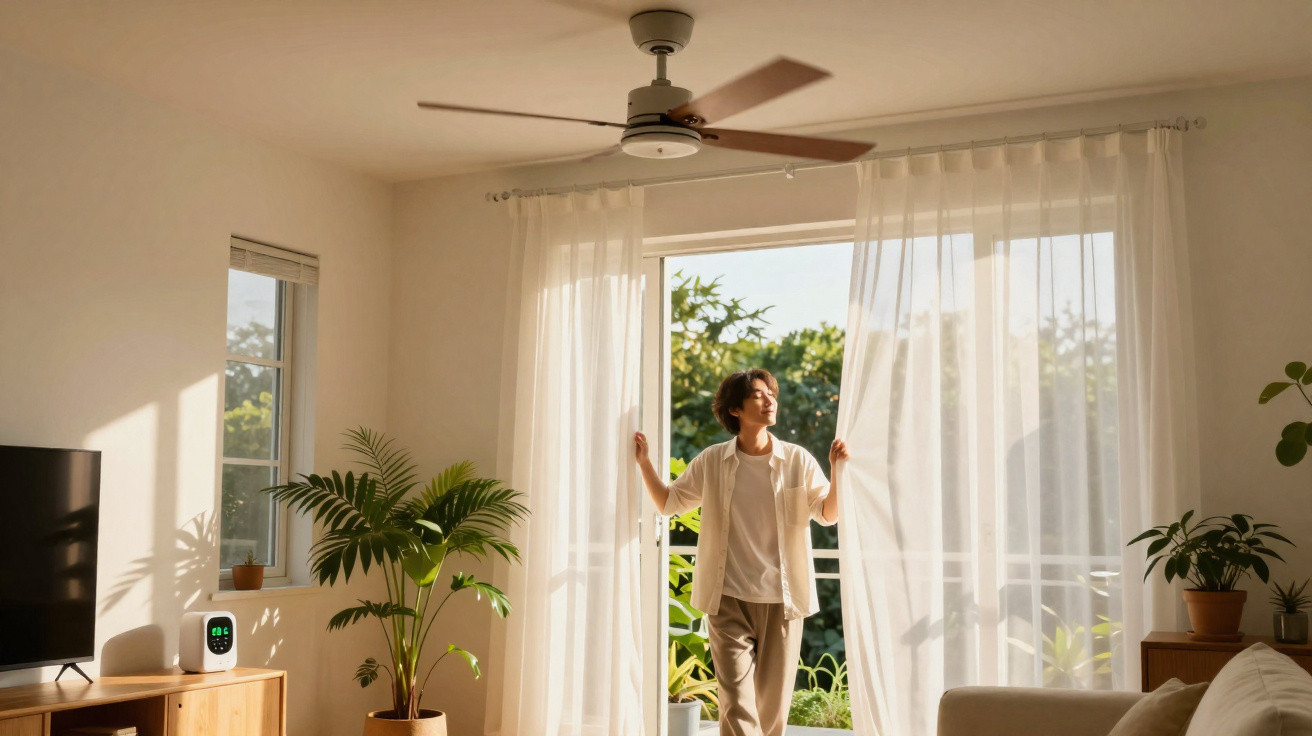
The ceiling fan above the dining table was turning so slowly it barely seemed to be doing anything-just an unhurried sweep of blades.
Outside, the city was sweltering in late-summer heat, the sort that clings to your skin and makes the air feel thick in your chest. Indoors, though, the atmosphere felt strangely easy. No mustiness, no heavy “indoors” odour, even with the windows closed and the air conditioning murmuring away.
At first you chalk it up to nothing at all: a fan running quietly on its lowest setting. But after an hour working in that room, you notice what isn’t happening-you’re not rubbing your eyes, you’re not grabbing tissues, and you’re not battling that dull, closed-room headache. The space feels… cleaner.
Which is odd, because the fan isn’t bringing in fresh air.
Why a slow-spinning fan changes the air you breathe
A ceiling fan on low can look almost useless. The blades move in what feels like slow motion-just enough to flutter a curtain edge or lift a stray hair. And yet that barely-there movement is exactly where the effect begins.
When a fan runs fast, it tends to blast air down in a way you immediately feel. The airflow can become loud and choppy, cycling in tight, turbulent loops. On a low setting, the behaviour shifts: it gently nudges and blends the air instead of battering it. Your body hardly registers the breeze, but the room’s air gradually evens out.
The difference isn’t the quantity of air in the room-it’s how that air moves around you.
A London office study found that people working in rooms with low-speed ceiling fans reported fewer headaches and less “stale air” than colleagues who relied on air conditioning alone. Same building, same ventilation. The only change was those slow, almost self-conscious blades turning above their desks.
As one employee put it: “It’s like the air doesn’t get a chance to die in the corners.” That’s the point. Fine dust, shed skin, VOCs from furniture and cleaning products, and even moisture from breathing and cooking can build up in still spots-behind sofas, in corners, under tables.
On low speed, a ceiling fan creates a subtle loop: air drifts down, spreads outward, then rises again along the walls. The whole room gets lightly stirred-nothing dramatic-so there are fewer dead zones where pollutants can linger and concentrate right where you’re breathing.
Picture your living room like an aquarium in slow motion. With no circulation, the “water” stagnates and suspended matter gathers in pockets. Switch on a filter or a small pump and the tank stays in gentle, constant motion; particles don’t get to settle in one place. A ceiling fan on low works in much the same way for indoor air.
It can also help even out humidity, lowering the chances of mould establishing itself in that one persistently damp corner behind a wardrobe. And it can make ventilation more effective-whether that’s a mechanical system or a window-by pushing slightly fresher air further into the room instead of letting it hover and fade near the opening.
In simple terms: you’re not generating clean air, you’re making the air you already have more evenly shared.
How to use your ceiling fan as a quiet air ally
The most practical habit is almost comically straightforward: in the rooms you actually use, keep the ceiling fan on its lowest speed for much of the day. Not a gale-just a slow, steady rotation you can barely feel.
Combine it with even a small source of fresh air. Leave the bathroom extractor on for a little longer. Crack a window open by 2 cm. Run an HRV system on its quietest mode. The fan helps spread that incoming air through the space, rather than letting it creep in and disappear near the gap. Think of it as turning the whole room into a gentle mixing bowl.
If you’ve got more than one fan in an open-plan area, it’s usually better to run all of them on low than to crank one up high. You’ll get calmer, more consistent circulation instead of erratic gusts.
Most people either set a fan to maximum or ignore it completely unless there’s a heatwave. Let’s be honest: hardly anyone uses it “perfectly” every day. But there’s a realistic middle option that fits normal life.
Use low speed while you work, read, or sleep. Save medium speed for sudden heat spikes. Keep high speed for the occasional “all hands on deck” moment: cooking fumes that got away from you, DIY that throws dust into the air, or airing out after strong cleaning products.
If you live with other people, talk about comfort openly. Some people hate feeling a draught. Let them choose a seat where the downward flow is weakest, then adjust the fan direction or blade setting so they experience indirect movement rather than air blowing straight at their face. A fan that suits one person but irritates another usually ends up switched off.
“The best fan setup is the one you forget about. It just spins in the background, and suddenly your home feels less heavy, less loaded - like your lungs got a bit more room.”
A few small adjustments can quietly improve air quality when you run a ceiling fan on low speed:
- After cooking or showering, keep the fan on low for 30 minutes to disperse moisture and odours before they settle.
- Pair a low-speed ceiling fan with an air purifier; the fan helps the purifier influence the whole room.
- In winter, use the reverse setting on low to bring warm, filtered air down without creating a draught.
- Dust the blades every few weeks so the fan isn’t redistributing fine particles each time it runs.
- Let the fan run on low while you clean; it can keep disturbed dust airborne long enough for filters to catch it or for it to exit via ventilation, rather than dropping straight back down.
The quiet power of barely-there movement
It’s easy to treat air quality as something you solve with high-tech filters, smart sensors, and pricey purifiers. Those can help, of course. But what you breathe is also shaped by small, ordinary habits: how often you open a window, where you dry laundry, and how you use the fan that’s already mounted to your ceiling.
A low-speed ceiling fan is almost a lesson in patience. You don’t get the instant “wow” of full power and flapping curtains. What you get is subtler: fewer stuffy afternoons, fewer complaints about “heavy air”, fewer nights of waking with a dry mouth and a foggy head. The change is real-it just arrives quietly.
On a calm evening, with city noise softened and the blades whispering overhead, the air can feel simpler. Less burdened. A touch kinder. And once you’ve clocked the difference, a slow-spinning ceiling fan starts to look like a small, steady ally in the background of everyday life.
| Key point | Detail | Why it matters to you |
|---|---|---|
| Low speed = better mixing | Gentle airflow reduces stagnant pockets where pollutants and moisture build up. | Easier breathing in the same room, with fewer “stuffy” areas. |
| Works with what you already have | Strengthens the effect of open windows, extractors and purifiers without extra kit. | Better air quality for almost no extra cost or effort. |
| Comfort without a draught | Softer circulation can reduce dry eyes, headaches and fatigue linked to strong air jets. | Makes longer use practical, including overnight or while working. |
FAQ:
- Does a ceiling fan actually clean the air? It doesn’t filter or remove particles on its own, but it spreads pollutants and humidity more evenly, which supports ventilation and purifiers and reduces local concentrations where you breathe.
- Is it better to run the fan on high to “clear” the room faster? High speed moves more air but can create draughts and turbulence that people find tiring; low speed gives steadier mixing that you can keep running for hours without discomfort.
- Can running a fan on low spread dust around? Only if the blades are dusty or the room is rarely cleaned; in a normal home, low-speed movement helps keep dust suspended long enough for filters or exhaust to remove part of it rather than letting it pile up in one spot.
- Should I use the reverse setting to improve air quality? Reverse mode on low is useful in cooler seasons, gently pulling air up and redistributing warm, filtered air without a direct downward draught, which still supports mixing and comfort.
- Is it expensive to leave a ceiling fan on low all day? Most modern ceiling fans on low speed draw roughly the same power as a small LED bulb, so the running cost stays very low compared with heating or cooling systems.



Comments
No comments yet. Be the first to comment!
Leave a Comment