
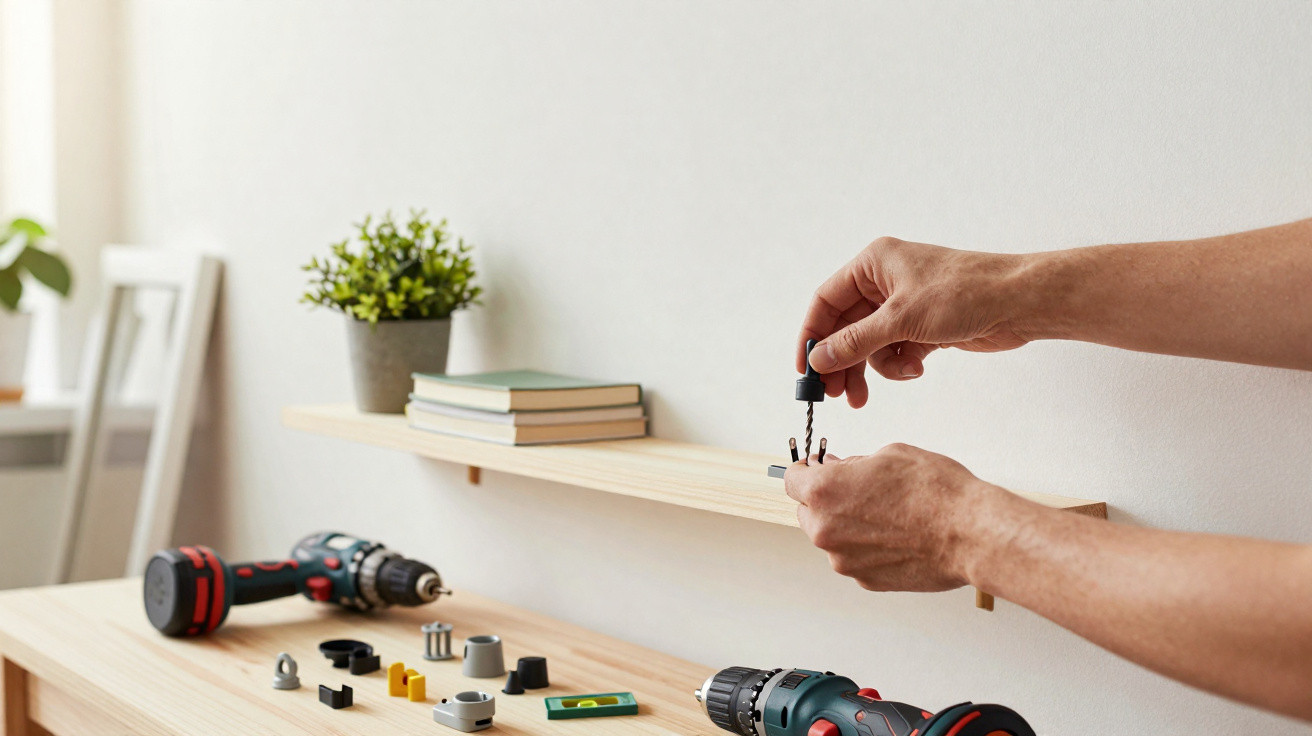
The sound is always familiar: a faint crack, then the books slide, the plant tips over, and the shelf ends up on the floor amid dust, bent screws and muffled swearing. We have all had that moment when we glare suspiciously at the wall, as though it had personally chosen to let us down. Yet in most cases, neither the shelf nor even the drill is to blame: it starts with a wall plug selected too hastily because it “looked as though it would fit”. A secure fixing depends on one easily overlooked detail: a plasterboard, hollow-brick or concrete wall does not behave in the same way. Nor is a universal wall plug magic. A few minutes spent inspecting the surface can prevent a serious household disaster.
Why a shelf gives way even when it appeared securely fixed
A shelf rarely falls without warning. It will often begin to sag almost imperceptibly, while the brackets pull on the screws and the plasterboard hollows out around the holes like damp cardboard. The weight stated on the bracket packaging may be reassuring, but it tells only part of the story: that figure assumes an evenly distributed, static load in ideal conditions.
In a kitchen, for instance, two rows of plates, several jars and a casserole dish can soon weigh 25 to 35 kilograms. When that load sits on an 80-centimetre shelf positioned away from the wall, it creates leverage that pulls the fixings forwards. One poorly suited wall plug can then bring the others down with it.
The wall is the key factor. Solid concrete provides dense resistance, whereas a plasterboard partition conceals a void and a slim metal or timber framework. A screw may appear firm during installation, only to loosen after a few weeks because of vibrations, doors opening and closing, or items added “just temporarily”. A shelf is never as light as it is on the day it is fitted.
Identify your wall before choosing a wall plug that really holds
Before reaching for the wall plugs, take time to assess the surface. A wall that sounds solid when tapped with your knuckles is often concrete, stone or solid brick; a hollow sound suggests a honeycomb partition, plasterboard or hollow brick. Drilling dust also provides a clue: fine white dust often indicates plaster, reddish dust points to brick, and grey dust to concrete.
For a solid concrete or solid-brick wall, an expanding nylon wall plug remains a dependable choice for a standard shelf, provided the drill-bit and screw diameters are correct. For a heavy load, such as a filled bookcase or wall-mounted unit, chemical anchoring with a threaded rod can provide greater strength, particularly in old, crumbly material.
Plasterboard requires a different approach: the wall plug must expand behind the board to spread the load. An expanding metal wall plug, often called a Molly bolt, suits medium to heavy shelves, whether installed with dedicated pliers or a carefully controlled drill driver.
“The best wall plug is not the one that feels strongest in your hand; it is the one that works with the wall rather than against it.”
- Solid wall: nylon wall plug, anchor bolt or chemical anchoring, depending on the load.
- Plasterboard: expanding metal wall plug for substantial loads.
- Hollow brick: long expanding wall plug or chemical anchoring with a mesh sleeve.
- Aerated concrete: a specialist wide-thread wall plug or suitable chemical fixing.
The installation details that keep a shelf stable
The first rule is to consider what the shelf will need to carry in six months’ time, rather than only on installation day. A board intended for novels may eventually be loaded with lever-arch files, vinyl records or particularly heavy art books. Allow a generous margin and use more fixing points instead of relying on two heroic screws at either end.
Also follow the diameter stated on the wall plug packaging. A hole that is too large prevents effective expansion, while one that is too narrow damages the plug when it is forced in with a hammer. Let us be honest: nobody thoroughly cleans every drilled hole every day, but removing dust with a vacuum cleaner or air blower noticeably improves grip, especially when using chemical resin.
The screw deserves as much care as the wall plug. It must extend far enough into the fixing without being too short, and its head must suit the chosen bracket. Avoid mounting a heavy shelf close to the edge of a crumbly wall, as the material may break away. A successful fixing relies on a simple trio: the right substrate, the right wall plug, the right screw.
A quick check that could save your wall, belongings and Sunday
Once the shelf is in place, the safest habit is to load it gradually. Start with a few books or non-fragile items, watch the brackets, and then check that the screws are not turning freely. Slight movement, a crack around a hole or a shelf pulling away from the wall are not decorative details: they are the first warning signs.
You must also accept that older walls can hold surprises. In a refurbished flat, a layer of plaster may conceal damaged hollow brick; in a newer home, a partition may hide an electrical cable, pipework or a metal stud. A material detector costs far less than water damage or a socket pulled out along with the fixing.
The good news is that a fallen shelf does not necessarily mean the wall is ruined. Damaged holes can be filled, then the fixing can be moved a few centimetres to a sound area or redone with a system suited to the cavity encountered. This mishap often reflects something very ordinary: we wanted to finish quickly because a simple shelf seemed like a minor DIY task. It never quite is, especially once it becomes the home for everyday life.
| Essential point | Detail | Benefit for the reader |
|---|---|---|
| Identify the wall | Test the sound, examine drilling dust and locate hollow areas. | Prevents using a wall plug designed for concrete in a fragile partition. |
| Anticipate the load | Account for future objects, not only those present when fitting the shelf. | Reduces the risk of gradual overloading and bracket distortion. |
| Take care with installation | Use the correct drill bit, clean the hole and select a compatible screw. | Turns an ordinary fixing into a durable anchor, even for daily use. |




Comments
No comments yet. Be the first to comment!
Leave a Comment