
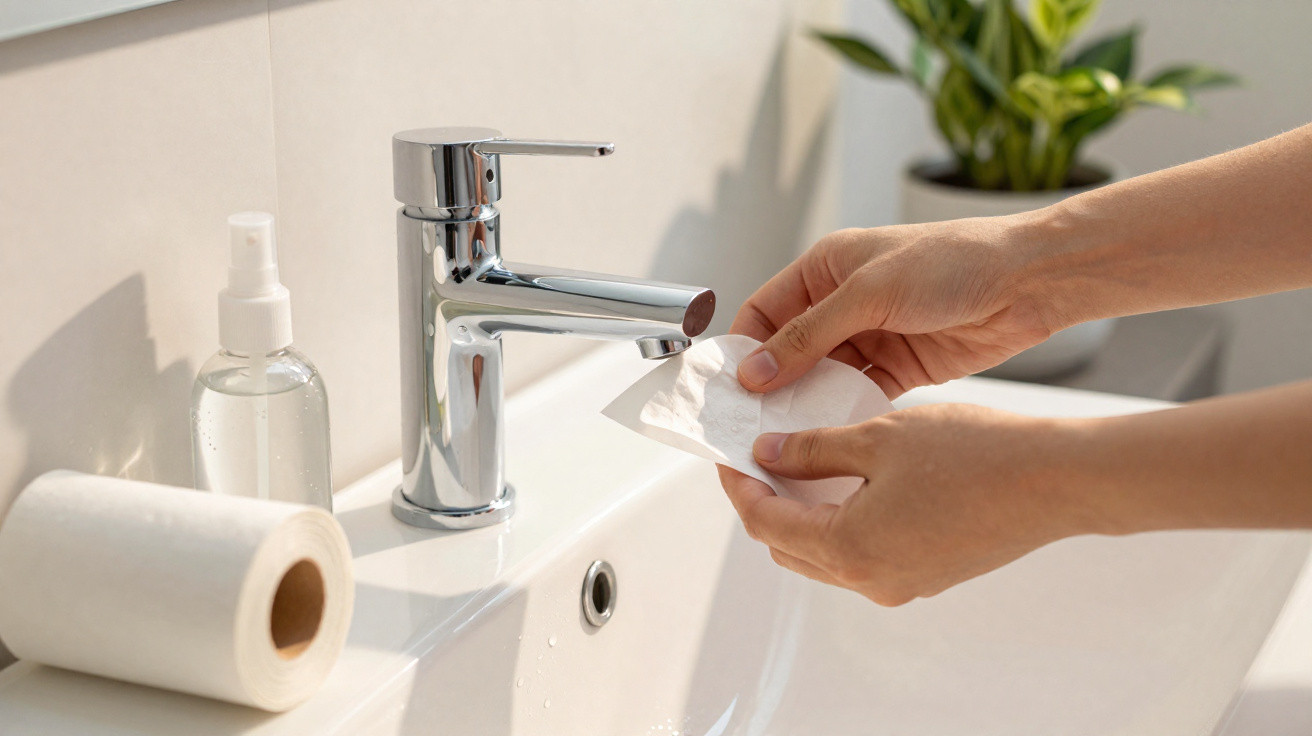
If you live in an area with hard water, you will know the problem: no sooner has the bathroom been thoroughly cleaned than white marks and dull patches reappear on taps and sinks. Many people reach for harsh limescale-removal sprays, often with a pungent smell and plenty of follow-up cleaning. Yet an everyday kitchen item can provide a surprisingly effective solution and keep surfaces gleaming for several days.
Why limescale quickly spoils taps
Limescale, also known as calcium carbonate or boiler scale, consists mainly of calcium carbonate. It forms when water containing high levels of calcium and magnesium ions evaporates or is heated. Hard mains water contains large quantities of these minerals, which is why fresh deposits keep appearing in bathrooms and kitchens.
On taps, this typically appears as:
- tiny white spots around the base;
- a dull film on chrome and stainless steel;
- encrusted aerators in the spout, which weaken the flow of water.
Regular use of strong limescale removers may dissolve these deposits, but over time it can also leave surfaces looking dull. Highly polished chrome taps are especially sensitive and can quickly become scratched when cleaned with overly abrasive sponges or scouring powders.
“The best strategy against limescale consists of two stages: descale thoroughly – then prevent fresh marks from settling.”
Many households already rely on home remedies such as vinegar, citric acid or bicarbonate of soda. They work, but need time to take effect and must be rinsed away thoroughly. For day-to-day cleaning, many people therefore want a faster trick that needs no additional cleaner at all.
The surprising kitchen helper: baking paper
At the heart of current cleaning hacks is an item found in almost every home: baking paper, also known as parchment paper or cooking paper. Its surface has a fine non-stick coating to stop dough and vegetables sticking in the oven. That same feature can be put to use in the bathroom.
When used on dry chrome or stainless-steel taps, the slightly slippery coating has two effects:
- It removes light limescale haze and fresh water marks without scratching.
- It leaves behind an ultra-thin water-repellent layer that slows the build-up of new marks.
After treatment, water beads more readily, spreads less into a flat layer and dries more quickly. This means far fewer of the familiar white rings and streaks that make metal look dull. Many users report that taps look well cared for with this method for around five to seven days.
How the baking paper method works, step by step
Preparation: dry the tap completely
The tap must be genuinely dry before you begin. A soft microfibre cloth works best for this. Wipe over the spout, lever, base and, where present, the hand shower until no drops remain visible.
Applying the baking paper
Next, take a small piece of baking paper, roughly half the size of an A4 sheet. Loosely scrunch it into a ball so that it sits more comfortably in the hand and reaches small curved areas more easily.
Now for the polishing stage:
- Work over the tap spout with the paper ball in circular motions.
- Then polish the handle, base and every shiny surface.
- Do not apply much pressure; treat it more like polishing a pair of glasses.
- The process is complete after about one minute.
Finish with a quick pass using the microfibre cloth. This spreads the invisible layer evenly and removes any small remnants of paper.
“The combination of gentle abrasion and an ultra-thin, water-repellent layer turns baking paper into a simple yet effective shield against limescale.”
Suitable surfaces and where to take care
The technique works particularly well on:
- polished chrome taps;
- stainless-steel taps;
- smooth metal surfaces on sinks and basins.
The following surfaces can be more sensitive:
- black or coloured taps with a matt finish;
- textured surfaces that have not been polished smooth;
- materials such as brass with a delicate specialist coating.
For these, first test the method carefully in an inconspicuous area. The trick is unsuitable for direct contact with natural stone around the tap, such as marble, limestone or travertine, because the non-stick layer can settle in pores and cause marks.
What baking paper cannot do: remove heavy limescale
This method is a form of maintenance rather than a replacement for a thorough descaler. If the spout and base are already heavily encrusted, baking paper alone will not be enough. In that situation, a conventional deep clean is the only solution.
Thorough descaling in a few steps
For a badly scaled tap, a short intensive treatment is a practical option:
- Unscrew the aerator and place it in warm vinegar or diluted vinegar essence.
- Leave it to soak for one to several hours, depending on the severity of the limescale.
- Wrap the outer surfaces with a cloth soaked in vinegar or citric acid, and leave it in place briefly.
- Clean further with a soft brush or cloth, then rinse thoroughly with water.
- Dry everything completely – only then use baking paper for ongoing care.
Once this deep clean has been completed, treating the tap with baking paper once a week is usually enough. This can significantly delay the next major descaling session.
Everyday habits that slow limescale from the start
Alongside the baking paper trick, a few quick routines can make a noticeable difference:
- Briefly wipe the tap and sink after showering or washing up.
- Clean the aerator regularly so the water flow does not spray and fewer drops land on surrounding surfaces.
- In areas with very hard water, consider water filters or specialist anti-limescale aerators.
Drying surfaces quickly after use removes the conditions limescale needs. When no residual moisture is left standing, fewer minerals can settle. This also reduces streaks on glass screens and tiles.
Why the trick is particularly useful in hard-water areas
In places where mains water has a high limescale content, deposits can become visible after just one or two days. Baking paper is especially worthwhile there because the method can be easily incorporated into a weekly cleaning routine. Keeping a small supply in the bathroom or kitchen is enough, and one sheet can be used for several applications.
At the same time, less specialist cleaner is needed. This benefits both the household budget and the airways, as many sprays are irritating because of their smell. Anyone sensitive to chemicals, or living with children and pets, will often appreciate any approach that uses fewer added substances.
Practical tips for a permanently shiny tap
This simple guide shows how the individual measures complement one another:
| Measure | Aim | Frequency |
|---|---|---|
| Drying with a microfibre cloth | Remove fresh droplets | After using the sink or shower |
| Baking paper polish | Slow light limescale build-up and maintain shine | About once a week |
| Thorough descaler treatment | Dissolve thick deposits | As required, usually every few months |
| Clean or replace the aerator | Improve water flow and reduce splashing | Every 1–3 months |
Combining these measures means considerably less trouble with marks around the basin and on the sink. Taps retain their shine for longer, and even older fittings look better maintained.
It is also worth considering the chemistry behind the method: the water-repellent effect works in a similar way to an impregnating treatment – it does not alter the metal itself, only the way water sits on its surface. It will not prevent limescale forever, but it postpones the point at which the next major clean is needed. For many households, that is enough to keep bathrooms and kitchens looking tidy with much less effort.


Comments
No comments yet. Be the first to comment!
Leave a Comment