
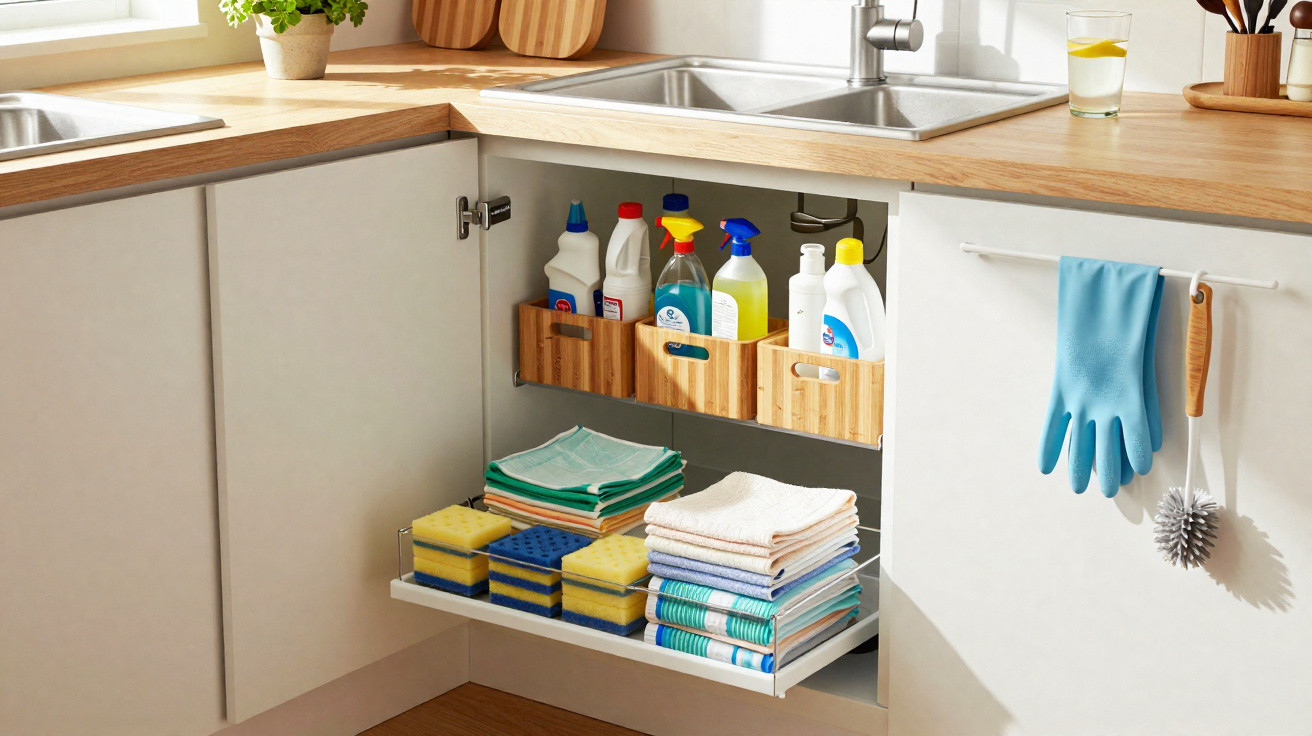
In a modern kitchen, every centimetre matters. Yet the space beneath the sink often turns into a cluttered dumping ground for cleaning products, bags and cloths. This area can be used remarkably well, however – with a solution that appeared in many homes during the 1960s and 1970s and is now making a genuine comeback.
Why space under the sink is so often wasted
Open the door of most sink units and the view is much the same: half-empty bottles, crumpled shopping bags, rubber gloves and washing-up sponges wedged somewhere in between. Pipes run through the middle, conventional shelves rarely fit properly, and everything eventually ends up in one unsorted heap.
This is widely seen as an awkward area: it is damp, irregularly shaped, shallow and filled with plumbing. For precisely those reasons, it is often left without proper organisation. Rather than a system, there is simply stacking – and whenever something is hidden behind the last bottle, the cupboard becomes a reminder of just how frustrating it is.
“The trick is not merely to create order – it is to make it more attractive and easier to access at the same time.”
The return of the sink skirt: a retro trend with real benefits
The understated star of 2026 is the sink skirt, also known as a sink curtain or simply a curtain beneath the sink. It is a fabric panel fixed directly below the worktop, concealing the entire space under the sink.
This was standard in many kitchens before enclosed base units became ubiquitous. The idea is returning now not solely because of nostalgia, but because it offers several very practical advantages.
What makes a sink skirt so useful
- Clutter is hidden by fabric: Whether there are baskets, bottles or buckets underneath, the outside still looks calm and tidy.
- Quick access: Rather than opening a cupboard door, squeezing past bottles and bending down, you simply lift the fabric, take what you need and carry on.
- Flexible styling: Colours, patterns and materials can be matched to the kitchen or changed with the seasons.
- Easy cleaning: When required, the fabric can simply go in the washing machine. There are no more yellowing cupboard doors that are difficult to clean.
- Perfect for awkward dimensions: If the space below the sink is uneven, narrow or full of corners, a curtain will often work better than a made-to-measure door solution.
The result is striking: the kitchen immediately feels more homely, with a slight country-kitchen character – even in a rented flat with a standard fitted kitchen.
Choosing the right sink skirt for your kitchen
Anyone opting for a sink skirt should consider more than appearance alone. A few practical details make a substantial difference in daily use.
Material and care
The space beneath a sink quickly becomes damp and can occasionally be splashed with water. The chosen material needs to cope with this:
- Cotton or blended fabrics: Soft and pleasant, easy to wash, and ideal for homes with children and pets.
- Linen-look fabric: Creates a high-quality, contemporary effect, but needs slightly more care because it creases more easily.
- Coated fabrics: A sensible choice where water splashes frequently or where lots of cleaning products are stored underneath.
The key point is that the skirt should be machine washable, preferably at a minimum of 30°C. This makes it possible to remove stains, dust and kitchen odours regularly.
Fixing options: tension rod, rail or hook-and-loop tape
There are several installation methods, depending on whether drilling is permitted and how the worktop is constructed:
| Option | Advantage | Best suited to |
|---|---|---|
| Tension rod / clamp rod | No drilling required and quick to fit | Rented homes and delicate surfaces |
| Screw-fixed strip / curtain rail | Very secure, including for heavier fabrics | Permanent installations, owner-occupied homes and hard-wearing kitchens |
| Hook-and-loop tape | The skirt can be removed completely | Anyone wishing to change or wash it frequently |
It is important to allow extra width so the fabric hangs in soft folds. A taut, straight curtain can quickly look cheap, while gentle gathering better disguises what is stored behind it.
Organising beneath the sink: making the area genuinely useful
The sink skirt is only the visible element. To make the space work in everyday life, it needs a system behind the fabric. Otherwise, the same mess simply builds up out of sight.
Basic layout: zones instead of piles
It helps to divide the available space into clear sections:
- Zone 1: Everyday essentials – washing-up liquid, dishwasher tablets, sponges, brushes and bin bags.
- Zone 2: Cleaning products – multi-purpose cleaner, bathroom cleaner, glass cleaner and rubber gloves.
- Zone 3: Supplies – spare sponges, extra bin bags, kitchen roll and specialist cleaners used infrequently.
Anything used several times a day should sit at the front within easy reach. Items needed only once a week can be stored further back.
Baskets, boxes and tiered shelves
A modest set of organisers prevents everything from sliding into a random jumble:
- Stackable baskets for cleaning products grouped by category.
- Narrow boxes for dishwasher tablets, sponges and brushes.
- Adjustable tiered shelves that can be arranged around the pipes.
- A hook rail or bar for tea towels, rubber gloves or brushes.
Many standard sink-unit shelves can be adjusted in both width and depth so that they do not clash with the trap. This creates a second level where smaller items can be stored.
“The combination of concealed storage and a clear structure achieves what many enclosed cupboards fail to do: the space beneath the sink becomes an easy-to-reach, purposeful working area.”
Sink skirt design trend 2026: changing the look of the kitchen
The appeal of a sink skirt extends beyond its practical function. It can alter the feel of the entire kitchen. In particular, an off-the-shelf fitted kitchen gains an individual touch from a fabric curtain, almost like a bespoke kitchen made by a joiner.
Some ideas that are especially popular in 2026 include:
- Checks and stripes in a country-house style for pale timber or white kitchens.
- Earthy shades such as beige, sand and olive for modern, minimalist spaces.
- Graphic black-and-white patterns for city flats with concrete or stainless-steel finishes.
- Seasonal fabrics: floral designs in spring and muted colours in autumn.
The key is to use the sink skirt as a deliberate design feature rather than as a stopgap. If desired, repeat the same fabric on cushions for a bench seat or small curtains at the kitchen window, so the whole room feels cohesive.
Practical guidance for daily use, safety and durability
For all its nostalgic charm, the area beneath the sink must remain safe. It is often where strong cleaners and chemicals are kept, so a short safety check is worthwhile, particularly in households with children.
- Place cleaning products carrying hazard symbols at the back or inside a lockable box.
- Store tablets and brightly coloured cleaning products where young children cannot simply reach them.
- Make sure strongly scented products are kept in containers that seal securely.
If you store numerous bottles, it is best to place them in a tray or waterproof basket. Should one leak, nothing will run directly onto the floor of the kitchen unit, and clearing up remains manageable.
Moisture is another consideration. Condensation can collect beneath the sink, for instance if a connection is leaking. It is worth checking behind the fabric from time to time. Small felt mats or a water-repellent liner protect the base and are easier to replace if anything does drip.
Sink skirts in the bathroom, utility room and camper van
This trend is not confined to the kitchen. The principle of “curtain instead of door” works wherever pipes and appliances are unattractive to look at but the space is badly needed.
Typical places to use it include:
- In the bathroom below the basin, where a conventional vanity unit is not wanted.
- In the utility room in front of a washing machine or shelves holding cleaning products.
- In a camper van or caravan, where every flexible storage solution is invaluable.
In small flats and mobile homes especially, the combination of low weight, flexibility and storage space matters. A fabric curtain weighs virtually nothing, can be pulled narrower or wider, and removed entirely when necessary. At the same time, it conceals anything visually distracting.
Combining the old idea of a sink skirt with modern organisers such as boxes, baskets and adjustable shelves makes surprisingly good use of an often neglected space – while adding a few convenient moments to everyday routines.

Comments
No comments yet. Be the first to comment!
Leave a Comment