
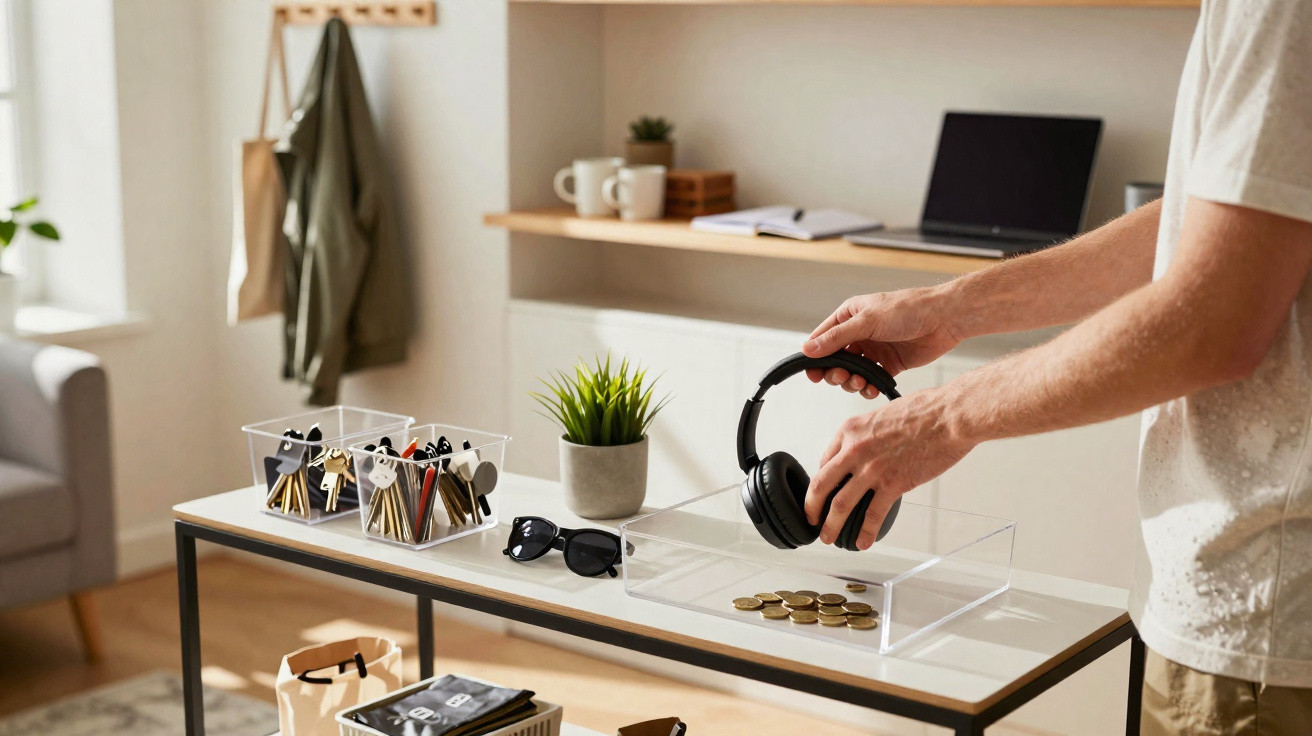
You open the kitchen drawer for the third time, yet the scissors you could have sworn belonged there are nowhere to be seen. The tape measure is lurking behind the soy sauce. Your earbuds are technically “on the shelf” - beneath a winter scarf you have not worn for two years. You are not exactly untidy; your belongings simply seem to vanish the moment you want them.
That is the unnoticed cost of daily life: seconds lost, small flashes of stress and the uneasy feeling that you own three of something because the first two cannot be found.
There is a way to change this without making your home feel like a showroom.
It begins with making the things you use most easy to see.
The simple visibility rule your future self will thank you for
Look around the room you are in and identify the objects you handle every day: keys, a phone charger, a coffee mug, a notebook. They are unlikely to be hidden in a box under the bed. Instead, they are somewhere in the open - perhaps awkwardly placed or a little untidy, but visible.
That is the first indication. Things used regularly need to stay in sight. They work best close to where life happens: by the door, beside the sofa or near the bed, rather than inside a “perfect” storage system that looks appealing but is never used.
Think of a hallway where everyone leaves their keys “just for now”. It may be a ceramic dish on a console table, an arbitrary wall hook or a basket that has turned into the household catch-all. Eventually, that place becomes almost sacred. You no longer have to consider it; your hand simply goes there.
The arrangement may not be attractive. Perhaps it is a chipped bowl and an old nail in the wall. Still, it can work better than a Pinterest-worthy pegboard that no one actually uses. This is what organising looks like when everyday life takes the lead.
Your brain has a reason for favouring these “obvious” places: it relies on visual cues to remember routines. When an item sits directly within your sightline, your mind uses less energy searching and more energy getting on with things. Put everyday objects inside opaque boxes, deep drawers or behind solid cupboard doors, and that mental effort rises.
Be realistic: almost nobody manages this without fail every day. On a hectic Tuesday night, you will not carefully return headphones, passes and remotes to labelled containers. The most effective system demands virtually no thought or self-discipline, quietly accommodating the chaos rather than resisting it.
The best way to store what you use most: visible, reachable and boringly obvious
Use this practical rule: anything you handle every day should have a visible front-row position at eye or hand height. Open storage is better than closed storage. Shallow is better than deep. Clear is better than opaque.
This could mean a wall rail with hooks near the entrance for keys and a tote bag. It could be a slim open tray on your desk for pens, lip balm and that particular USB stick. Or it might be a transparent bin on the lowest fridge shelf for yoghurt, cheese sticks or chopped vegetables. It can seem almost overly simple, which is precisely the aim. You should not have to recall where things belong; your eyes should show you.
The most common error is attempting to conceal everything: doors, lids and attractive unlabelled baskets. The space looks peaceful for a day, then gradually becomes a guessing game. Which basket holds the chargers again? You take them all down and search through them, and before long the “minimal” shelf is cluttered.
Show some consideration for the exhausted version of yourself who arrives home at 8 p.m., hands full and mind drained. That person is not going to open three boxes before putting sunglasses away. They will leave them on the nearest flat surface. If storage works against your natural habits, your habits will win every time.
“The best organizing system is the one you can keep going on your worst day, not your best,” says a professional organizer I interviewed who spends half her time undoing over-complicated systems from social media.
- Keep daily items at eye or hand level – Shelves from shoulder to hip height are valuable space. Use them for keys, notebooks, skincare and remote controls.
- Use open, shallow containers – Trays, low-sided bins and rails make everything visible at a glance, preventing items from vanishing into a dark corner.
- Give each item a single obvious home – Have one hook for keys, one tray for chargers and one basket for post. Avoid “perhaps here, perhaps there”.
- Choose clarity over aesthetics – Clear bins, open shelving and straightforward hooks outperform picture-perfect boxes that you forget to open.
- Store for how you actually live, not how you wish you lived – If shoes accumulate by the door, you do not need greater discipline; you need a visible place for shoes right there.
Living with visible storage without feeling like you live in a warehouse
The ideal balance is visible but calm. You do not need to leave every possession out; only the objects that genuinely play a daily part in your life need to be on show. Everything else can stay behind the scenes.
Go through your home room by room and ask: “What do my hands reach for here, every single day?” Give those items an easy, open and obvious place. Everything else can be put away where retrieving it takes slightly more effort. It is a subtle way of prioritising what matters in your real life.
Once your essentials stop playing hide-and-seek, you may be surprised by how much lighter the room feels - and how much lighter you feel while in it.
| Key point | Detail | Value for the reader |
|---|---|---|
| Front-row storage | Place daily-use items at eye or hand height in open or shallow containers | Cuts down search time and everyday stress |
| One obvious home | Give every frequently used object one visible, dedicated location | Makes routines automatic and simpler to sustain |
| Store for real life | Plan storage around where things naturally end up and how you genuinely move through your home | Builds a realistic system that lasts after the first tidy weekend |
FAQ:
- Question 1 Should everything I use often be out on display?
Answer 1 No. Only items you genuinely use every day, or nearly every day, need visible homes. Things used weekly or monthly can be stored a little further away or behind doors, provided they remain easy to reach.
- Question 2 What if visible storage makes my space feel cluttered?
Answer 2 Keep each “station” limited to a small number of selected items, using matching trays, hooks or bins. Visually grouping possessions creates a sense of order, even when they remain exposed.
- Question 3 How do I stop family members from leaving things everywhere?
Answer 3 Give them clear, highly obvious drop zones exactly where items tend to be left: a basket beside the sofa for remotes, a tray by the door for keys and a named or colour-coded hook for every bag.
- Question 4 Is labelling necessary when items are already visible?
Answer 4 Brief labels are useful when several types of item share a bin or shelf. They are particularly helpful for children, guests or shared areas where “What goes where?” is a daily question.
- Question 5 What is one quick change I can make today?
Answer 5 Pick one problem area, such as the entrance hall or coffee table, and make a simple open station: a tray for small belongings and a hook or basket for everything else. Try it for a week, then adjust it according to what actually ends up there.
Comments
No comments yet. Be the first to comment!
Leave a Comment