
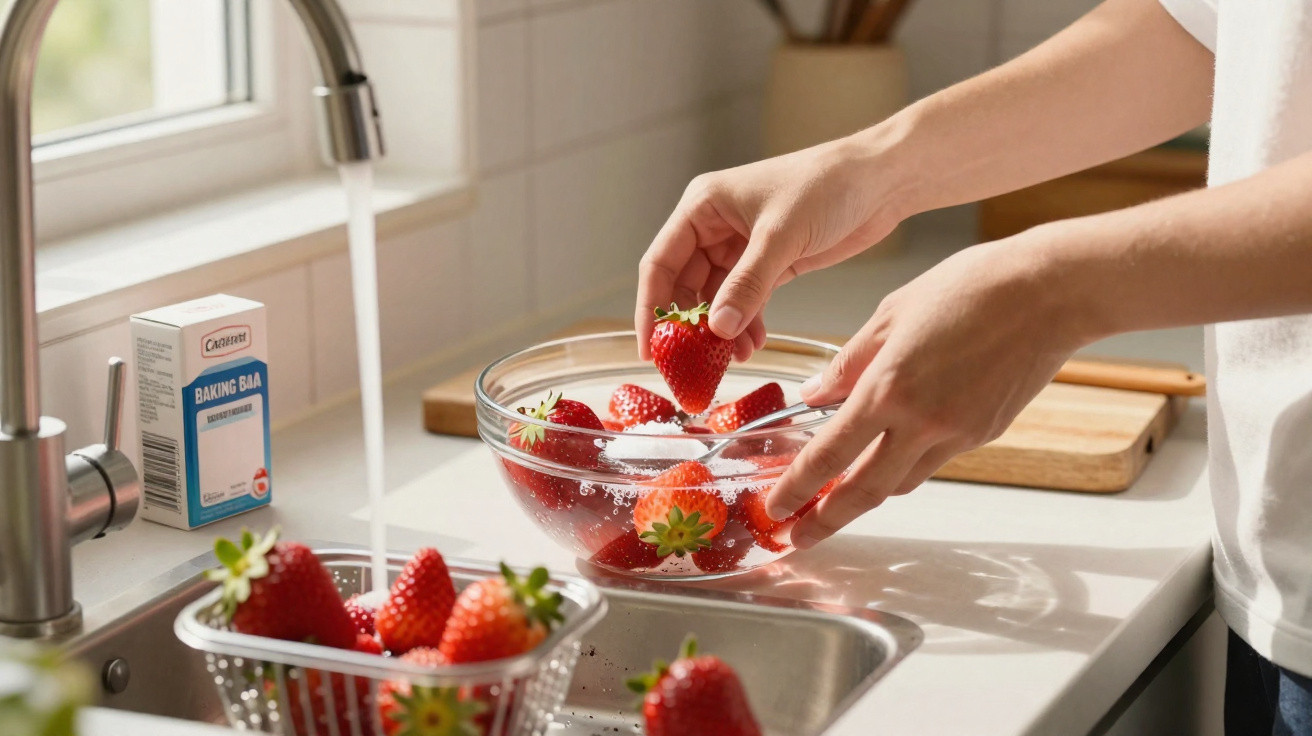
Yet it is precisely this common washing mistake that leaves most pesticides on the fruit.
The red berries look fresh, smell wonderfully fragrant and often go straight onto the plate after a quick rinse. The dust has gone, so that is enough – isn’t it? Unfortunately, no. Laboratory findings from the US and Europe indicate that strawberries are among the fruits most heavily affected by pesticide residues. A few seconds beneath the tap makes almost no difference.
Why strawberries so often contain pesticide residues
Strawberries are considered a particular concern in several international assessments. Reviews drawing on data from bodies including the USDA, ANSES and the environmental group EWG reveal a clear pattern: strawberries regularly rank among the fruits with the highest pesticide contamination.
USDA testing of conventionally grown strawberries found:
- 99 % of samples contained at least one pesticide residue
- around 30 % contained ten or more different substances
- some samples contained as many as 23 different molecules
Substances frequently detected included carbendazim and bifenthrin. Both are active ingredients intended to control mould or pests, yet they can remain attached to the fruit’s surface. A strawberry may look clean after washing, but laboratory analysis tells a different story.
Holding strawberries briefly under running water removes dirt – not most pesticides.
Why tap water alone does very little
The main misconception is that water dissolves everything. Many modern crop-protection products are designed to be “rainproof”. They cling to the fruit’s waxy outer layer and are often lipophilic: attracted to fats rather than water.
Research from the University of Massachusetts suggests that an ordinary rinse under cold tap water removes only 10 to 20 per cent of residues on average. This mainly applies to the small number of substances that dissolve readily in water; most of the residue stays in place.
There is also a second mistake that can make matters worse: many people remove the green hull before washing. This creates an exposed opening through which contaminated water can enter the fruit more easily. What is intended to clean the strawberry may then carry residues further inside.
A more effective approach: cleaning strawberries in a bicarbonate bath
Laboratory trials show that mixtures which alter the pH perform considerably better. One particularly effective option is a soak using baking soda, or food-grade bicarbonate of soda. This substance is mildly alkaline.
Its pH is generally between 8 and 9. At this level, processes known as alkaline hydrolysis can take place, which may attack or loosen certain pesticide molecules. Compounds such as thiabendazole and phosmet can therefore be removed from the surface much more easily.
In University of Massachusetts experiments involving apples, a solution of this kind reduced surface residues by up to 90 per cent after roughly 15 minutes. Strawberries respond in a similar way, provided they are handled gently.
How to use a bicarbonate bath step by step
For everyday use, a straightforward method can be easily added to a kitchen routine:
- Fill a large bowl with 1 litre of cold water.
- Dissolve 1 heaped tablespoon of food-grade bicarbonate of soda thoroughly in the water.
- Place the strawberries carefully in the solution with their green hulls still attached.
- Move the fruit gently; do not rub or crush it.
- Leave to soak for 10 to 15 minutes.
- Transfer the strawberries to a colander and rinse them under running water for around 30 seconds.
- Spread them over a clean tea towel and pat them dry carefully.
Measurements indicate that a quick rinse can leave up to 80 per cent of residues lodged in the tiny seeds, known as achenes, on the surface. A bicarbonate bath removes much of this adhering layer.
A bicarbonate bath is no substitute for good provenance or organic quality – but it does measurably reduce residues on the surface.
How useful are vinegar, salt water and other home methods?
Many people favour diluted vinegar or salt baths to clean strawberries. Laboratory tests do show differences between these approaches:
| Method | Approximate range of residue reduction |
|---|---|
| Tap water only | about 10–20 % |
| Vinegar water (1 part vinegar, 5 parts water) | around 60–70 % |
| Lukewarm salt solution | about 40–60 % |
| Bicarbonate solution | up to about 80–90 % on the surface |
Vinegar water can certainly work, although it may slightly alter the flavour of strawberries and make their flesh soft if left for too long. Salt water also removes some residues, but can dry the surface slightly and leave a salty film if the berries are not rinsed thoroughly afterwards.
Household cleaning products, washing-up liquid and specialist fruit washes with unclear ingredients should be avoided altogether. Nobody wants residues from those products left on their fruit.
Organic strawberries: is that enough? Unfortunately, only partly
There are good reasons why many shoppers choose organic strawberries. The permitted crop-protection products differ significantly from those used in conventional farming, and overall contamination is lower on average. Even so, residues still regularly appear in organic samples, whether from approved products, spray drift from neighbouring fields or contaminated irrigation water.
For that reason, specialists recommend giving organic strawberries a thorough soak in bicarbonate water too, followed by a good rinse and careful drying. It takes little effort and provides a noticeable extra measure of reassurance.
The most common mistakes when washing strawberries
- Rinsing for too little time: A few seconds under the tap achieves almost nothing.
- Removing the hull before washing: Contaminated water can enter the fruit more easily.
- Washing far too early: Moisture encourages mould, causing the berries to spoil sooner.
- Handling them too roughly: Rubbing or using a forceful water stream damages the surface and releases juice.
- Using cleaning products: Washing-up liquid or household cleaners leave residues that are not intended for consumption.
It is best to wash strawberries just before eating them. If they need to be prepared the day before, dry them extremely carefully after soaking, place them in a shallow container and keep them in the fridge. Be sure to avoid condensation in a closed container, otherwise they will go mouldy more quickly.
How great is the risk from pesticides in strawberries?
Measured residues are usually below the legally established maximum limits. These limits include safety margins, but they often address individual substances, whereas everyday consumption may involve an entire mixture of compounds on the plate. This “cocktail effect” has concerned toxicologists for years.
For children, pregnant people and those with pre-existing health conditions in particular, every measure that lowers the total amount is worthwhile. A bicarbonate bath is a simple option that costs very little and requires no specialist equipment.
Practical tips for your next strawberry purchase
Anyone hoping to reduce exposure while shopping can look out for a few signs:
- Choose locally grown produce in season rather than strawberries imported from overseas.
- Select fruit that is neither highly glossy nor smells of chemicals.
- Go for strawberries that are ripe but not overripe, as very soft fruit deteriorates quickly.
- Pick smaller berries, as they have a more favourable surface-area-to-volume ratio.
- If strawberries are eaten frequently, consider organic produce where the budget allows.
If you enjoy eating strawberries straight from the punnet at home, it is worth getting used to the brief extra step of using a bowl of bicarbonate water. Within a few days, it can become second nature – much like washing your hands before a meal.
The same method can be used for many other delicate fruits, including grapes, peaches and apples. The chemistry is the same: a mildly alkaline environment loosens certain residues from the skin more effectively than water alone. Combined with thoughtful choices in the shop, this can noticeably reduce exposure without anyone having to give up their bowl of strawberries.



Comments
No comments yet. Be the first to comment!
Leave a Comment