
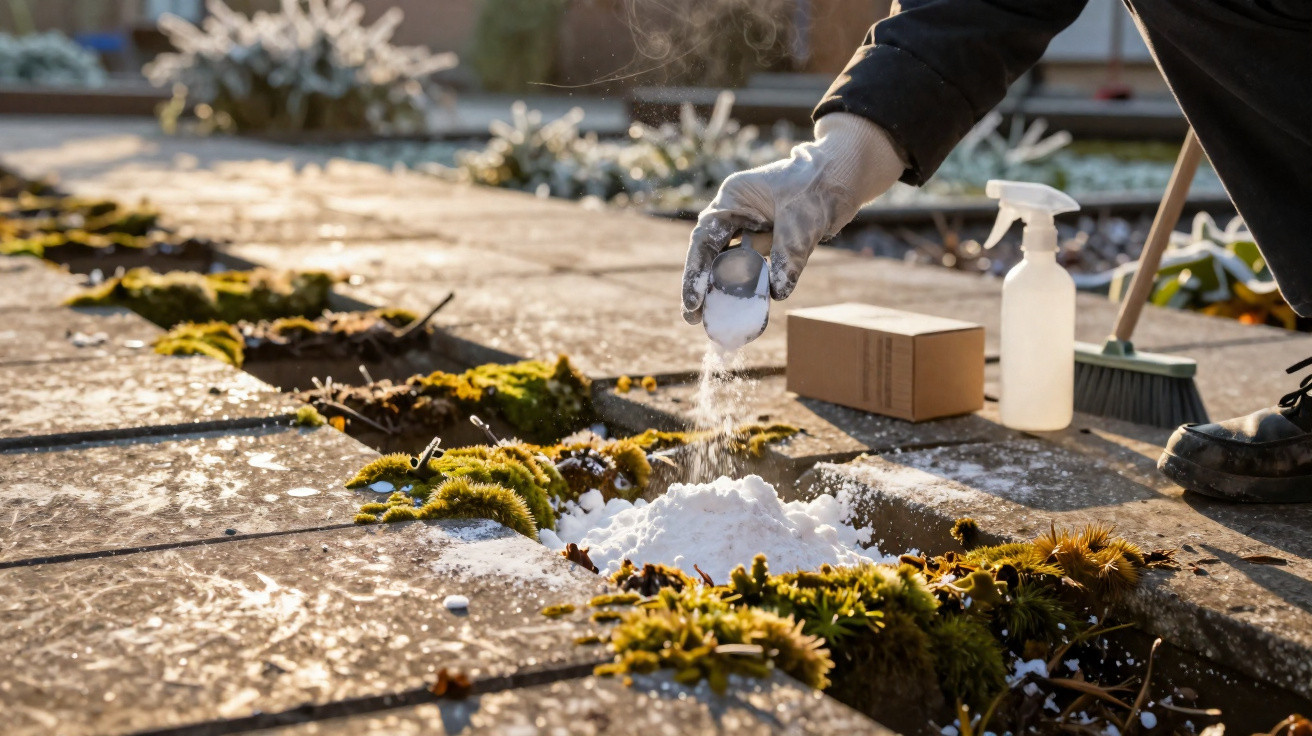
Rather than spending hours in spring tackling joints with a grout scraper, pressure washer or harsh chemicals, the task can be moved to the colder months. An everyday powder found in almost every kitchen cupboard attacks moss and weeds at the root, taking advantage of the fact that plants are far weaker in winter.
Why moss and weeds are so vulnerable in winter
At first glance, everything appears dormant during winter. Beds look bare and the patio seems frozen in time. Yet the gaps between paving slabs and blocks tell a different story: roots, spores and seeds remain protected in the crevices, simply waiting for the next mild day.
At this stage, even minor intervention can weaken unwanted growth for the longer term. Acting between January and February makes use of a key window:
- plants barely grow;
- their metabolism is running at a minimum;
- they are less able to recover from damage;
- there is less watering and follow-up work for the gardener.
Many people automatically reach for hot water or vinegar. Although this may sound harmless at first, both approaches have drawbacks: boiling water can encourage hairline cracks in damp paving slabs, while vinegar may damage the visible growth but often leaves the roots intact, allowing weeds to return quickly.
The overlooked powder from the kitchen
Garden and landscaping professionals use another household remedy: bicarbonate of soda, also known as sodium hydrogen carbonate. It is usually kept at home as a raising agent or all-purpose cleaner. On the patio, however, it offers another, lesser-known benefit.
Bicarbonate of soda acts like a mineral drying agent: it draws water from plants and disrupts their delicate cells all the way down to the roots.
Its effect is based on two factors:
- Osmotic effect: The salt alters the concentration at the plant surface, drawing water out of the cells. In effect, the plant dries out.
- Alkaline action: In paving joints, bicarbonate of soda raises the pH slightly. Many mosses and weeds that grow in joints then find conditions far less favourable and germinate less readily.
Unlike conventional herbicides, bicarbonate of soda does not work through complex chemical reactions inside the plant. Instead, it simply deprives the tissue of water. This is precisely why it is well suited to use in the colder months, when plants have very little energy available for recovery.
Applying bicarbonate of soda as a dry winter treatment
The most straightforward method is to apply it dry, directly into the joints. This is particularly suitable as a preventative measure when the patio has not yet become completely green.
Step-by-step guide for dry joints
- Sweep the patio roughly, removing loose dirt and leaves.
- Measure or estimate the bicarbonate of soda: allow around 20 grams per linear metre of joint, roughly a small handful.
- Scatter the powder loosely over the joints.
- Work it into the gaps with a stiff brush or broom so that it comes into contact with the soil.
- Do not rinse it away; moisture from dew, rain or mist will gradually carry the salt deeper down.
As it dissolves slowly, the active ingredient seeps bit by bit into the upper layers of soil beneath the paving. Moss, root remnants and germinating seeds are put under pressure for weeks, without anyone needing to pick up a scrubbing brush.
Liquid treatment for heavily greened surfaces
Where the patio is already noticeably covered in algae and dense cushions of moss have formed, dry powder alone will usually not be enough. In this case, a more concentrated liquid application can help.
Simple mixing ratio for the spray solution
| Amount of water | Bicarbonate of soda | Suitable for |
|---|---|---|
| approx. 1 litre | 2 tablespoons | light growth |
| approx. 1 litre | 3 tablespoons | dense moss cushions, stubborn weeds |
Dissolve the powder fully in lukewarm water, then pour the mixture into a watering can with a rose or a pressure sprayer. The next step requires precision:
- spray or pour only onto the joints and moss cushions;
- choose a dry day with no rain or strong wind;
- do not allow it to run freely across adjacent beds.
After one to two days, the vegetation visibly changes colour, first becoming yellowish and then brown. The plants turn brittle and can be swept out of the joints easily the next time the area is brushed. Particularly stubborn patches often respond well to a second targeted application.
If you get the dosage right, come spring you will often need only half an hour with a broom – rather than half a Saturday with a scraper and pressure washer.
Where bicarbonate of soda is useful – and where it is not
Although this mineral can be helpful on patios and paths, it should not be spread without thought. At high concentrations, it can place stress on the soil and disrupt soil life. Choosing the right location makes all the difference.
Suitable surfaces
- patio slabs and block paving;
- driveways made from concrete or natural stone;
- garden paths with firm joints;
- outdoor steps.
Areas where it should not be used
- vegetable beds and fruit plantings;
- lawns;
- areas intended for planting later on;
- places with direct drainage into ponds or sensitive water areas.
Using bicarbonate of soda only on mineral surfaces and preventing runoff towards the kitchen garden keeps the impact low. One or two treatments a year are normally entirely sufficient.
How bicarbonate of soda affects moss and soil chemistry
Moss thrives in slightly acidic, damp conditions. Patio joints frequently provide exactly that: rain, decomposing leaves, shade and soil that becomes more acidic over time. Bicarbonate of soda works precisely at this point.
It slightly increases the pH at the joint surface, changing the local conditions. Many mosses, as well as typical weeds found in paving joints, struggle more in this environment. When used sparingly, the effect generally remains limited to a depth of a few millimetres. Soil life in deeper layers remains relatively undisturbed, provided that large quantities are not washed into beds.
Practical tips for less work in spring
Anyone who has tried this winter approach once will often make it a regular part of their annual routine. A simple plan can help keep the patio easy to maintain:
- Late autumn: Sweep leaves and organic debris from the patio regularly.
- January/February: Use a dry day to work bicarbonate of soda powder into the joints.
- Early spring: Carry out a visual check and, if necessary, apply a targeted liquid treatment.
- Summer: Sweep lightly as needed, remove heavier dirt and keep an eye on growth in the joints.
This method is especially valued by older people and homeowners who do not want to use heavy machinery. Anyone unwilling to carry a pressure washer or kneel for hours gains a quiet, relatively gentle solution in this white powder.
Risks and useful combinations with other measures
Even though the active ingredient comes from the kitchen, it remains harmful to plants. If very sensitive ornamental perennials grow directly along the patio edge, take care that larger amounts of solution do not seep into those areas. A narrow gravel strip between the bed and paving can serve as a buffer.
The joint material is another worthwhile addition. For very wide joints, using specialist jointing compound or polymeric sand can make it harder for weeds to germinate over the long term. Combined with a bicarbonate of soda treatment during the colder months, this can often greatly reduce green growth in paving.
Those who are curious can start with a small corner of the patio. This makes it easy to see how quickly moss and weeds respond without treating the whole surface immediately. With a little feel for the right amount, a simple kitchen aid can become a quiet ally against green growth on stone and concrete.



Comments
No comments yet. Be the first to comment!
Leave a Comment