
Anyone who has ever been pushed through an IKEA store on a Saturday will recognise the pattern: some pieces of furniture turn up in almost every home. IKEA France has now revealed which items truly lead its sales charts – and alongside the expected classics, there is an armchair few people would have predicted.
Why these IKEA furniture favourites are so successful
The figures from France reveal a clear trend: furniture that can handle several roles at once is the biggest winner. Compact homes, rising rents and working from home have all increased demand for pieces that remain flexible, evolve over time and adapt to changing circumstances.
IKEA bestsellers in France stand out above all for their versatility, adaptability and prices that do not overstretch the budget.
According to IKEA France, modular shelving, adaptable wardrobe systems and timeless essentials dominate. They can be upgraded, rearranged, extended and reimagined time after time. That combination turns straightforward furniture into quiet household companions that remain useful for years.
Billy: the enduring bookcase that survives every house move
At the top of the podium is a familiar name: the Billy bookcase. It has ranked among the Swedish retailer's best-selling furniture for decades, and France is no exception.
Its success is no accident. Billy is a textbook example of the IKEA formula:
- simple, understated design
- a comparatively low price
- units that can be expanded gradually
Many people begin with a single bookcase in the living room. Further units are added later, eventually creating an entire wall of bookshelves. Others use Billy in a home office, children's bedroom or as hallway storage. Doors, top units and various heights transform the standard bookcase into a compact modular system.
To stop Billy from feeling stale, IKEA regularly introduces new colours and finishes. A blue version is currently adding a fresh note in France, showing how closely the brand follows contemporary interior trends without changing the core concept.
Kallax: the shelving unit that does it all
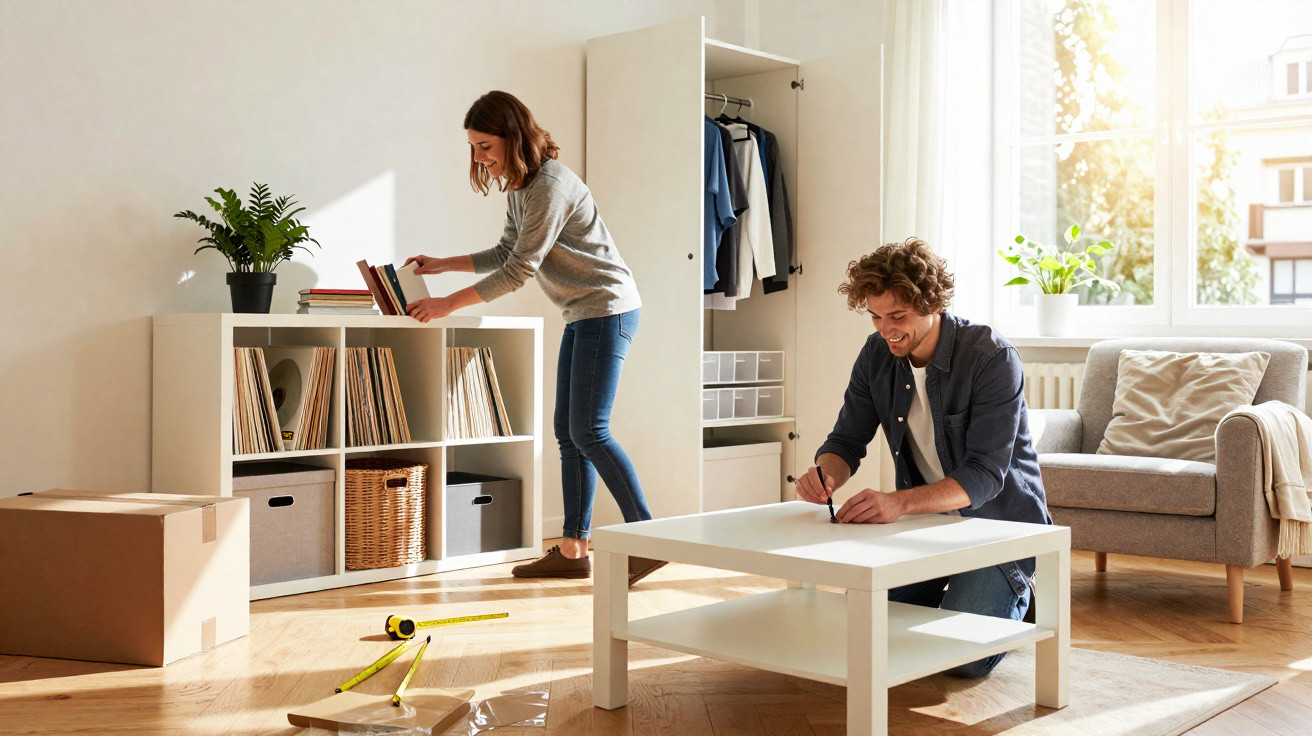
Just behind Billy comes Kallax, the open cube shelving unit that seems to appear in every student flat share – and often moves on to the first family home. In France, it is one of the range's most frequently repurposed pieces.
Kallax can be positioned horizontally, vertically, against a wall or in the middle of a room. In smaller flats, it often works as a room divider, for example to create a reasonably separate workspace or sleeping area within the living room.
What is striking is how differently people use the unit. One French example involves a music enthusiast who uses Kallax to store records, as its compartments are almost perfectly sized for vinyl. Word of this small detail has spread through music forums and social media, and Kallax is now regarded as the unofficial standard for record collections.
There is plenty to suggest that Kallax remains so popular because it can be repurposed so easily – from a children's room to a recording studio in the living room.
Pax: a made-to-measure wardrobe from a modular system
Third place goes to Pax, the wardrobe system IKEA introduced in the 1970s. In France, it is especially sought after in cities with tight floor plans because Pax can be tailored very precisely to the available space.
Its width, height, internal fittings and doors can all be configured. Those with lots of shirts can include more hanging rails. Shoe enthusiasts can add extra shelves. In narrow rooms, customers often choose sliding doors so the wardrobe does not take up space when opened.
Interior designers have long pointed out that well-designed wardrobe solutions can make everyday life more relaxed. Properly organising clothes delivers not only extra storage but also saved time. This is exactly where Pax strikes a chord: it has the feel of a bespoke wardrobe while remaining within a manageable budget.
Saving space as a climate issue
There is another factor that now carries greater weight in France: resource-conscious living. The national ecological transition agency recommends flexible furnishing systems to make more efficient use of living space. The more readily a wardrobe or shelving unit can be adapted, the less often it needs replacing – a point IKEA also highlights in its communications.
Poäng: the armchair hardly anyone expected
The real surprise in the French ranking sits in fourth place: rather than the widely known Malm chest of drawers, it is an armchair – Poäng. Many people will know its curved wooden frame and simple cushioning from student rooms, waiting areas or holiday lets.
Poäng has been available since the 1970s, yet its design still looks remarkably contemporary. The armchair feels light, has little visual bulk and therefore suits compact rooms well. In many living rooms, it sits beside a bookcase or by a bright window – a classic setting for an evening of reading.
Why does Poäng sell so well in France? Three factors stand out:
- Comfort: Its gently springy construction provides a pleasant seating experience.
- Appearance: A restrained Scandinavian look that is neither rustic nor showy.
- Options: A choice of covers and wood colours, from subtle to bold.
Poäng demonstrates that comfort furniture, not just storage, is among the quiet stars of the IKEA range.
Lack: the coffee-table icon for a first living room
Fifth place belongs to Lack, a piece almost everyone has owned or at least seen somewhere: the plain, angular coffee table. In France, as in Germany, it is a typical starter item for young people.
Its exceptionally low price is a key reason. People moving into their first home are rarely keen to spend hundreds of euros on a table likely to hold crisps, red wine or pizza boxes on a regular basis. Lack provides a straightforward answer: minimalist, easy to replace and surprisingly sturdy, provided it is not used as a stool.
Because the table is so unassuming, it fits into almost any interior. It recedes into the background in colourful homes, while in very minimalist spaces it complements the clean style. Many people continue using it later, perhaps in a guest room, as a side table or even as a drawing table in a child's bedroom.
What the bestsellers reveal about our furnishing style
The French sales figures point to one thing above all: people are happy to invest in furniture that leaves them free to make choices. A bookcase that first holds books, then toys and eventually files. A wardrobe that can adapt to a new home. An armchair that lasts for decades because only the cover needs changing.
For consumers in German-speaking countries, this has a practical implication: these models are also enduring favourites here, particularly in cities where floor space is limited. Anyone planning their home can take useful cues from the French favourites, especially when looking for flexible storage solutions.
Getting more from the classics
Many people underestimate how much can be achieved with small alterations to standard furniture. Here are a few examples that have become established in France and elsewhere:
- Billy with doors and LED strips as a stylish display cabinet for tableware or collectibles.
- Kallax with inserts and baskets as combined storage for a home office and living room.
- Pax with internal boxes, hooks and extra hanging rails as an alternative to a full dressing room.
- Poäng with a footstool as a small reading corner instead of a bulky sofa.
- Lack as a side table beside the bed when a conventional bedside table will not fit.
Choosing furniture like this deliberately saves money and materials over the long term. Rather than buying everything new with every move, existing pieces can be adapted. That makes financial sense and also reduces the volume of waste the furniture industry would otherwise generate regularly.
At the same time, the French data shows that IKEA still understands what people want with its blend of modular systems and affordable basics. The bestseller list reads like a compact guide to living well in limited space – with room for a little comfort that can make even the smallest home feel more inviting.

Comments
No comments yet. Be the first to comment!
Leave a Comment