
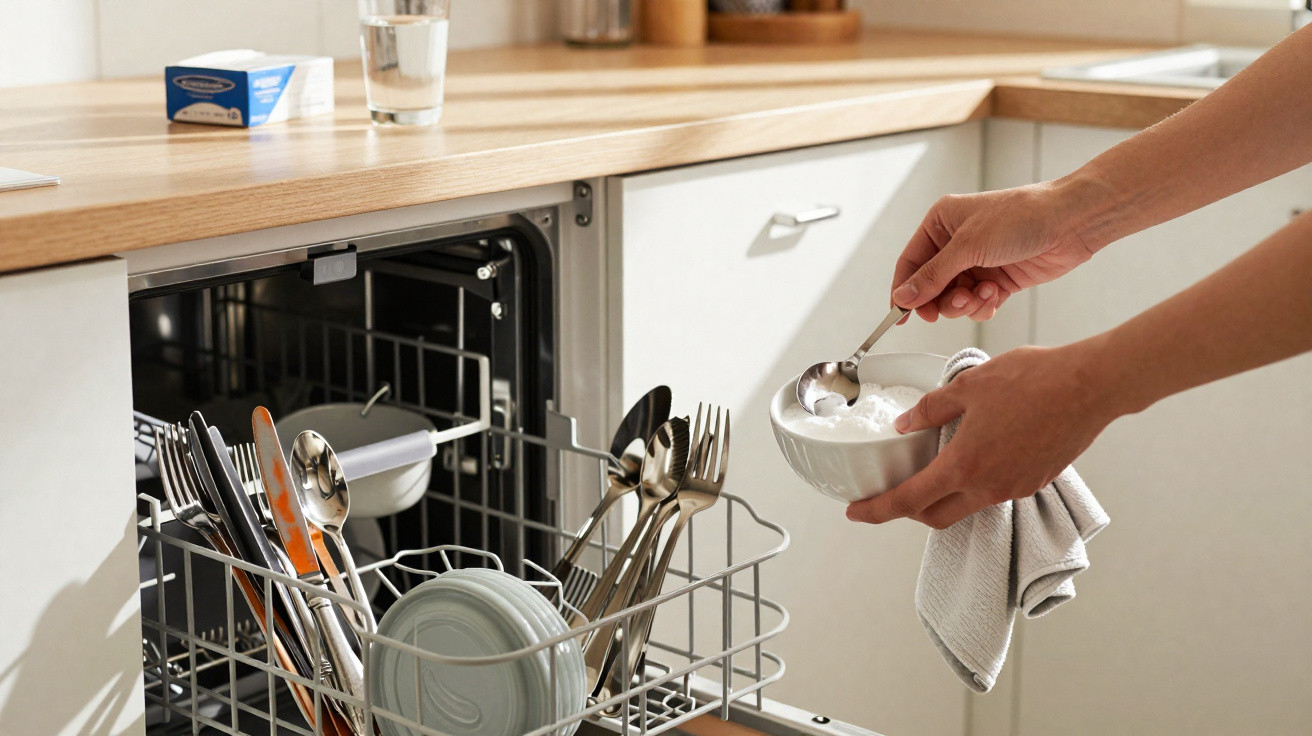
Behind it is usually a surprisingly simple reason.
Many households know the frustrating sight: knives covered in brown spots, forks with a dark film, while the glasses come out sparkling. It is easy to blame the dishwasher or supposedly “poor-quality” stainless steel. In reality, however, a combination of metallurgy, water chemistry and everyday handling is at work inside the dishwasher – and these factors are remarkably easy to adjust.
Why stainless-steel cutlery can rust in the dishwasher
The biggest misconception is that stainless steel is indestructible. Many people assume that “stainless” means it can never rust. That is not quite true.
Modern cutlery is generally made from different grades of stainless steel. Forks and spoons are often produced from high-quality steel containing nickel and chromium, whereas knives use another type of steel that is easier to sharpen. The reason is simple: a higher carbon content creates a sharper blade, but also reduces corrosion resistance. That is precisely why knives are especially prone to rust marks.
“Stainless” means highly resistant to rust, not completely immune. Under unsuitable conditions, even stainless steel can give way.
The protective chromium oxide layer on the surface may also be damaged by harsh detergents, prolonged moisture and improper storage. Once this protective layer is weakened, surface rust can develop easily.
Silver cutlery in the dishwasher: an expensive mistake
Genuine silver has a different issue. It does not rust; instead, it tarnishes black. This happens when sulphur compounds in the air react with the silver. It may look like rust, but chemically it is something entirely different.
Even so, silver has no place in the dishwasher. Most dishwasher tablets contain substances that attack silver. Chlorine compounds and powerful bleaching agents can cause permanent damage, leaving the metal dull and pitted with small spots.
Genuine silver cutlery belongs in the sink, not in the dishwasher.
Anyone with inherited or expensive silver items should always wash them by hand, using mild washing-up liquid and a soft cloth.
The unseen factors: water, salt and moisture
Whether cutlery rusts depends heavily on the conditions inside the appliance. Three factors are particularly important:
- Moisture after the programme finishes: If the door remains shut, warm and humid air builds up.
- Regeneration salt: Incorrect dosage or unsuitable water-hardness settings can put unnecessary strain on metals.
- Contact corrosion: Different metals touch one another and affect each other.
If the dishwasher is dealing with hard water using too little salt, more minerals remain inside the machine. These can form deposits and, in turn, encourage corrosion. Conversely, an overly high salt concentration can attack seals and metal components. Strong dishwasher tablets, hot water and trapped moisture intensify the effect.
Previously damaged parts inside the dishwasher are another source of trouble. Rusty baskets or holders shed tiny particles of rust. These settle on otherwise intact cutlery – a typical case of surface rust that is often mistakenly seen as “rust in stainless steel”.
Everyday habits that unnecessarily damage cutlery
Leaving cutlery in a closed dishwasher for hours
A very common mistake is leaving everything inside once the cycle has finished. The dishwasher stays closed, sometimes overnight.
The longer cutlery remains in a warm, humid dishwasher, the greater the risk of rust spots.
The interior then becomes a miniature tropical climate. Water does not evaporate fully; instead, it condenses on metal items. Sensitive knives in particular can quickly develop small brown dots in these conditions.
Mixing metals and loading them incorrectly
Many households put every shiny item into the same basket: stainless steel, silver, coated knives and perhaps even a pan with an unusual metal handle.
This is exactly what encourages contact corrosion. When two different metals lie close together in a damp environment, they create a small electrochemical system – and one metal is attacked more severely. The result can be discolouration, marks or tiny pits.
How to prevent rust on cutlery in everyday use
A few simple routines can prevent a great deal of inconvenience. Here are the most important adjustments:
- Open the dishwasher promptly after the programme ends: Open the door as soon as the beep sounds so that steam can escape.
- Unload quickly: Put cutlery away dry and with good airflow while it is still warm, where possible.
- Separate metals: Never position silver and stainless steel directly beside each other, and place delicate knives separately.
- Check the salt setting: Check the hardness of your tap water and set the dishwasher accordingly.
- Deal with rust on baskets: Repair damaged areas on the dishwasher basket or replace the basket.
Anyone who regularly uses very sharp knives may wish to consider washing them by hand. This not only protects the blade, but also significantly reduces the risk of rust.
Cutlery already affected? How to remove rust spots
If the damage is still superficial, much can be saved. Simple household chemistry works surprisingly well on lightly rusted stainless steel.
Bicarbonate of soda and vinegar as first aid
For fine rust spots, a paste made from bicarbonate of soda, or plain baking powder without additives, and a little water is usually enough. Apply it, rub gently with a soft cloth, rinse thoroughly and dry straight away.
Clear household vinegar essence can also help. Leave it to work briefly, then rinse well and rub dry. Important: do not leave cutlery soaking in vinegar for hours, as this can damage the surface.
After every treatment with household remedies, the rule is: rinse immediately, dry thoroughly and do not leave items wet.
Restoring shine to blackened silver
A simple chemical trick using aluminium foil can help with tarnished silver:
- Fill a bowl with hot water.
- Place a piece of aluminium foil on the bottom.
- Add one or two spoonfuls of bicarbonate of soda.
- Put the silver cutlery in the bowl and wait a few minutes.
During the reaction, the sulphur moves from the silver to the foil, making the silver lighter again. Then rinse thoroughly and dry with a soft cloth.
When rust becomes a genuine structural problem
If the same areas keep rusting repeatedly, this suggests more extensive damage. Tiny surface “craters”, known as pitting corrosion, can hardly be reversed completely. In this case, the usual solution is to remove the rust regularly and wash the affected items by hand in future.
Severely damaged knives do not merely lose their appearance over time; they may also seem blunter. Anyone who cooks frequently will notice this quickly. In such cases, replacing them with a better-quality new set can sometimes be worthwhile – together with more careful treatment.
Why water hardness and dishwasher detergent matter more than many realise
The hardness of tap water determines how many minerals are dissolved in it. Hard water is more likely to leave deposits on cutlery and inside the dishwasher. The appliance’s water softener and regeneration salt are intended to offset exactly this. If they are set incorrectly, the balance shifts – at the expense of the metals.
The dishwasher detergent itself also plays a part. Strongly dosed tablets with numerous additives can irritate sensitive surfaces more than necessary. Anyone regularly experiencing rust or spots can try switching to powder and reducing the dosage slightly. Combined with correctly adjusted salt and rinse aid, this often produces a noticeably better result.
What cutlery reveals about its quality
When buying new cutlery, it is worth taking a little longer to check the markings. High-quality stainless steel is often labelled with figures such as “18/10”. These codes indicate particular proportions of chromium and nickel, which make the steel more resistant to corrosion.
If an inexpensive set develops obvious rust marks after only a few dishwasher cycles, the appliance is not always solely to blame. In these cases, a combination helps: careful dishwasher use and a deliberate choice of better quality – especially for knives, which are exposed to the greatest stress.




Comments
No comments yet. Be the first to comment!
Leave a Comment