
The first truly cold evening of the year always seems to arrive at the least convenient time. You get home with icy fingers, turn the thermostat up slightly and wait for the welcome rush of heat that never seems to arrive quickly enough. The radiator is hot to the touch, yet the room remains cold.
Someone online swears that aluminium foil behind radiators is the answer. A friend says thicker curtains are essential. You test a little of everything, partly persuaded and partly doubtful, while your energy bill climbs with every experiment.
Yet there is a quieter, almost unnoticed adjustment that can genuinely alter how quickly a room feels warm.
And it has nothing to do with foil.
No, foil is not the real issue
Aluminium foil behind radiators has become the DIY version of a magic solution. It is inexpensive, reflective and simple to tape to a wall, which makes it look ingenious enough for us to expect dramatic results. For many homes, however, its impact is minimal and can sometimes be barely measurable.
The more mundane truth is also more effective. How quickly a room heats up depends less on foil than on the way warmth travels through the air and around your furniture. When hot air is trapped, slowed down or diverted, it can take a long time before the room feels genuinely comfortable.
Imagine a small sitting room with a large, soft sofa pushed directly against the radiator “to save space”, while a heavy curtain covers half the window and half the radiator. The resident complains that “these old heaters don’t work anymore” and keeps raising the thermostat.
A thermal camera would reveal another explanation. The air behind the sofa and curtain is extremely hot near the radiator. Yet at head height in the centre of the room, the temperature is several degrees lower. The heat has been generated and paid for, but it is blocked where the air needs to circulate.
In physical terms, radiators do more than emit radiant heat; they mainly warm rooms through convection. Warm air rises, colder air sinks, and this unseen cycle gradually carries heat around the space. Blocking the radiator’s base, front or the area immediately above it interrupts that cycle.
This is why foil can be a distraction. It may marginally limit heat loss through an uninsulated wall, but if a sofa, full-length curtains, drying laundry or a large cabinet are pressed close to the radiator, the room will still take frustratingly long to heat. Improving the airflow around the radiator produces much faster and more noticeable results.
The smarter radiator trick: free the heat and direct the air
The more effective approach begins with one straightforward step: create a 20–30 cm “breathing zone” around every radiator. Avoid pushing sofa backs against it, placing shelves in front of it, storing boxes beneath it or letting curtains drape over the top. Keep the bottom clear for cold air to enter and the top open so warm air can rise without restriction.
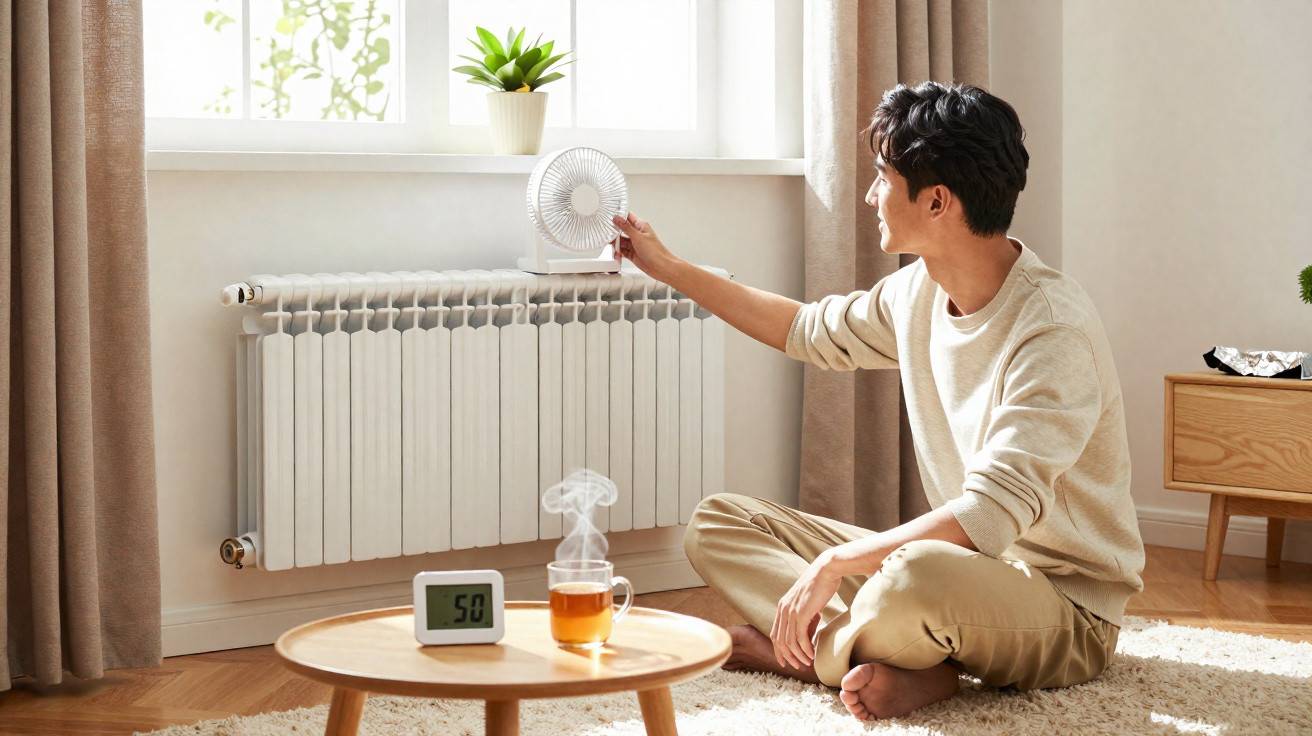
Next, use household items you already own to direct that warmth. A small, quiet fan on the floor, running at its lowest setting and angled slightly upwards near the radiator, can dramatically shorten the time a room takes to feel warm. It does not create extra heat; it mixes the air more quickly, preventing warmth from lingering by the wall and helping it reach you.
This may feel counterintuitive. Most of us associate fans with cooling, while radiators seem like separate, untouchable fixtures. However, many energy specialists have carried out the same comparison: two similar rooms with similar radiators, one with a small fan circulating the air and one without.
The room using the fan reaches a comfortable-feeling temperature several minutes sooner, often with the thermostat set lower. The explanation is almost too obvious: the fan disrupts pockets of hot air that collect around the radiator and ceiling. You begin to feel warmth at sofa level rather than only in the corner by the window.
There is a mental trap here. We often fixate on gadgets - foil rolls, radiator boosters and smart stickers - instead of considering the fundamentals: space, air and flow. A radiator squeezed into a corner and smothered by fabrics may be functioning perfectly while delivering only half of its possible comfort.
Free it up and give the airflow a modest boost, and the same heating output feels different. The room heats more evenly, draughts become less harsh and the “cold corner” becomes usable. It’s not about producing more heat, it’s about letting the heat you already pay for actually reach your skin.
How to create a room that warms quickly
Begin with a careful walk around your home, one room at a time. Stand in front of every radiator and consider what is obstructing the air route. If a sofa touches it, move the sofa away; even 10–15 cm can make a difference. Where curtains hang over the top, shorten or tie them back so they finish immediately above or below the radiator rather than covering it halfway.
Then clean the radiator panels or fins. Dust acts as a soft insulating layer and reduces heat transfer. A quick vacuum followed by a damp cloth will often do the job. Realistically, nobody does this every day; doing it once at the beginning of the heating season is already worthwhile.
Now try the “fan trick”. Use a compact desk fan or a quiet tower fan. Position it on the floor near, rather than directly against, the radiator, pointing it across the room or slightly upwards. Keep it on its lowest setting. The aim is not a cooling breeze, but a light movement that blends the air.
Many people make the same first-time error: they turn the fan up too high or point it straight at their face, then feel colder. If that happens, angle it towards the ceiling or the opposite wall, allowing the air to rebound and circulate gently. Within ten minutes, you may find that your hands and feet feel warmer without adjusting the thermostat.
“Once I stopped obsessing over tricks like foil and just moved my sofa and used a tiny fan, my living room finally felt warm without turning the heat higher,” says Laura, 37, who lives in a poorly insulated rental. “The bill didn’t explode, and I actually enjoy sitting by the window now.”
- Clear space around radiators
Keep 20–30 cm free on all sides where possible, particularly underneath and above. - Use a low-speed fan
Put it close to the radiator to distribute warm air evenly without causing a draught. - Manage your curtains
Shorten or tie them back so they do not cover the radiator and hold heat against the wall. - Keep the radiator top clear
Do not place decorative boards, books or clothes on top, as these obstruct rising warm air. - Prioritise one room at a time
Concentrate on the room where you spend your evenings, so faster comfort reaches the place where it matters most.
Rethinking comfort when cold weather arrives
Once you have seen how quickly a room can heat when warmth circulates freely, it is difficult to return to old habits. The fixation on foil begins to resemble belief in a lucky charm. Comfort is not simply about buying equipment or increasing the thermostat; it also depends on how your home breathes.
We have all had the moment of blaming the heating system, the building or even the weather, while the answer sits quietly in the room layout. Move a sofa, shorten a curtain, repurpose a small fan from summer, and the space can suddenly feel transformed: more welcoming and less inhospitable when you return at night.
Some people will still tape foil to the wall and insist that it works for them, and that is fine. The more important change is mental: replacing quick, shiny solutions with smarter, nearly invisible adjustments that have a genuine effect. They are the kind of changes guests may not notice, apart from saying, “Your place feels so cosy lately, what did you do?”
You may start trying other ideas: shutting doors to keep warmth in the room you are using, laying carpets to reduce cold from the floor, or arranging furniture according to the way heat moves rather than simply where the television fits. That is when a home begins to work with you, rather than against you, every winter.
| Key point | Detail | Value for the reader |
|---|---|---|
| Free the radiator | Leave 20–30 cm clear around radiators and avoid blocking them with furniture or curtains | Room warms faster without extra energy use |
| Use a small fan | Low-speed fan near the radiator to mix warm air and reduce hot/cold zones | More even comfort at a lower thermostat setting |
| Prioritize air flow | Clean radiators, adjust textiles, and think about how air circulates in the room | Turns existing heating into effective, felt warmth |
FAQ:
- Does aluminium foil behind radiators work at all? It can slightly reduce heat loss through thin, uninsulated exterior walls, but the effect is often small compared to improving air circulation and freeing the radiator from obstacles.
- Won’t a fan “cool” the room instead of warming it? A fan does not alter the air temperature; it moves the air. When used gently near a radiator, it helps distribute warm air around the room, which usually makes you feel warmer sooner.
- How far should furniture be from a radiator? Ideally, leave at least 20 cm between the radiator and large pieces of furniture. More distance is even better, especially above and below, where air needs to move.
- Are long curtains really such a problem? Yes, when they cover the radiator. They hold hot air between the fabric and wall, preventing warmth from spreading into the room. Shorten or tie them back so the radiator can “breathe”.
- Can these tricks reduce my heating bill? They primarily improve how quickly and evenly comfort is felt. Many people find they can reduce the thermostat slightly once a room warms faster, which can lead to noticeable savings across a full winter.






Comments
No comments yet. Be the first to comment!
Leave a Comment