
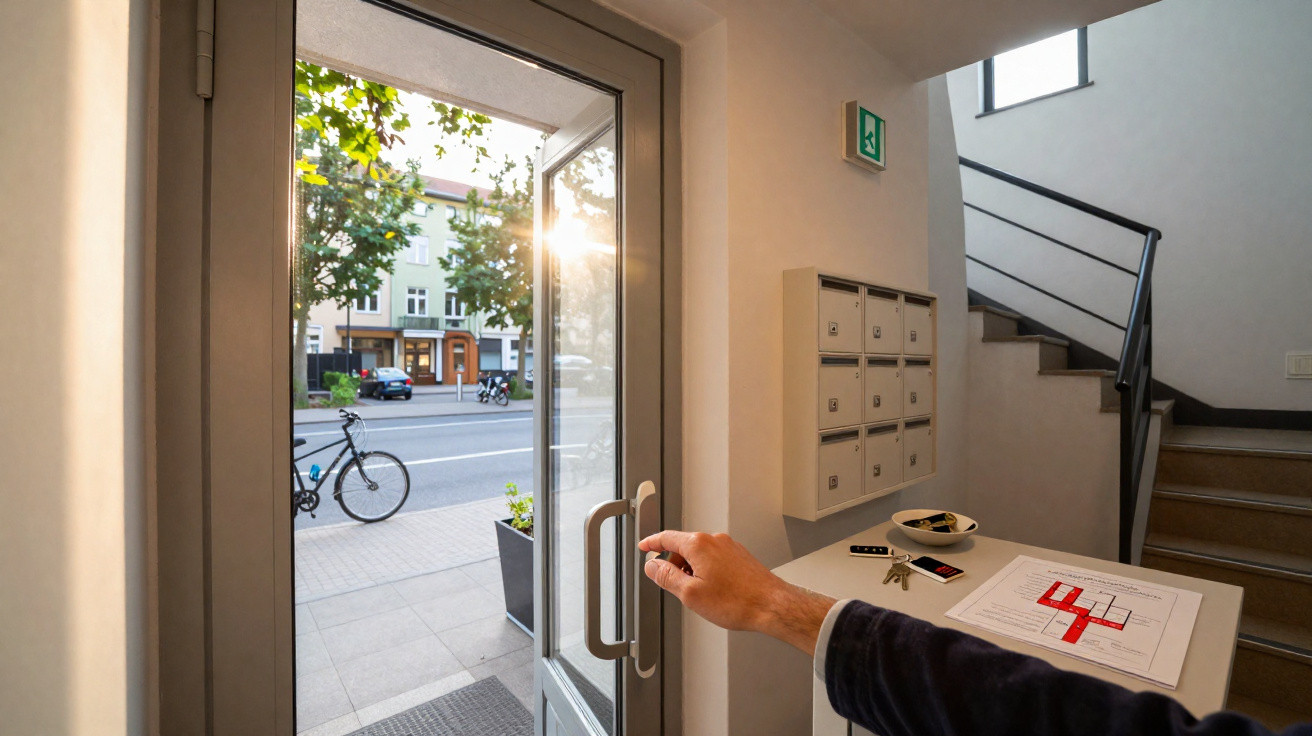
Turn the key, the lights go off and everything seems still. But the routine people rely on most can put them at risk.
Across Europe, legal and fire-safety arguments have focused on one straightforward issue: the entrance door. Should it be locked for reassurance, or left available for a rapid escape? A significant German court judgment offers a firm answer, affecting both building policies and night-time routines.
A court ruling puts life before locks
In a case that continues to influence property management, a regional court in Frankfurt found that locking the main entrance of a multi-unit building overnight creates an unacceptable danger. The concern was not burglary, but fire. When smoke fills a stairwell and panic takes over, people do not stop to search for keys. They flee - only to find their way blocked.
“In multi-unit buildings, a locked entrance can turn a smoke-filled corridor into a lethal cul-de-sac. Free egress saves seconds. Seconds save lives.”
The court’s position was unequivocal: communal escape routes must remain usable at every hour. Any building rule that leaves residents dependent on a key, however well meant, does not meet that standard. The principle applies far beyond a single property. In many countries, fire-safety rules require doors on escape routes to open from inside without a key. Stolen possessions can be replaced; a life cannot.
How panic changes decision-making in a fire
Fire leaves little room for hesitation. Poisonous smoke obscures vision, while stairwells can draw flames and smoke upwards like chimneys. Stress reduces fine motor control. People may be carrying children, pets or phones, while keys are buried in a bag or left on a hall table. At that moment, a locked communal entrance is an obstacle.
“Think about the sequence: alarm, smoke, movement. No one in bare feet and darkness wants to hunt for the right key while coughing.”
Who faces the highest risk
- Children, who may move more slowly or become frightened quickly
- Older people with reduced mobility or impaired sight
- People living with disabilities or injuries
- Visitors and delivery workers who do not know the building layout
- Night-shift workers and residents waking from deep sleep
- Anyone confused by smoke, noise or stress
Smart security that still lets you leave
A practical solution is already available. Panic-function locks - also known as “free-egress” or “emergency exit” hardware - keep a door securely latched from the outside while allowing it to open immediately from within with a single push. There is no key to find and no complex action required: one movement is enough.
Such locks are common in new-build properties. Older buildings can generally be upgraded using standard mortice or cylinder hardware. Costs depend on the door and building requirements, although hardware commonly costs £150–£400/$180–$500 per door, before installation. Busy entrances should also have a door closer and a robust strike plate to ensure the door latches properly.
“Secure, but passable: the right lock prevents unauthorised entry while never trapping someone on the inside.”
Practical upgrades that reduce burglary without blocking escape
- Free-egress locks with automatic latching
- Effective lighting and motion sensors around entrances
- Strong frames, reinforced strike plates and long screws
- Timed lights or smart plugs that create the impression of occupancy
- Neighbour visibility and unobstructed sightlines
- Straightforward video doorbells for deterrence and evidence
Should you lock your private flat door?
Communal and private doors are subject to different expectations. In a multi-unit building, shared exits must always be capable of being opened from inside without a key. Your own flat or house door is another matter. When going to work or away on a trip, insurers expect it to be locked. In Germany, several decisions have even led to reduced insurance payments where doors were left unlocked for hours. Requirements differ between policies and jurisdictions, so check your own terms carefully.
Brief trips are viewed differently. Putting out the bins or collecting the post for a minute is not normally treated in the same way as leaving for an afternoon. Even so, nobody should be unable to get out. Where someone remains at home, ensure they can open the door from inside without needing a key.
| Door location | When you’re at home | When you leave | Reason |
|---|---|---|---|
| Shared entrance of a multi-unit building | Keep free egress at all times | Keep free egress at all times | Escape route for everyone; firefighters need access |
| Your private apartment/house door | Free egress from inside; lockable if a thumb-turn is fitted | Lock it, especially for longer absences | Insurance and burglary prevention |
| Basement and storage rooms | Lock when unattended | Lock | Theft risk is concentrated here |
| Internal fire doors in corridors | Must close and latch; open from inside without a key | Same | Compartmentation controls smoke spread |
Fire safety starts long before the threshold
An exit that can be opened is only one part of overall fire safety. Functioning smoke alarms provide valuable time, while uncluttered corridors allow people to move quickly. Clear signs and good lighting help guide people when they hesitate. Small habits matter as well: keep spare keys near the door but out of view, show children how door handles work and agree an outdoor meeting point.
A quick night-time checklist
- Test smoke alarms every month and change batteries when scheduled
- Keep stairwells clear of bicycles, prams, boxes and plants
- Confirm that the main door opens from inside without a key
- Keep a small torch beside the bed or on a hallway shelf
- Mark the electrical consumer unit and main gas shut-off valve
- Rehearse a two-minute escape drill with everyone in the household
What building managers can change this week
Clear policy is stronger than custom. Revise building rules so shared exits cannot be locked. Install panic-function hardware wherever it is absent. Put up prominent notices stating: “This door must open freely from the inside.” Check doors every quarter and keep records of those inspections. Make sure residents understand the plan rather than merely receiving paperwork. A single faulty latch can undermine an entire fire strategy.
Beyond one country: why this story matters elsewhere
The underlying rule works everywhere: residents should never need a key to escape. Fire services around the world repeat this warning because incidents continue to demonstrate its importance. Locked exits slow evacuations and can also delay emergency crews. At the same time, visibility, lighting and time account for much of effective burglary prevention. Offenders tend to avoid effort and attention, rather than doors that can be opened from the inside.
A short thought experiment
Picture a pan fire at midnight. The alarm sounds. You pick up your child, cough twice and make for the stairwell. The lights flicker as smoke gathers along the ceiling before drifting downwards. Your hand reaches a cold handle. It is locked. You now need the key left on the kitchen worktop. How far back is it? How many breaths will that take?
“The safest door at night is one that latches shut, resists entry from outside, and opens instantly from the inside with one motion.”
Costs and trade-offs at a glance
- Free-egress locks: a modest expense with a major improvement in evacuation speed
- Lighting and sightlines: reduced burglary risk without interfering with exits
- Extra deadbolts on shared doors: limited theft benefit but a serious life-safety cost
- Routine door checks: minutes of effort with strong risk reduction
Extra context that helps decisions stick
The terminology is not always clear. A “panic” lock usually refers to a lock that can always be opened from inside using a push bar or handle, even when locked externally. A “thumb-turn” cylinder inside your flat offers a similar benefit: it lets you secure the door without leaving yourself dependent on a key. When buying hardware, ask for “free-egress” or “emergency exit” functionality rather than simply asking for something “secure”.
For anyone who prefers evidence, try a simple exercise this weekend. Measure how long it takes your household to leave the bedrooms and reach the street. Then repeat the drill while assuming you must locate and insert a key at the front door. Even calm adults will usually find the difference runs into double-digit seconds. In smoke, those seconds carry far more weight.
Insurance and compliance can also work together. Install suitable hardware on shared entrances, retain a lockable private door with a thumb-turn, and document regular inspections. That approach helps keep premiums reasonable, reassures landlords and protects residents on the night they need it most.


Comments
No comments yet. Be the first to comment!
Leave a Comment