
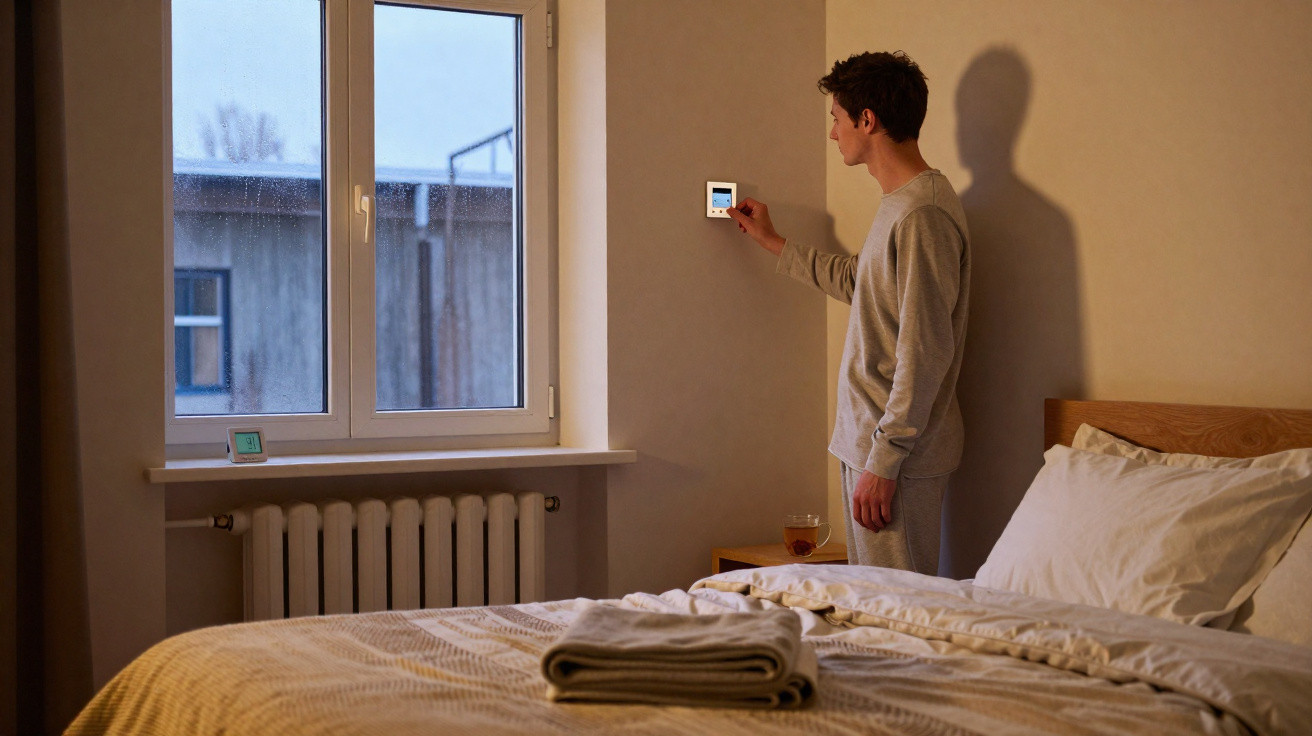
Energy professionals warn, however, that it is not quite that simple.
The heating season is drawing to a close, days are becoming milder, and the same question is arising in many homes: should you switch the heating off completely at night to save money? While this may sound logical at first, a closer look reveals that it is considerably more complicated. Whether it genuinely pays off depends heavily on the building, the equipment in the boiler room and even where you live.
Why switching the heating off completely often backfires
Heating accounts for an average of between 60 and 75 per cent of a household’s total energy use. It is therefore an obvious area in which meaningful savings can be made. A commonly cited rule of thumb is that reducing the room temperature by just one degree cuts heating costs by around seven per cent on average.
This is precisely where a widespread misconception begins: if one degree less saves so much, then switching the heating “completely off” overnight must be even better. Yet in many homes, the opposite happens.
In poorly insulated properties, heat escapes particularly quickly overnight. The walls, floors and furniture cool down completely. In the morning, you not only wake up feeling cold: the heating system also has to work hard to bring rooms back up to a comfortable temperature.
“Where insulation is poor, the heating system often uses more energy when warming up in the morning than was saved overnight.”
This effect is especially pronounced with heating systems that respond slowly, such as:
- gas heating systems with conventional radiators
- oil heating systems with a large boiler
- older central-heating systems without modern controls
These systems generally operate most efficiently when they continue heating at a slightly reduced level rather than having to compensate for major temperature changes. Repeated switching on and off creates extra work and raises consumption.
Turn it down rather than off: the professionals’ preferred approach
In the vast majority of cases, specialists therefore advise reducing the temperature overnight in a targeted way rather than turning the heating down to zero. For living rooms, around 19 to 20 degrees during the day is considered a sensible balance between comfort and cost. At night, less is sufficient.
“The recommendation from many energy advisers: around 16 to 17 degrees in bedrooms at night, and one to two degrees below the daytime setting in the rest of the home.”
This offers several benefits at once:
- The heating system avoids extreme output peaks when restarting in the morning.
- Walls and furniture do not cool completely, allowing rooms to warm up again more quickly.
- Temperatures remain more stable overall, making the indoor climate feel more pleasant.
- The risk of damp and mould in cool corners is reduced.
Many modern thermostats and heating controllers include a dedicated night programme. For example, you can set the target temperature to fall automatically by two to three degrees from 10 pm, then rise again at around 5 or 6 am, depending on when you get up.
The real role of insulation
How far you should turn down the heating overnight is directly linked to thermal insulation. The better insulated a home is, the more slowly it loses heat - and the more confidently you can lower the temperature.
| Building type | Recommended overnight strategy |
|---|---|
| Unrenovated older property | reduce only slightly, usually 1–2 degrees below the daytime temperature |
| Partly renovated older property | a reduction of 2–3 degrees is sensible; keep an eye on humidity |
| Well-insulated home / new build | a greater reduction is possible, and temporary switch-off may also be appropriate |
In a very well-insulated new-build home with underfloor heating, the air temperature barely drops over eight hours. In this case, it can make sense to reduce the flow temperature substantially or even switch the heating off for a few hours. The heat stored in the screed lasts for a long time.
The situation is different in an unrenovated older property with draughty windows: temperatures there fall quickly and significantly. Anyone who switches the heating off completely overnight risks cold, damp walls and a system running at full output in the morning.
Heating type: heat pumps work differently from gas and oil
The building is not the only deciding factor; the technology also matters. Different heating systems react very differently to overnight temperature reduction.
Gas and oil heating systems
These established systems are particularly efficient when they run relatively consistently. Sharp temperature reductions and frequent restarts can quickly lead to higher consumption. Specialists therefore usually recommend only a moderate overnight reduction for them.
Heat pumps
Heat pumps respond slowly because they are often paired with underfloor heating. Large differences between daytime and night-time temperatures are also unfavourable here. The system then needs high flow temperatures, which significantly reduces efficiency. A highly consistent operating pattern with only a slight reduction overnight is better.
Electric heating and storage heaters
Anyone heating with electricity should examine carefully how their tariff works. With traditional storage heaters, charging to a certain extent overnight can be worthwhile if the tariff is cheaper. Direct electric heaters, by contrast, can quickly push costs up if they have to reheat everything at full power in the morning.
When can the heating be switched off completely in spring?
The big question of whether to switch it off comes around every spring. There is no fixed date, but a broad guideline can be given: many households turn their heating off completely from around mid-April, once daytime highs settle at roughly 18 to 20 degrees and nights become milder.
Where you live also has a role to play:
- In generally warmer areas, heating can often remain off earlier.
- At higher elevations and in the cooler north, cold nights remain an issue for longer.
- People who are particularly sensitive to cold may need heating support for a little longer.
Checking the weather app can help here: if night-time temperatures consistently remain in double figures and the home no longer cools down sharply, there is much to be said for switching the system off - then briefly turning it back on if there is a sudden cold spell.
Practical overnight tips without sacrificing comfort
If you want to reduce heating costs without waking up cold, several simple adjustments can help:
- Set bedroom thermostats to 16–17 degrees.
- Close shutters and curtains at night to reduce heat loss through windows.
- Air rooms briefly before bed, then close the windows again.
- Do not place furniture directly in front of radiators or thermostats, so that the controls can work properly.
- In blocks of flats, maintain an even background level of warmth - completely cold flats can develop damp problems.
Those using programmable thermostats or a smart-home system can test fine adjustments, such as changing the overnight reduction in half-hour increments and observing how much the home actually cools down.
Why damp and mould become an issue when temperatures are reduced too much
Cold air holds less moisture. When walls and corners cool down significantly, humidity settles there more quickly. If the heating is switched off completely overnight on a regular basis, the risk of condensation and, later, mould growth increases - especially behind cupboards, on external walls or in poorly ventilated rooms.
A moderate overnight temperature reduction helps limit this risk because walls do not cool down completely. Regular short bursts of ventilation during the day and humidity that is not too high - ideally around 40 to 60 per cent - complete the protection.
A conclusion without clichés: less is more - but not zero
Anyone seeking to cut heating costs will do considerably better with a sensible overnight temperature reduction than with radical switch-off. In many cases, the combination of a slightly lower temperature, good insulation and properly adjusted thermostats is what genuinely saves money in the end - while still keeping the home comfortable.




Comments
No comments yet. Be the first to comment!
Leave a Comment