
You open the refrigerator on an ordinary weekday, ready to put together a quick lunch.
Inside, a slightly wilted tomato seems to stare back at you, the cheese no longer smells quite right, and the container of leftovers from Sunday dinner has become a chilled mystery. It is a familiar scene: food quietly spoiling while grocery prices rise and we promise ourselves we will “get more organised next time”. The refrigerator door becomes a kind of modern confessional, covered in takeaway-menu magnets, electricity bills and a mental reminder: stop throwing food away. You close it, then open it again, trying to find some logic in that cold chaos. Some people blame the appliance. Others blame a lack of time. Yet there is one detail that hardly anyone properly considers.
Why your refrigerator makes food “age” faster
Organising a refrigerator is not simply about making it look tidy. It is about extending the life of your food. Every shelf has its own microclimate, temperature range and ideal purpose. Yet most people put things wherever there is room, in a genuine game of improvised Tetris. The outcome is visible in frost-damaged leaves, yoghurts forgotten at the back and fruit that never makes it into a recipe. The refrigerator may work perfectly well, but the way we fill its space quietly undermines it.
A UN survey shows that Brazil wastes millions of tonnes of food each year, much of it in the home. It is not only down to impulse purchases at the supermarket. There is also the container of beans that keeps being left behind, the tray of meat that freezes at the back of a shelf, and the salad saved “for tomorrow” that no one remembers to eat. A nutritionist told me that, in some of the families she worked with, reorganising the refrigerator cut the amount of fresh food discarded at the end of the month by almost half. There was no magic formula involved, only a change in habits and a little attention to the cold.
There is physical logic behind this kitchen drama. Cold air falls and warm air rises. In most refrigerators, the coldest areas are the top shelf and the back wall. Contrary to what many people assume, the door is the least stable area, experiencing sharp temperature changes every time the appliance is opened. By keeping milk, eggs and delicate leftovers in the door, we expose the most fragile foods to the daily opening and closing. Storing food correctly is not fussy kitchen-influencer behaviour; it is a direct response to the way air currents work inside the appliance, out of sight.
The invisible map of the ideal refrigerator
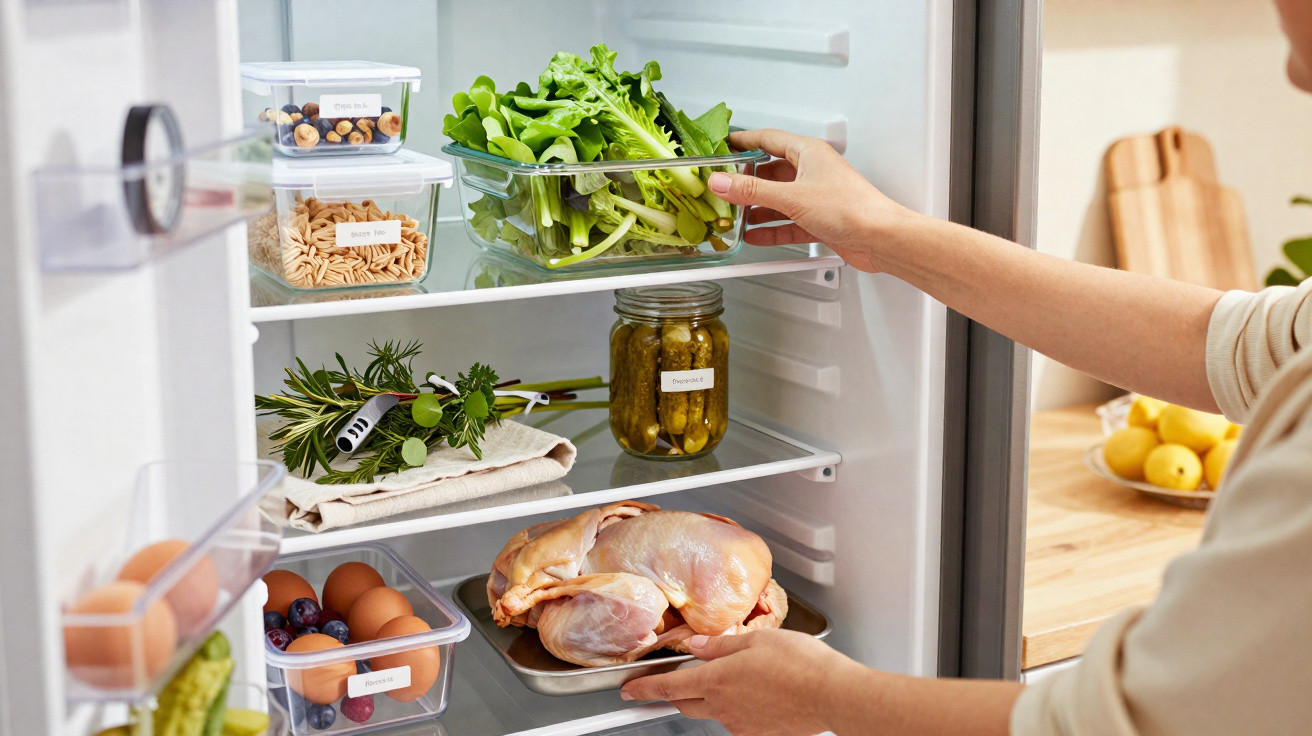
One straightforward rule can change everything: see your refrigerator as a map of zones. The upper shelf, where the cold is more consistent, is for foods ready to eat soon, such as cooked leftovers, yoghurt and sliced cold meats. The middle section, with its stable temperature, suits ingredients that will soon become a meal: milk, cheese, eggs and butter. The bottom shelf is the place for raw meat, always kept in sealed containers and preferably placed on a tray to catch any liquid. This prevents contamination of food stored above it.
The drawers are generally designed for fruit and vegetables. When they are overfilled, air cannot circulate properly and leafy greens deteriorate faster. When they are empty, they create a false sense of scarcity and encourage us to buy more than we need. A couple in São Paulo tried using one drawer exclusively for washed leaves and another only for whole vegetables for two weeks. The result was that they started making salad almost every day, simply because the preparation was already halfway done. The food you see first is the food you eat first. Forgetfulness lives in the shadows at the back of the refrigerator.
There is a useful trick that hardly anyone teaches: the door shelf is not the place for milk. Temperature fluctuations there can shorten the drink’s shelf life by several days. The door is best reserved for condiments: sauces, mustard, ketchup, jams, preserves, water and ready-made juices. Dairy drinks and eggs are better kept on an internal shelf, where the temperature does not swing like a rollercoaster. Let us be honest: nobody gets this right every day, but simply moving a few items can make people notice that yoghurt does not “go sour” as quickly and that butter keeps a more consistent texture.
Small routines that save food and money
A simple routine before putting away the shopping makes a real difference. Remove food from bulky supermarket packaging, discard polystyrene trays, and dry excess moisture from leaves and vegetables. Use transparent containers, even if they are reused glass jars, and sort foods by type: one container for cheese, another for cut fruit and another just for leftovers. When you can quickly see and understand what is there, you are far less likely to forget something. It is almost like turning the refrigerator into a private display of upcoming meals.
A common mistake is washing everything as soon as it comes home from the supermarket and storing it while still slightly damp. Wet leaves spoil sooner, delicate fruit develops dark patches and vegetables begin to soften. It is better to separate the approach: some foods, such as grapes and strawberries, can be washed shortly before eating. Lettuce and rocket, on the other hand, last longer when washed, thoroughly dried and stored in containers lined with kitchen paper. Nobody is born knowing this. Everyone learns after throwing away an entire bunch of dark, slimy leaves, with that small sting of guilt.
“Organising the refrigerator is not a cleaning obsession; it is a quiet way of looking after your routine and your budget,” said a homemaker who agreed to photograph her own refrigerator week by week for a zero-waste project.
- Add simple date labels to containers of leftovers: seeing the date creates a healthy sense of urgency.
- Create a “use now” box: a basket or tray for anything that needs eating within 1–2 days.
- Keep the most delicate foods at eye level, never hidden behind bottles.
- Follow the basic rule: what arrived first goes at the front, while newer items go behind.
- Set aside 5 minutes on Sunday evening for a light clean and a quick reorganisation of the shelves.
When the refrigerator reflects your routine
Ultimately, organising the refrigerator is less about appearance and more about being honest about your own pace of life. Someone living alone may not need three drawers full of vegetables. Families with young children may benefit from an easy-to-reach shelf dedicated to healthy snacks. The secret is not to copy the perfect refrigerator from a social-media video, but to adapt the space to what is genuinely cooked, the household timetable and the home’s real energy levels. When that alignment happens, food lasts longer because it stops being background scenery and becomes the star of a meal at the right moment.
| Key point | Detail | Value for the reader |
|---|---|---|
| Refrigerator zones | Each shelf and drawer has a specific temperature and purpose | Helps position each food more effectively and extend its shelf life |
| Visibility | Use of transparent containers, labels and a “use now” box | Reduces forgotten leftovers and fresh ingredients |
| Quick routines | 5 minutes each week to check dates, clean and reorganise | Cuts waste and saves money without demanding much effort |
FAQ:
- Question 1 Can I keep any food in the refrigerator door? It is best to avoid delicate items such as milk, eggs and ready-made leftovers. The door is subject to frequent temperature changes, so use it for sauces, preserves, jams and drinks that cope better with fluctuations.
- Question 2 Do I need to wash all fruit and vegetables before storing them? Not always. Leafy greens can be washed, dried thoroughly and stored in containers with kitchen paper. More delicate fruit, such as strawberries and grapes, lasts longer when washed close to the time it is eaten.
- Question 3 How long can food leftovers stay in the refrigerator? Generally, 3 to 4 days in sealed containers. Use dated labels and keep these containers on the top shelf or in the “use now” box, so that you remember to eat them.
- Question 4 Is it worth using specific organisers and baskets? Yes, provided they suit your space and routine. Even simple baskets help create visual categories and make it easier to clean or pull everything out at once.
- Question 5 My refrigerator is small; can I still organise it this way? You can, perhaps with a little more creativity. Focus on turnover: keep less stock and shop more often in smaller amounts. Group items by type, use stackable containers and retain only what will genuinely be used over the coming days.


Comments
No comments yet. Be the first to comment!
Leave a Comment