
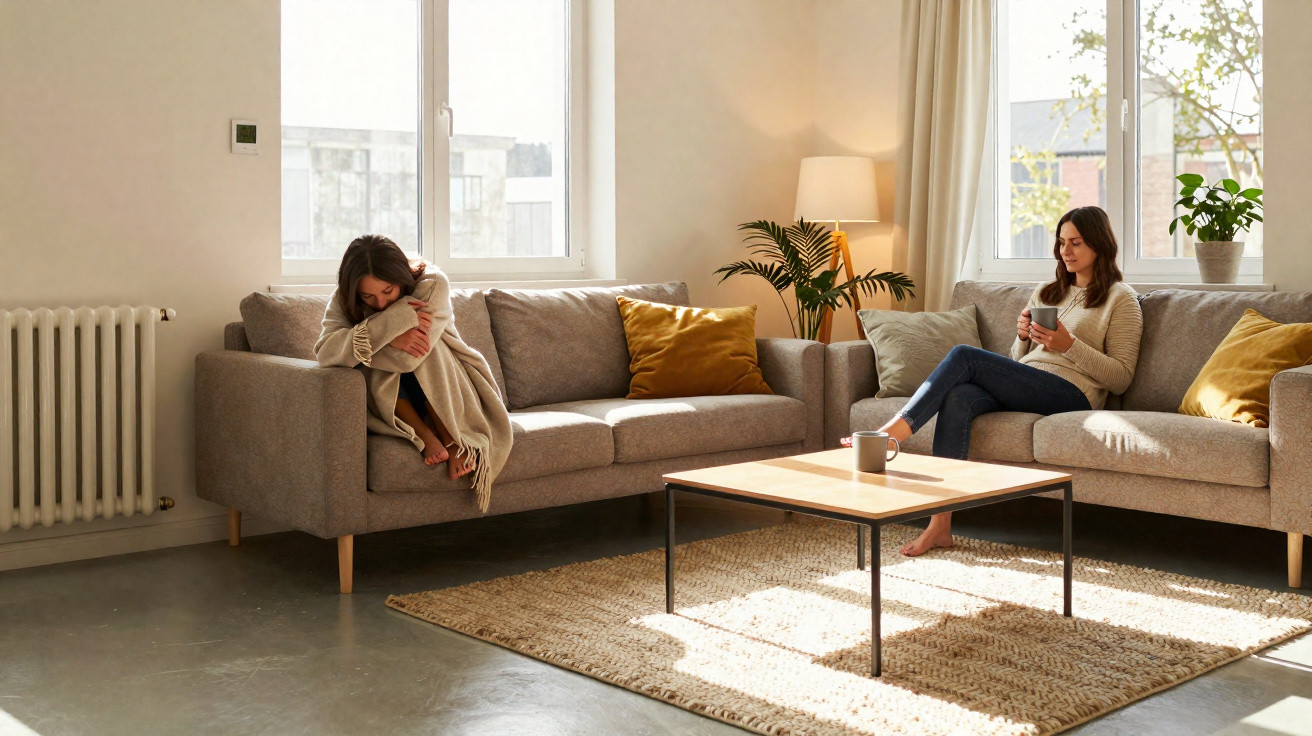
You know that mildly infuriating moment when a friend says, “But the thermostat says 21, it’s warm,” while your body emphatically disagrees? You are sat there with your sleeves over your hands, wondering whether you are somehow the odd one out. Then you step into the kitchen - same home, same thermostat setting - and suddenly feel comfortable. No shivering. No temptation to borrow somebody’s blanket. Just... normal. The sort of normal that makes you doubt your own internal thermometer.
We tend to describe warmth as though it were a simple figure: one tidy number glowing orange from a wall display. But how a room feels is far less orderly and far more personal. It depends on where you are seated, what is in front of you, how air travels through the space and how your mind reads the room before your skin has fully registered it. On paper, two rooms can look identical yet feel entirely different in real life. Once you spot this, it becomes impossible not to notice it.
The living room that feels colder, even when it is not
There is a certain sort of British living room that appears built to mislead the body. The thermostat confidently reports a perfectly decent 20 or 21 degrees and the radiators are running, but the second you settle on the sofa, there is a persistent little chill. It is not severe; it is simply the low-grade unease that has you folding your feet beneath you and looking towards the nearest throw. Your partner claims to be warm, and you begin to wonder whether you are coming down with something.
Now consider a different room in that very same house. The reading is identical, as are the boiler and the weather outdoors. You sit at the dining table or lean on a kitchen counter, and everything feels absolutely fine. In some houses, the rear bedroom is always snug, whereas the front room overlooking the road resembles a chilly waiting area. Separate rooms, one thermostat figure. Most of us have had the realisation that the displayed number is not the whole picture.
Some of this comes down to straightforward physics: glazing, walls and insulation all matter. Yet those are rarely the first things we consciously register. What we notice most is the room’s arrangement: our position relative to cold glass, whether the sofa interrupts the path of heated air, and whether we happen to be in a calm pocket or an unnoticed draught channel. Your body responds to the microclimate right where you are, rather than to the room’s average temperature.
Why your body ignores the thermostat reading
We like to see ourselves as rational. If the thermostat reads 21 degrees, surely we ought to feel “warm enough”. The human body, however, is unapologetically local. It does not survey the whole room; it responds to what is occurring against your skin at that precise moment and in that exact position. If a faint draught catches your ankles or a cold wall is behind your back, that is the information your brain prioritises - not the thermostat positioned in the hallway.
The warmth you perceive often relates less to the air itself than to the surfaces around you that radiate heat or cold. Sit beside a large, cold pane of glass and your body is effectively “looking at the sky”, losing heat invisibly. Sit by an internal wall or near a warm radiator cover, and you can suddenly feel enclosed and supported. A wall-mounted thermometer cannot detect that contrast. Your skin can do so in seconds.
Air movement exerts a similarly quiet effect. A room may be 21 degrees, but a barely noticeable current passing over your neck from an ill-sealed window or beneath a door can make it feel colder than a completely still room at 19. The number remains unchanged, but your experience does not. Your body trusts the air it can feel, rather than the digits displayed across the room.
How living room layout shapes warmth
This is where the layout becomes the real lead character. Picture two otherwise identical rooms, equally heated and insulated. In one, the sofa sits beneath the window, with your back towards it. In the other, the sofa faces the window and your back is against an internal wall. The boiler, radiators and outdoor conditions are all the same. Still, you would be convinced that the first room is colder.
With your back to a window, you are closer to the coldest surface in the space. Heat escapes through the glass, and your back becomes part of that exchange. You may not notice a “draught” in the obvious, curtain-flapping sense, but the small temperature difference behind you is enough for your whole body to interpret the situation as uncomfortable. Turn the room around and your back has protection. The cold remains, but it is no longer attached to you personally.
The sofa versus radiator stand-off
There is also a familiar British habit of placing furniture in front of a radiator. A substantial sofa ends up parked directly against it because that is the only place for the television and the cable does not reach any further. Technically, the room does heat up, but much of that warmth embraces the sofa’s back instead of the people sitting on it. Air heated above the radiator strikes the furniture and struggles to circulate around the room properly.
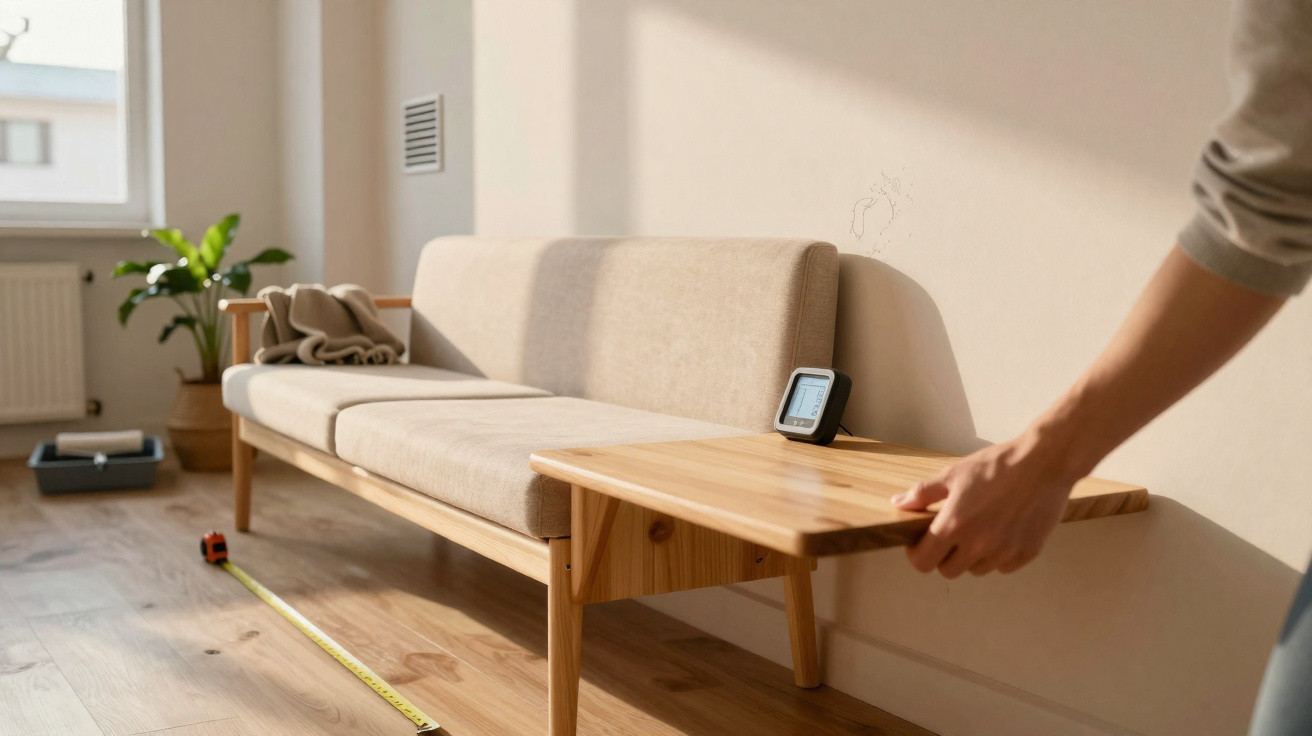
Move the sofa just 20 or 30 centimetres forward, or create a little room for heat to emerge and travel, and the entire space may begin to feel different. Choose a low shelf rather than a deep cabinet, and warm air can pass over it instead of fading away behind it. It is not the most glamorous piece of interiors advice, but the placement of one piece of furniture can change how warm the entire room feels. Your boiler cannot tell the difference. Your body certainly can.
Cold corners and warm nests
Every room has its own character, and particular corners are plainly more appealing than others. You may not describe it in those terms, but you will recognise the sensation: one chair is a favourite, while another gets avoided, despite being only a few metres away. Perhaps one sits close to the door and slightly within the route of moving air. Perhaps another is beneath a window that has never sealed properly. Without necessarily noticing, we create mental maps of the home’s “safe” places and its cold ones.
Especially in compact homes and rented properties, our instinct is to push every item against the walls. It seems logical: it frees up the centre of the room and keeps things out of the way. Yet it can leave us sitting right beside the coldest surfaces. Anyone who has slept in a bed pressed against an external wall during winter will recognise that gradual cold seeping through the plaster. Even moving the bed or sofa a hand’s width from the wall can produce a surprisingly noticeable change.
The psychology behind a corner
There is another dimension here: temperature is not just felt through the skin; we also sense “safety” and interpret it as comfort. Being seated in a corner, able to see the door and supported by a solid wall, often feels more restful than having your back open to the room. That sense of calm affects how we make sense of physical feeling. A slightly cool room can be perfectly pleasant when the layout makes us feel protected. A room at an ideal temperature may feel wrong when its furniture arrangement leaves us exposed or uneasy.
Consider seating in cafés. The window table photographs beautifully for Instagram, but many people instinctively choose the booth further inside, where their back is against a wall. They remain longer, order another drink and remove their scarf. Warmth is more than a reading; it is also posture and the feeling of being nestled into a room rather than lingering awkwardly at its edges.
Sunlight, sightlines and your brain’s trick
There is a subtle psychological factor at work too. A room that receives sunlight, even for only an hour, is likely to be considered “warmer” in our minds. The temperature may fall rapidly once the sun has gone, yet the impression stays with us. A bright south-facing room with uncluttered lines and an open outlook can seem warmer at 19 degrees than a north-facing room filled with tall furniture and heavy dark curtains at 21.
Your brain processes colour, light and space before your body fully takes in the air. Light-coloured walls, lower furnishings and uninterrupted sightlines can make a room seem more spacious and at ease, qualities we commonly read as “more comfortable”. Dark, cluttered or cramped arrangements may heighten a feeling of either stuffiness or cold, depending on the time of year. You are reacting not only to the air surrounding you, but also to the message the room gives about itself.
Realistically, few people rearrange their entire home simply because they feel slightly chilly. We put on a jumper, reach for an extra blanket and complain about the gas bill. Yet over winter, that small sense of “I’m never quite comfortable in here” can build up. At times, it is not the boiler setting that needs changing but the arrangement of the room around the places where our bodies actually sit and rest.
What people quietly do in winter that designers rarely mention
Watch how people actually inhabit their homes rather than how homes appear in photographs, and small winter migrations become clear. Families gradually stop using the formal sitting room and congregate around the kitchen table instead. Teenagers haul duvets to whichever spot has the warmest radiator. Pets unquestionably identify the best warm places, claiming them ruthlessly while we act as though we are above such instincts.
Those movements offer live feedback on a room’s layout. The armchair by the bay window that nobody uses in January is your body casting a vote with its feet. When everyone gathers at one end of the sofa to avoid a minor draught, that is another unspoken judgement. We might not discuss it directly, but our routines constantly reveal which areas of the house feel inviting and which do not.
One modest practical option is to set up a different “winter layout” from your “summer layout”. The armchair might shift slightly further from the window when the clocks change. The dining table could turn so that chairs no longer sit directly in a draughty doorway’s path. This need not involve a complete redesign; small adjustments can take a room from merely tolerable to truly cosy.
Listening to what your body has been saying
It can be unexpectedly reassuring to realise that you are not “being fussy” when a room feels cold at an entirely ordinary temperature. Your body is sensing details that the thermostat does not record: cold glass radiating nearby, tiny currents of air and the space between your skin and the closest warm surface. Those signals are easy to dismiss because they can sound subjective or overdramatic. Often, though, they are accurate.
The next time you enter a room and immediately think, “Nope, too cold,” pause before blaming the boiler. Where are the windows? How are you positioned in relation to them? Is your back against an external wall? Is the radiator concealed by a bulky sofa or thick curtains? Such small details generally account for more than you might expect.
Two rooms may have the same temperature, but only one may feel like home. It is not because one has the superior boiler, but because one has quietly worked out how to care for the bodies living there. Warmth lives in the layout, not just in the heating - and once you begin to see that, you may be able to make your surroundings feel warmer without adjusting the thermostat at all.




Comments
No comments yet. Be the first to comment!
Leave a Comment