
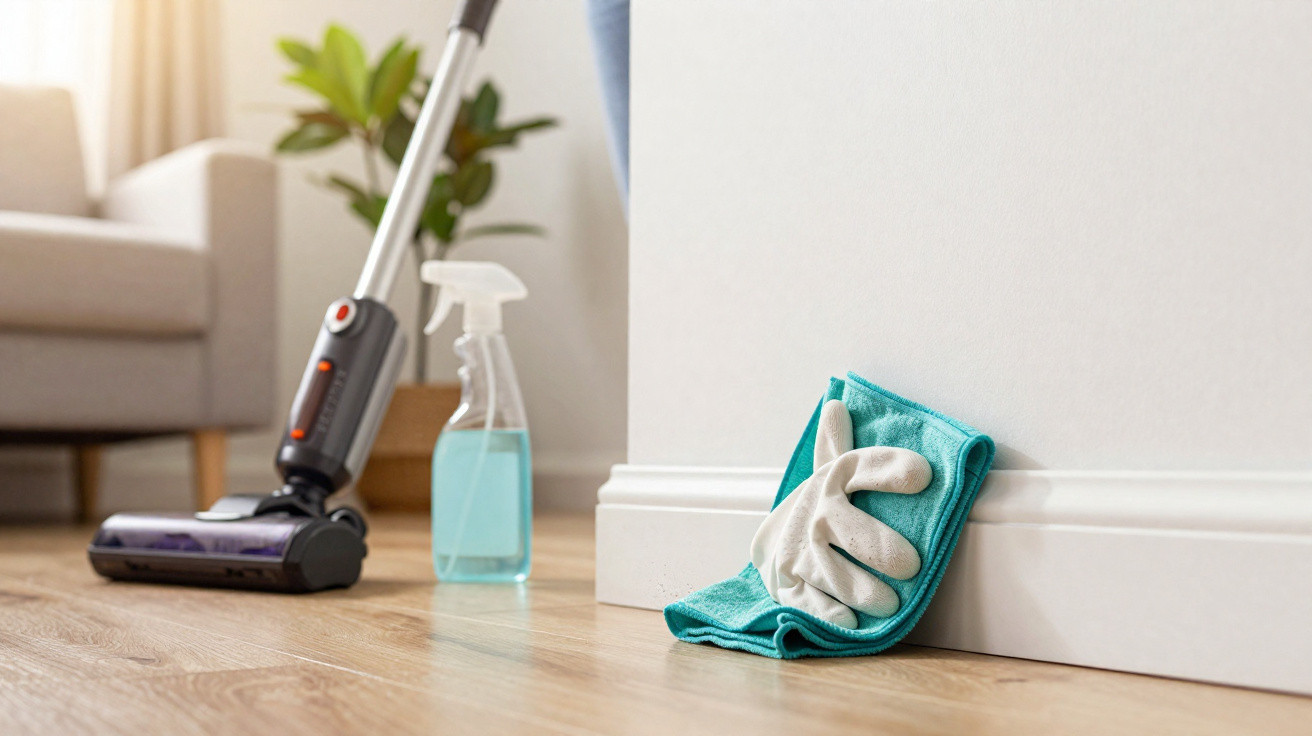
You tend to spot it on an ordinary Tuesday, often while searching for something completely different. Sunlight falls across the hallway at an odd angle and, suddenly, the skirting boards you painted last spring seem to have aged by a decade. A soft grey stripe sits along their top edge, while little dust bunnies gather in the corners as though they belong there.
You crouch down, run a finger over the surface and regret it immediately.
The cloth you reach for fails to pick up every bit. A vacuum cleaner wand feels awkward to manoeuvre. Then a small question starts nagging away in the back of your mind: is there any way to stop it returning quite so quickly?
The brief answer is that you cannot prevent dust altogether. You can, however, stop it settling in on your skirting boards.
Why skirting boards collect dust so quickly
Take a slow walk around your home one afternoon and view the walls from the side. Skirting boards work like miniature shelves. Whenever you move about, open a door or walk along a corridor, you shift air - and the dust travelling in it - straight on to those narrow ledges.
They are low down, horizontal and rarely high on the cleaning-day list: a perfect storm.
What collects there is not merely “dirt”, either. It includes clothing fibres, pet hair, skin cells and tiny particles brought in from outdoors. Anything floating through the air has to settle somewhere, and skirting boards are where it quietly chooses to remain.
One reader said she only noticed her “baseboard situation” after moving the sofa before guests arrived. Six months of fluff, hair and grey film ran along the wall like a record of procrastination.
She spent twenty minutes tackling that single wall, scrubbing it with an old T-shirt and muttering to herself. Two weeks later, she passed by and saw the dust line beginning to form again. That is the point at which people either surrender or start looking for a more sensible approach.
We have all had that moment: the sigh followed by the thought, “Didn’t I just clean this?”
Static is one reason dust on skirting boards can be so persistent. Dry, painted surfaces draw in particles like a faint magnet. Whenever the heating or air conditioning comes on, air circulates close to the floor and dust is drawn right back towards the trim.
Texture is the other factor. Slightly coarse paintwork, chips and brush marks give dust more places to cling to. Smooth surfaces that have been lightly conditioned do not hold nearly as much.
This is why people who simply wipe and move on often feel that the dust has returned overnight. Cleaning is not pointless - it just misses the step that alters how the skirting board behaves during the following days.
Methods that keep dust off skirting boards for longer
Begin with a gentle reset. Before trying to prevent dust, clear away the layers already present. For this, a vacuum cleaner with a soft brush attachment, moved along the top and face of the skirting board, is ideal.
Work slowly, particularly around corners and doorways, where the build-up tends to be heaviest. Afterwards, wipe everything with a damp microfibre cloth and warm water containing a drop of washing-up liquid. Nothing elaborate is needed.
When the skirting boards are clean and dry, the useful part begins.
The step that makes the real difference is creating a “shield”. It is not plastic or a special gadget, but a thin, invisible layer that encourages dust to slide away rather than stick. Many people run a tumble dryer sheet along the fully dried skirting board. Its soft coating reduces static, and leaves a fresh-laundry scent for a day or two.
Others rely on a very small amount of diluted fabric conditioner or wood polish on a cloth, buffed on with a very light touch. The aim is a smooth finish, never a greasy one. Grease is simply a dust magnet in disguise.
Let us be realistic: hardly anyone does this every day. The aim is to do it once a month, quietly folding it into a task you already carry out.
What catches most people out is attempting to “deep clean” every skirting board in the home during one heroic weekend. That is how you end up with aching knees, rooms left half-finished and a private promise never to attempt it again.
Think in zones instead. Do one hallway today, then the living room next Saturday. Link the job to something obvious, such as changing the bed linen or vacuuming beneath the sofa. Small, almost unremarkable repetitions are more effective than one huge burst of motivation every time.
“The only cleaning routine that works is the one you can still face on a bad day,” said a professional organizer I spoke to, who sees a lot of dusty baseboards in beautiful homes.
- Use the vacuum brush before a dry cloth, so you lift the dust rather than spread it around.
- Rub over the paint with a tumble dryer sheet or a lightly conditioned cloth to reduce static.
- Tackle zones across a month instead of in one tiring session.
- Seal chipped or rough skirting boards with touch-up paint to give dust less to grip.
- Reduce dust throughout the home: clean filters, shake rugs outdoors and groom pets regularly.
Living with dust without letting it win
There is a quiet relief in accepting that dust will always be part of a home. Once you stop pursuing the idea of perfectly white skirting boards 24/7, it becomes easier to establish a rhythm that keeps them “good enough” most of the time. Most visitors do not notice your trim; they notice when a room feels cared for.
What truly stops dust from settling on your skirting boards is not a single miracle product, but a collection of small, barely noticeable habits. Use a soft vacuum pass near the floor once a week. Give the boards a quick wipe with a treated cloth when you are already down there plugging in a charger. Touch up chipped paint when you notice it, rather than waiting until “someday”.
You do not need an immaculate home to feel in control; you only need a few areas that remain quietly manageable. Skirting boards are one of those overlooked, low-level details that influence the feel of a room.
Next time the light lands across the hallway in just the right way, you may still notice some dust - but perhaps you will notice something else as well: evidence that your home is lived in, cared for and always moving.
| Key point | Detail | Value for the reader |
|---|---|---|
| Control static on skirting boards | Use tumble dryer sheets or light conditioner on clean, dry trim | Dust clings less and is easier to wipe away between cleans |
| Clean in a sensible sequence | Vacuum first, then use damp microfibre with mild soap | Removes build-up without scratching paint or spreading dust |
| Move to zone-based routines | Divide skirting boards by area and rotate weekly or monthly | Makes upkeep realistic, quick and less overwhelming |
FAQ:
- Question 1 How often should I clean my skirting boards to keep dust away?
- Answer 1 For most homes, a light pass every two to four weeks is enough, especially if you are managing dust elsewhere through filters, rugs and pets. Busy hallways and entrance areas may need a quick wipe more often.
- Question 2 Are tumble dryer sheets safe to use on painted skirting boards?
- Answer 2 Yes, when used gently. Test one in a concealed corner first. Do not scrub vigorously, and avoid using them on delicate specialist finishes or very fresh paint that is less than a few weeks old.
- Question 3 What is the best tool for very dusty, neglected skirting boards?
- Answer 3 Use a vacuum cleaner with a soft brush head, followed by a slightly damp microfibre cloth. For thick build-up, vacuum first, then wipe with a cloth and mild soapy water in short sections.
- Question 4 Can I use furniture polish to repel dust on skirting boards?
- Answer 4 You can apply a very small amount to wood or older oil-based paint, putting it on a cloth rather than spraying it directly. Excess polish leaves a residue that attracts extra dust and may look streaky.
- Question 5 Will repainting my skirting boards help with dust?
- Answer 5 Fresh, smoother paint can help, particularly if the existing finish is chipped or rough. A semi-gloss or satin finish is generally easier to wipe and less likely to hold dust than flat paint.





Comments
Смотрите так же разделы:
Ответы на часто задаваемые вопросы:
Если у Вашей организации присутствует необходимость в максимально оперативном и качественном проведении калибровки средств измерений, то оптимальным вариантом решения вопроса станет обращение в компанию «Алира», метрологическая служба которой имеет государственную аккредитацию на осуществление такого вида работ https://analyztepla.ru/katalog-geodezicheskogo-i-navigatcionnogo-oborudovaniya/trassoiskateli/trassoiskateli-texno-as/kabeletrassoiskatel-s-czvetnyim-ekranom-atlet-ag-319cz
Наличие аккредитации позволяет лаборатории проводить проверку точности приборов, использовать разрешенные методы поверки и калибровки средств измерений, выдавать официальные документы https://analyztepla.ru/katalog-izmeritelnykh-priborov/teplovizory/teplovizoryi-trotec/
Без аккредитации сертификат о проведенной процедуре не будет действительным http://analyztepla.ru/katalog-izmeritelnykh-priborov/teplovizory/testo/testo-890-2-komplekt
Методики калибровки https://analyztepla.ru/katalog-izmeritelnykh-priborov/gazoanalizatory/sensory-dlya-gazoanalizatorov/sensory-kisloroda-o2/sensor-kisloroda-ssn-gec-o2
Успешное проведение процедуры калибровки средств измерений удостоверяется специальным калибровочным знаком – отметкой, наносимой непосредственно на тестируемое оснащение https://analyztepla.ru/katalog-izmeritelnykh-priborov/gazoanalizatory/msn/statcionarnye-datchiki-gazoanalizatory-47k/datchik-s47k-prp-nerzhaveyuschaya-stal-316-m25x1-5-3-3-2-2
Полученные результаты также фиксируются в эксплуатационной документации, а предприятия, владеющие прошедшим калибровку измерительным инструментом и оборудованием, получают в качестве подтверждения завершения процедуры свидетельство о калибровке (метрологический сертификат).
размножения пробиотиков, тем самым стимулируют рост здоровой микробиоты
Сохранив традиционную форму лекарства – гранулы сферической формы –технологи БУАРОН довели до совершенства ее качество https://пик-крым.рф/vrachi-gomeopaty/
Полный цикл производства гранулы составляет 16 дней: за это время сахароза и лактоза в соотношении 85/15% формируют идеальную по пористости нейтральную основу https://пик-крым.рф/product/shershneva-proczessy/
Если с продуктаит все понятно, тогда давайте рассмотрим лекарственные
Галактоолигосахариды;
Олигосахариды грудного молока;
Поликомпонентные, комбинированные и сорбированные препараты: Бифиформ-содержит бифидобактерии (B https://пик-крым.рф/product/acetonum/
bifidum) и энтерококки (S https://пик-крым.рф/product/kreatininum/
faecalis).Бификол-содержит бифидобактерии и эшерихии (B https://пик-крым.рф/product/caladium-seguinum/
bifidum,E https://пик-крым.рф/product-category/mono/c/ch/
соli М-17).
деталей промышленного оборудования
Дополнительно мы предлагаем услуги литья под давлением для серийного производства металлических деталей https://korpus.ru/
Данная технология позволяет изготавливать прочные и долговечные изделия с высокой скоростью производства и стабильными характеристиками https://korpus.ru/
На рабочие поверхности пресс-форм при подготовке и в ходе литья наносят слой смазки, которая предназначена для облегчения извлечения готовых отливок, а также (частично) для предохранения рабочих поверхностей формы от повреждения термическим ударом https://korpus.ru/
Благодаря применению специальных смазочных материалов существенно повышается качество поверхности готовых изделий https://korpus.ru/
Отливки, создаваемые литьем под давлением, имеют приливы для толкателей https://korpus.ru/politika_confid_npo_tehnolit
Чтобы предотвратить деформирование и проколы в тонких стенках под действием выталкивателей, приливы располагают на стороне подвижных частей пресс-форм https://korpus.ru/
компонентов приборостроения
Современное оборудование, контроль качества на всех этапах производства и большой опыт специалистов позволяют изготавливать литейную продукцию с высокой точностью и стабильными характеристиками https://korpus.ru/politika_confid_npo_tehnolit
Мы подбираем оптимальную технологию производства в зависимости от назначения детали, условий эксплуатации и требований заказчика https://korpus.ru/politika_confid_npo_tehnolit
Leave a Comment