
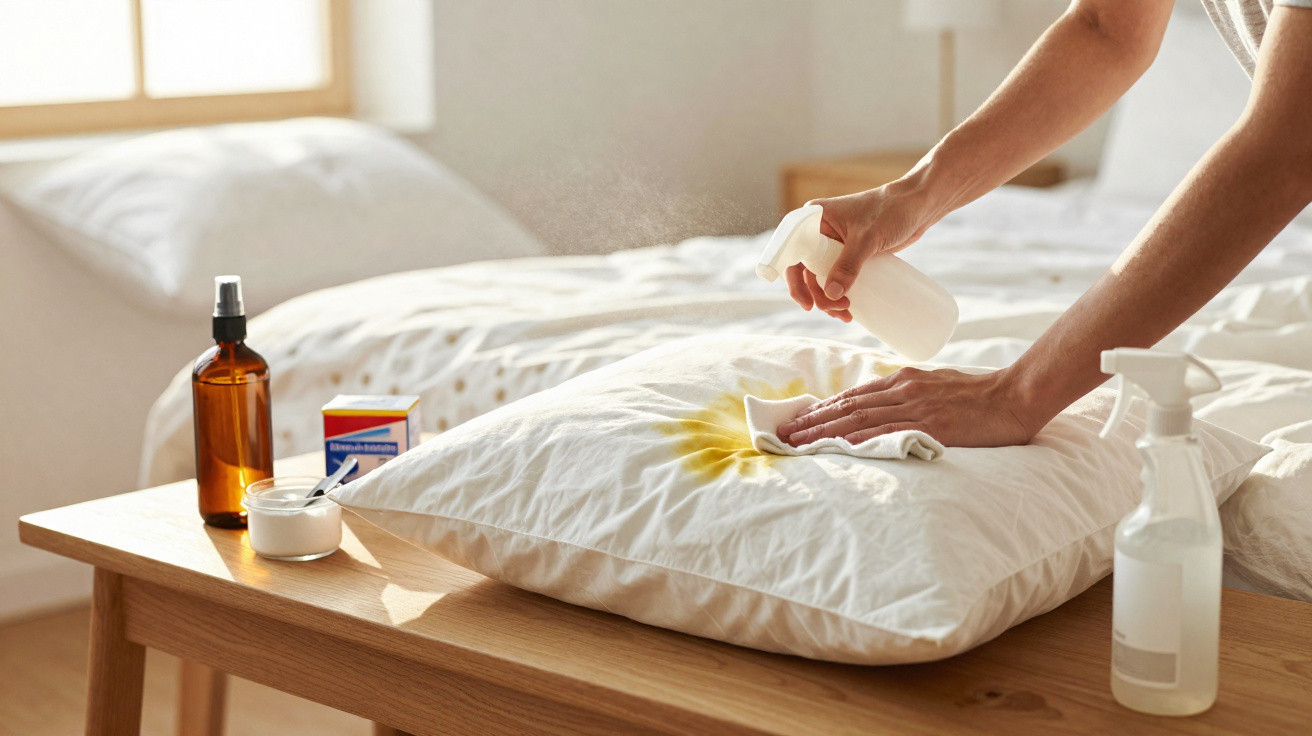
In France and elsewhere, pillows can turn yellow over successive nights because of moisture, perspiration and built-up residues.
Published on 25 May 2025, the source page, whose media outlet is not named in the excerpt provided, sets out a method using three household products. It is intended to tackle visible pillow marks, which are often unattractive, while noting that these items sit directly against the face.
Why pillows develop yellow stains
A clean pillowcase does not necessarily protect a pillow completely. Over time, moisture can pass through the fabric and reach the filling. Night-time perspiration, saliva, and products used on the face and hair can all contribute to this build-up.
The source also mentions residue left by cosmetics. Night cream, hair oil, incompletely removed make-up and styling products may gradually stain the fabric. Dust collected on the face and hair during the day adds to this soiling.
Yellow rings often develop when moisture and organic residues remain embedded in the pillow fibres for a prolonged period.
These marks do not automatically mean that the pillow can no longer be used. However, they should prompt a check of its overall condition: a lingering smell, flattened filling, weakened seams or an unreadable care label are all signs worth considering.
The three products named by the source
The method described uses detergent, bicarbonate of soda and hydrogen peroxide 30. The page advises mixing the detergent and peroxide with a little water, then applying the liquid to the stained areas before sprinkling on bicarbonate of soda.
- Detergent, intended to lift dirt from the surface;
- Bicarbonate of soda, used here in powder form;
- Hydrogen peroxide 30, an oxidising product described as a bleaching agent.
The publication says to leave the mixture in place for five minutes, then rub gently with a soft-bristled brush. A damp cloth can then be used to remove any visible residue.
An essential precaution when using hydrogen peroxide
Hydrogen peroxide can refer to preparations with very different strengths. In particular, the term “30” may indicate a concentrated product that can irritate or burn the skin and damage certain fabrics. It should not be handled without carefully checking its label, hazard pictograms and instructions for use.
Before trying it, it is best to test the mixture on a small, inconspicuous area. Some pillows contain delicate fibres, dyes, fine ticking or filling that does not tolerate moisture well. A bleaching product may also leave a paler patch or permanently damage the cover.
The five-minute period stated by the source refers to how long the preparation should be left on, not to the full cleaning process or the pillow’s drying time.
How to treat a pillow without soaking the filling
The aim is to deal with the stain without saturating the inside of the pillow. Too much water can make drying difficult, encourage unpleasant odours and cause some fillings to clump together. Use a limited amount of product, therefore, and dab rather than pour heavily.
- Read the care label and check that the pillow can be washed or dampened.
- Remove the pillowcase and protective cover, if they can be taken off.
- Carry out a discreet test with the chosen product.
- Apply the preparation sparingly to the yellowed area.
- Observe the contact time specified by the source: five minutes.
- Rub carefully with a soft brush or clean cloth.
- Remove residue using a lightly dampened cloth, without soaking the pillow.
- Allow it to dry fully before putting the pillow back on the bed.
Incomplete drying is a genuine issue. A pillow that remains damp can develop an unpleasant smell and lose its loft. It should be dried flat, or in line with the manufacturer’s recommendations, in a well-ventilated place. Replacing the pillowcase while it is still damp risks trapping moisture.
Pillow care guidance for France
In France, the care label stitched onto the pillow remains the key reference. It specifies permitted washing methods, the suitable temperature and drying precautions. A pillow filled with feathers, down, memory foam, latex or synthetic fibres will not react in the same way to water and stain-removing products.
Foam and latex pillows often do not tolerate being fully soaked. For these types, very light spot cleaning is generally safer, subject to the manufacturer’s directions. Machine-washable pillows must also be dried all the way through: a dry exterior does not mean the filling is dry.
Preventing yellow rings from returning
Prevention begins with changing the pillowcase regularly. A washable protective cover creates an additional barrier between the face and the filling. Going to bed after removing make-up, and allowing damp hair to dry, can also reduce the transfer of products and water to the pillow.
Very old stains do not always disappear after one treatment. Repeated harsh treatments can weaken the fabric. If the pillow is still stained, misshapen or smelly after cleaning and drying completely, replacing it may be preferable to using several product mixtures.



Comments
No comments yet. Be the first to comment!
Leave a Comment