
In France, as elsewhere, greasy residue quickly builds up on frying pans, making everyday cleaning more difficult.
Published on 10 May 2025, this article draws in particular on advice shared by Okdiario, a Spanish online newspaper. It sets out a technique using two everyday kitchen products, without vinegar or bicarbonate of soda.
Why grease sticks so firmly to frying pans
A frying pan is used to sear meat, sauté vegetables, cook eggs or make pancakes. With each use, a small amount of fat may remain on its base or sides. Heat gradually causes these traces to adhere to the surface.
The issue often becomes apparent once the pan has cooled. Oil and grease residue then thickens, making it harder to remove using only a sponge and washing-up liquid. Over repeated cooking, it can create a brownish, sometimes sticky layer, particularly on the outside of the pan.
The text cited by Okdiario also points out that pans with scratched coatings require extra care. Marks made by metal utensils create small indentations in which residue can collect. Scrubbing too vigorously may then worsen this damage.
The difficulty is not caused by grease alone: heat, cooling and the condition of the coating also affect how firmly deposits stick.
Salt and olive oil at the centre of the method
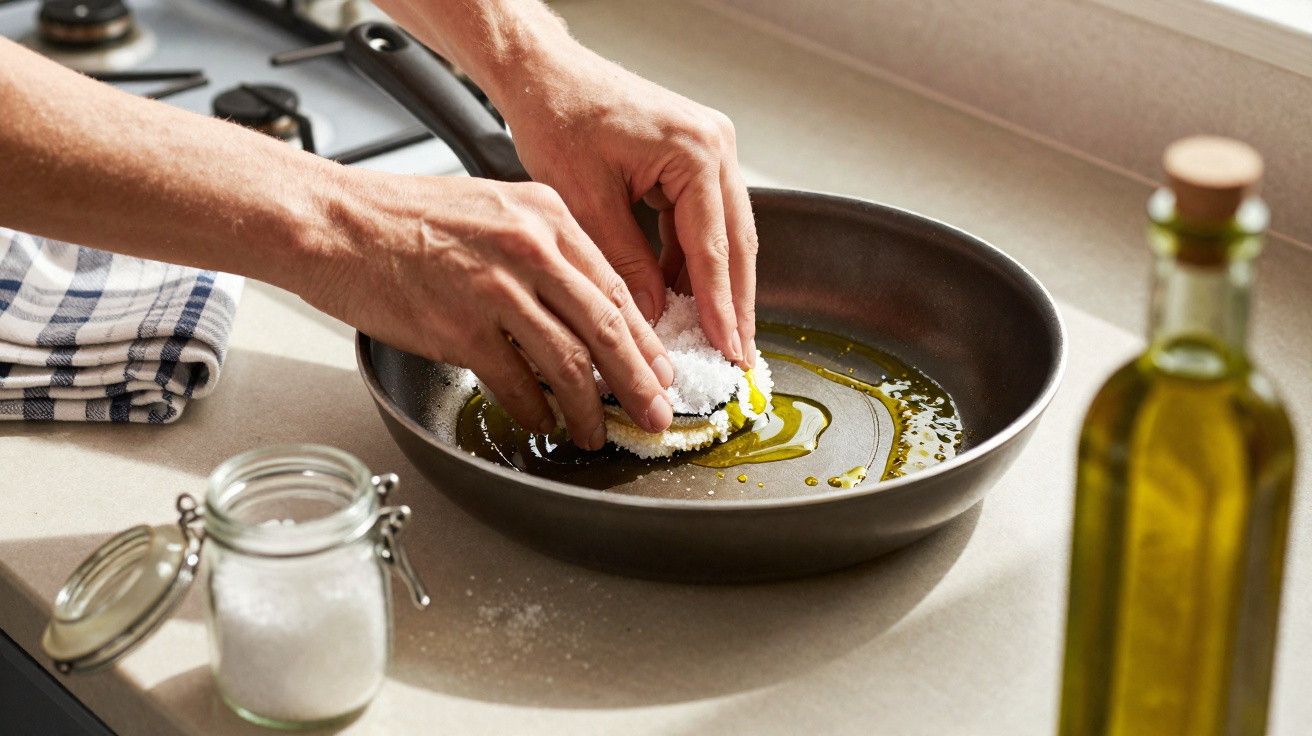
The tip relies on salt and olive oil. Here, salt acts as a mild abrasive. Its grains make it possible to rub greasy areas without using an overly harsh powder or a metal scourer.
Using olive oil to clean a surface that is already greasy may seem surprising. According to the method shared, it helps loosen deposits by making rubbing easier. The aim is therefore not to add oil to a clean pan, but to use a small amount with salt to tackle ingrained marks.
Before starting, gather a few simple items:
- table salt;
- a little olive oil;
- a non-abrasive sponge or soft brush;
- clean tea towels for drying the pan;
- hot water for rinsing.
Choosing a soft sponge is especially helpful for non-stick pans. A scouring surface, steel wool or a very hard tool can damage a surface that is already weakened.
Steps to follow on a cold frying pan
The first rule is to wait until the pan has cooled down completely. Handling cookware that is still hot can cause burns and makes cleaning more difficult. Once the surface is cold, spread salt over every area where grease is visible.
Next, pour a small amount of olive oil over the salt. The combination creates a grainy paste that can be worked across the base and sides. Rub gently with a non-abrasive sponge or a soft brush, concentrating on the areas with the most stubborn marks.
- Allow the pan to cool completely.
- Cover the residue with salt.
- Add a little olive oil.
- Rub without applying too much pressure.
- Rinse thoroughly with hot water.
- Dry immediately using a clean tea towel.
Rinsing is a crucial part of the process. Hot water helps remove the salt, oil and loosened residue mixture. If an area remains greasy, repeat the method gently rather than forcing it with an abrasive object.
Drying to prevent marks
After rinsing, it is best to dry the pan straight away. Water left on metal can leave marks, especially on stainless-steel cookware. Prompt drying also makes it easier to check whether the greasy areas have genuinely disappeared.
If the pan still has a cooking smell or a greasy film afterwards, conventional washing-up liquid can be used as an additional cleaning step. It should then be rinsed thoroughly so that no product remains on the cooking surface.
What to know in France about non-stick frying pans
In France, non-stick frying pans need particular care, whatever cleaning method is used. Their coating is designed to prevent food from sticking, but it can deteriorate through knocks, metal utensils and aggressive scrubbing.
To protect this type of cookware, wooden, silicone or cooking-safe plastic spatulas are generally preferable to forks and knives. It is also sensible not to stack pans without protection, as friction between two pieces of cookware can scratch their surfaces.
Cleaning will not restore the original coating of a heavily damaged pan. Maintenance can remove grease deposits, but it cannot repair scratches or areas where the non-stick layer has deteriorated. In this situation, it is better to monitor the cookware’s condition and avoid overly abrasive methods.
Salt should be rubbed in gently: its value lies in moderate abrasion, not in vigorously stripping the coating.
Preventing deposits after each use
The most useful habit is often the simplest one: clean the pan soon after use, once it has cooled enough to handle safely. Fresh marks are generally easier to remove than deposits that have built up over several days.
It is also better not to expose a still very hot pan to a large amount of cold water. A sudden change in temperature can warp some cookware. Waiting a few minutes before using lukewarm or hot water reduces this risk.
Finally, a small amount of fat suited to cooking is often enough. When oil spills over the edges or repeatedly burns, marks build up more quickly. Regular cleaning with a soft sponge and careful drying help keep a frying pan clean and ready for the next meal.





Comments
No comments yet. Be the first to comment!
Leave a Comment