
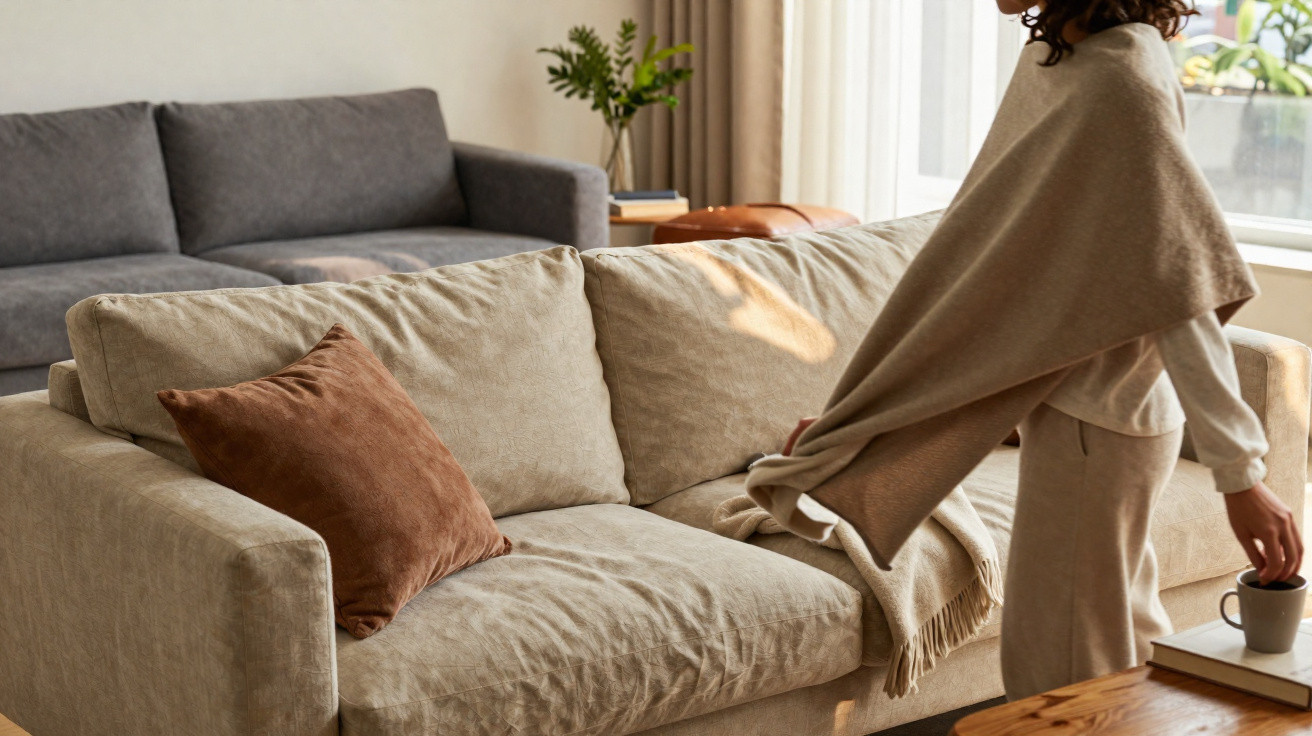
On a Saturday morning, disappointment often arrives quietly: the grey sofa that looked perfect in the shop makes the living room feel colder, the walls seem less bright, and even a favourite throw can no longer lift the scheme. We have all known the feeling of a costly, carefully chosen purchase somehow making the room appear smaller. This year, several interior designers are sounding the alarm about a shade long viewed as a safe option: cold grey. By contrast, a softer colour moves through trends without ever becoming truly tiresome. The detail that changes everything may be right in front of you.
Cold grey: the false neutral that tires an interior
In many living rooms, charcoal or blue-grey sofas became the default choice almost automatically. They promised to conceal minor stains, work with everything and offend nobody; on paper, that was reassuring. In reality, particularly where natural light is limited, this colour can drain a room’s energy and create a slightly stern, almost institutional look.
One interior designer recently described a couple who repainted their living room in off-white but kept their enormous graphite-grey sofa. The walls became softer, as did the curtains, yet the sofa still sat like a dark block in the centre of the room. Adding ochre, ecru and tobacco-brown cushions immediately made the result feel less rigid, showing that there is no need to replace everything.
Grey itself is not the issue: a warm grey, greige or subtly taupe shade can remain elegant. What professionals are more clearly advising against in 2026 is uniform cold grey, with no depth or variation, especially on a large sofa. It evokes the standardised interiors of the 2010s and works poorly with the smooth materials that feature heavily in budget collections.
Warm beige remains the colour that outlasts fashions
As icy grey loses ground, warm beige continues to feel reassuring without becoming dull. A sand, linen, oat or nuanced ecru sofa provides a calm foundation that can accommodate both a colourful rug and a dark wooden coffee table. It is not a dramatic colour, but it is often the one people still enjoy looking at several years later.
To choose it well, look at your living room at three points: in the morning, mid-afternoon and with the lamps switched on. A yellow-toned beige can turn very golden under a warm bulb, while a pink-toned beige readily softens a white wall. Let us be honest: nobody really does this every day, but taking a few photographs with a fabric sample held against the wall can prevent a major mistake.
A common mistake is to assume that a beige sofa means creating an entirely neutral setting, with white everywhere and matching cushions. The effect can quickly lack life, and it is not a matter of poor taste: it is simply a scheme that has not yet found its contrast. Introduce a raw material, an earthy shade or a touch of black, without trying to turn your living room into a catalogue photograph.
“A timeless sofa is not one that disappears: it is one that lets the objects, light and everyday habits of the home tell a story.”
- Choose: sand beige, warm greige, natural linen and soft caramel brown.
- Watch out for: blue-grey, plain anthracite and very smooth synthetic fabrics.
- To enliven a neutral sofa: rust, olive green, deep blue or terracotta cushions.
- Before buying: ask for a fabric sample and view it at home, rather than only under the shop’s spotlights.
A sofa selected for living, not merely for photographs
The real issue is not simply which colour is fashionable, but which shade will withstand your evenings, dog marks, children climbing over it or coffee set a little too close to the edge. Warm beige never truly goes out of style because it ages flexibly: it accommodates the marks of time, changed textiles and new preferences. An immaculate cold grey, by comparison, can demand considerable effort not to look gloomy.
Before writing off a grey sofa already in place, assess what surrounds it. A warm-light lamp, a textured ecru rug, linen curtains and two russet-brown cushions can transform its presence without blowing the budget. The most successful decoration does not always follow a trend to the letter; it is the kind that makes you want to sit down, welcome people in and stay a little longer.
| Key point | Detail | Added value for the reader |
|---|---|---|
| Colour to avoid | Cold, blue-toned grey or highly uniform anthracite | Prevents a living room from looking dark and dated |
| Timeless colour | Warm beige, sand, linen or nuanced greige | Easy to update with the seasons and accessories |
| Solution without replacing the sofa | Texture, warm lighting and earthy accents | Refreshes the room on a controlled budget |
Comments
No comments yet. Be the first to comment!
Leave a Comment