
If you live in an area with hard water, you will know the issue: you have barely cleaned the bathroom before white marks reappear on the taps. Many people reach for harsh anti-limescale sprays, which affect the air indoors and can damage surfaces. Yet a straightforward alternative from the kitchen promises far less effort – and may even reduce how much cleaning product you use.
Why limescale builds up on taps so quickly
Limescale forms when mineral-rich tap water dries. In many areas, the water contains particularly high levels of calcium and magnesium ions. When water is heated or evaporates, those minerals remain behind on the surface as whitish deposits or hard-edged marks.
Common signs of limescale on a tap include:
- dull-looking chrome or stainless-steel surfaces
- small white spots around the base of the tap
- a spluttering, uneven stream caused by blocked aerators
- a thin, cloudy film that quickly returns even after cleaning
Although many shop-bought anti-limescale products reliably dissolve these deposits, they come with several drawbacks: they have a strong smell, need time to work, require careful rinsing and may damage coatings when used frequently – particularly if you scrub with abrasive sponges.
“Anyone who tackles limescale only once it has visibly settled is making life unnecessarily difficult. Smart care starts earlier.”
That is where this kitchen trick comes in. Rather than relying on a powerful chemical reaction, it creates a fine protective layer that delays the formation of fresh marks.
How the baking paper method works
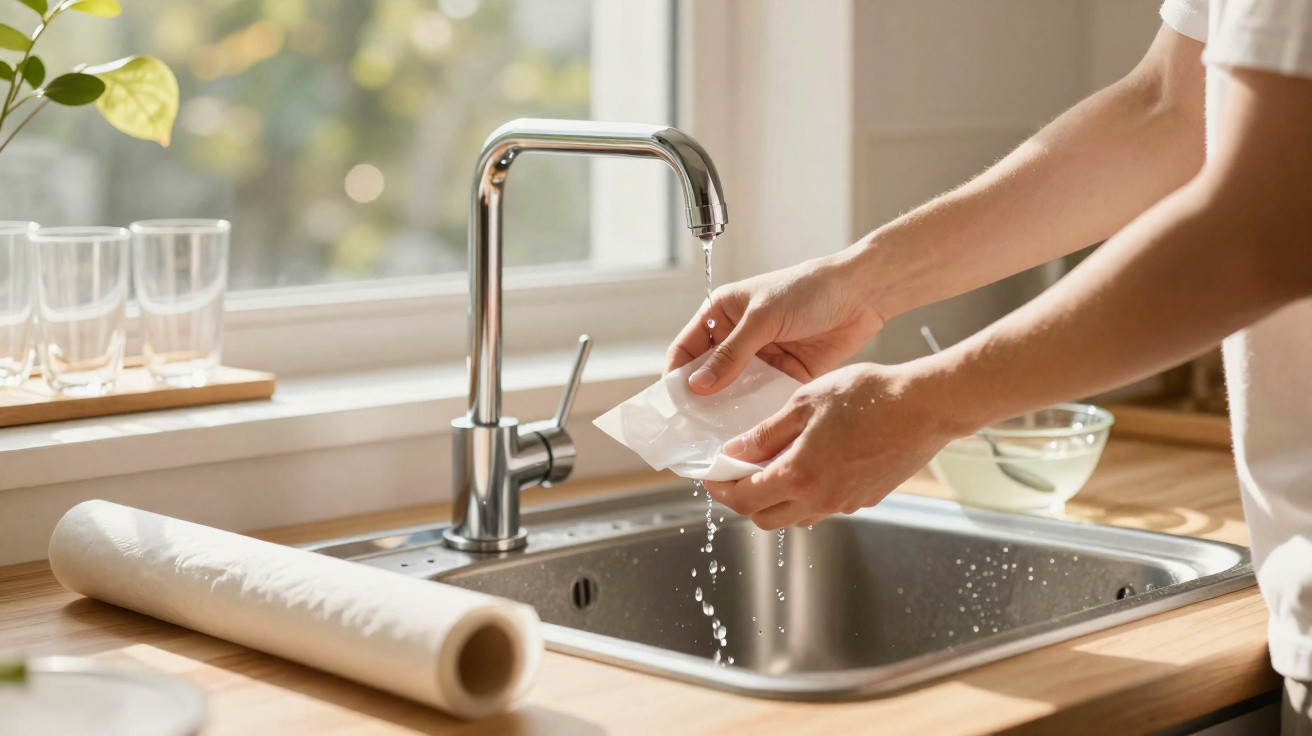
The surprising tool is not a specialist cloth from a DIY shop, but ordinary baking paper, also called parchment paper or oven paper. These sheets have a lightly slippery, non-stick coating so dough and vegetables do not stick to the baking tray.
That same property can be used around the home. When you rub a dry chrome or stainless-steel tap with baking paper, two things happen at once:
- Fine limescale that is still soft is lifted mechanically without scratching the surface.
- An invisible, mildly water-repellent film remains on the metal.
This layer causes water to bead more readily, run off faster and remain in droplets for less time. The fewer droplets that cling to the surface, the fewer limescale spots can form.
“Many users report that their taps remain visibly clean for five to seven days with this method – without needing to clean them again.”
How to use baking paper correctly
Step-by-step instructions
For the best result, the tap must first be clean and dry. Follow these steps:
- Dry the tap thoroughly with a soft cloth or microfibre cloth.
- Tear off a piece of baking paper and loosely scrunch it into a soft ball.
- Use gentle circular movements over every shiny area: the spout, lever, base and, where applicable, the shower head.
- Continue rubbing for about one minute, until the surface feels evenly smooth.
- Finish by briefly buffing it again with a dry microfibre cloth.
Important: this method is primarily suitable for smooth, shiny finishes such as chrome or polished stainless steel. With matt or black taps, test it carefully first in an inconspicuous area.
Where you should take care
Natural stone, such as marble or travertine, is often fitted around taps. Do not move the baking paper beyond the edges onto these surfaces, as grease or wax residues could settle in open pores. The trick is also less beneficial for plastic parts that are already heavily scratched.
If limescale is already firmly attached: deep-clean first, then maintain
The baking paper method is mainly intended for prevention and light maintenance. It does not replace a thorough descaling treatment when limescale has already formed thick, hard deposits or when only a weak flow comes from the tap.
In those situations, a proper descaling session is needed:
- Unscrew the aerator from the tap.
- Leave it in a glass of lukewarm household vinegar, or heavily diluted vinegar essence, for several hours.
- Carefully remove remaining limescale from the bristles and screens with an old toothbrush.
- Treat the tap and affected areas separately using vinegar, lemon juice or a paste made from bicarbonate of soda and water.
- Rinse everything thoroughly with clean water, then rub dry.
Only once the tap is free from stubborn deposits will weekly care with baking paper deliver its full effect. It then works as a form of “protective maintenance”, extending the time between intensive cleaning sessions.
A simple daily anti-limescale routine
To protect taps over the long term, combine a few uncomplicated habits. They take very little time but work effectively against new deposits:
- Briefly wipe the tap with a microfibre cloth after brushing your teeth or showering.
- Carry out the baking paper polish once a week.
- In areas with very hard water, remove the aerator every few weeks and clean it quickly.
- Squeegee splashed water from tiles and glass screens promptly, so fewer droplets dry in place.
“With this routine, many conventional anti-limescale sprays can be used much less often – a targeted application every few weeks is often enough.”
In homes with extremely hard water, some people also consider technical options, such as dedicated anti-limescale aerators or water-treatment systems. These reduce the overall impact on pipes, household appliances and surfaces. Anyone reluctant to make those investments can still achieve a great deal with the measures described above.
What hard water means – and why it is not “bad”
The term “hard water” may sound negative, but it simply refers to water with a high mineral content. From a health perspective, calcium and magnesium are actually desirable. The disadvantage is mainly seen in equipment and on surfaces: boilers scale up more quickly, shower heads become blocked, and glasses and tiles develop a spotted appearance.
Especially in older flats without modern water installations, a combination of practical measures and regular habits is worthwhile: finer screens, routine cleaning and simple aids such as baking paper can make a noticeable difference in everyday life.
When baking paper is not the best option
Useful as it is, the trick remains just one aid among many. It often has little effect on heavily textured surfaces, such as taps with a brushed-metal appearance or rough designer finishes. In these cases, promptly drying the surface with a soft cloth remains the most important measure.
In households with many people, where the bathroom and kitchen are in constant use, it is impossible to avoid limescale marks entirely. There, the value of baking paper shifts more towards “freshening up the appearance between two major cleaning sessions”.
The trick is particularly appealing to people who want to reduce the use of household chemicals. Buying and using fewer sprays is kinder not only to indoor air but also to your budget. Baking paper is already kept in most kitchens and will last for months in the cupboard. One sheet is often enough for several taps, and a piece can simply be set aside for next time.
Comments
No comments yet. Be the first to comment!
Leave a Comment