
The first time somebody told me they left bay leaves on their radiator overnight, I genuinely assumed they were winding me up.
I imagined a single leaf clinging to a dusty metal panel: a rather miserable cooking experiment that had gone awry. Then, on a chilly November evening, I stepped into their flat. It smelt cosy and full-bodied, rather like a leisurely Sunday dinner – except it was an ordinary Tuesday.
There was no candle, diffuser or plug-in fragrance pumping artificial vanilla through the room. Only a small cluster of bay leaves sitting on the warm radiator, doing their quiet job as everyone looked at their phones. Somehow, the whole room seemed more peaceful, as though it had let out a breath.
I left that evening with several leaves in my pocket. And the fragrance was not the only thing I noticed next.
Why people are suddenly putting bay leaves on radiators
In almost any traditional European kitchen, there is likely to be a neglected jar of bay leaves at the back of a cupboard. They are dry, slightly dusty and seldom used. Now this modest herb is moving beyond the stockpot and appearing in a far less expected spot: on the radiator.
As the heating season begins, increasing numbers of people are experimenting with this small ritual. With radiators running and windows shut, indoor air can become heavy, dull and faintly stale. Bay leaves offer another kind of lift: a subtle botanical note that does not announce itself like a fragrance spray.
The idea seems almost too straightforward to have an effect. That is precisely what makes it so appealing.
Browse home tips on TikTok or Instagram and you will find short clips of people laying two or three bay leaves on a warm radiator, alongside captions that promise “hotel smell at home” or “sleep better with this old trick”. One German lifestyle blogger said her late grandmother had always done it “for the nerves”. A small Italian survey into sleep habits also found that herbal scents, bay included, ranked unexpectedly highly among “comfort smells”.
These are not large-scale scientific trials. They are glimpses of ordinary people experimenting, adapting and passing ideas on. Yet the same observations recur: air that feels less stuffy, fewer cooking smells hanging about, and less reason to spray chemical products before bed. Plenty of comments also mention waking up “weirdly calm” or “less on edge”.
It is the sort of micro-trend that does not feel like a product launch. It feels more like a quiet suggestion.
There is an uncomplicated reason it may work. A radiator does more than heat a room: it can also encourage volatile plant compounds to evaporate. In bay leaves, this means the essential oils gradually disperse through the air, bringing hints of eucalyptus, clove, something slightly medicinal and something faintly sweet.
Your brain does not necessarily categorise that scent as “room fragrance”. Instead, it may connect it with “kitchen, family, slow cooking, background safety”. This is why people often call the feeling grounding rather than “fresh”. The aroma does not hit you as soon as you enter; it gently settles around you.
In a small bedroom at night, that may alter the entire mood without needing to adjust the thermostat.
How to use bay leaves on your radiator without making it a science project
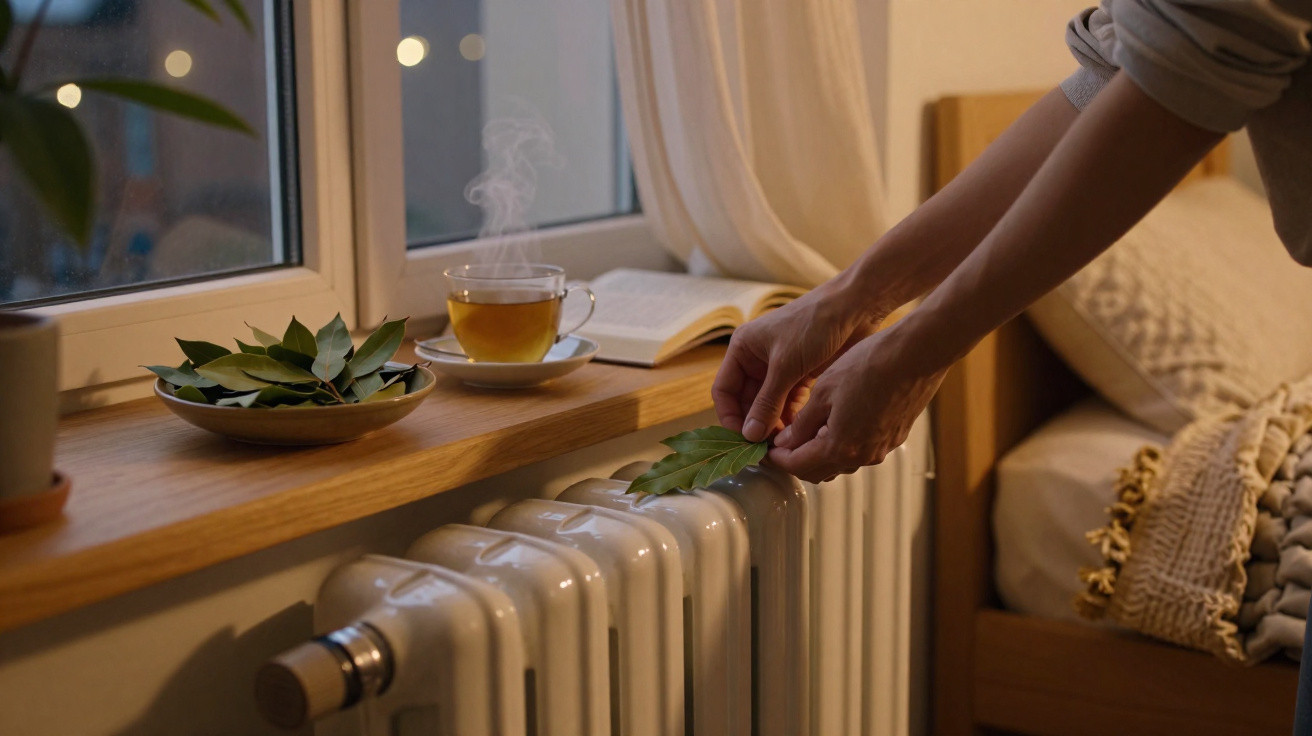
The basic approach could hardly be easier. Take two or three dried bay leaves, like those you would add to a stew. Once the radiator is warm, rather than scorching, lay them on top near the centre, where the heat remains even.
Keep a little distance between each leaf so air can circulate. Depending on how hot the radiator becomes, you should notice the aroma within 10–20 minutes. If your radiator has a cover, place the leaves on its top surface or put them in a small ceramic dish sitting there.
That’s really it. The magic comes from the waiting.
A few simple guidelines can make the ritual more pleasant. To begin with, avoid crowding the radiator. Using extra leaves does not necessarily improve the air; it can simply make the smell too intense, leaving the room feeling stuffy rather than calming. For an average-sized room, two to four leaves is a sensible amount.
Next, replace them with a fresh batch from time to time. After several nights, the leaves become drier still and much of their fragrance fades. Keep them away from plastic items and paper placed directly on the radiator, too. The risk may be small, but heat and clutter are never a good combination in a confined space.
Let us be honest: nobody really manages this every day. On some evenings, you will forget; on others, you will simply be too exhausted. That is perfectly fine. This should be a gentle ritual, not another task on an endless wellness checklist.
Those who continue with it tend to view it as a brief evening ceremony rather than a clever hack. You pass the radiator, set down the leaves, perhaps open the window for three minutes, then shut it again and allow the room to become still. Gradually, your body may begin linking that scent with winding down.
“I realised I wasn’t just scenting the room,” a reader told me. “I was telling my brain: this is the moment the day ends.”
To keep the routine convenient, many people leave a small set of essentials near the radiator, such as:
- A small jar or tin of bay leaves within easy reach
- A tiny heatproof dish for radiators with uneven surfaces
- A soft cloth for occasionally removing dust, so it does not mingle with the scent
This is not about achieving perfection. It is about making one small part of the evening feel a little more human.
The small bay leaf that can change the feel of your nights
There is something unexpectedly personal about changing a room’s scent after dark. It is not for visitors or Instagram pictures. It is for the version of yourself who wakes at 3:17 a.m., looks at the ceiling and wants the world to feel slightly gentler.
Bay leaves on a radiator will not solve an overwhelming life. They cannot make anxiety, unpaid bills or the sound of late-night emails disappear. What they may do is shift the character of the space around you, so that it suggests “home” rather than “holding area between two busy days”.
On a cold, grey weekday, that small change still matters.
People who give it a go often mention it to someone else almost bashfully. They do not present it as a miracle cure, but as a “this oddly helped me” admission. That is how modest rituals spread: from grandmother to neighbour, flatmate to colleague, and one weary person to another through a chat window.
You may find that bay leaves are not for you at all. Perhaps dried orange peel, a sprig of rosemary or even nothing suits you better. Still, the question remains: what small, almost unseen action could you introduce to your night-time routine to make the room feel as though it is on your side?
| Key point | Detail | Benefit for the reader |
|---|---|---|
| Warm radiators release bay aroma | Heat allows the essential oils in bay leaves to diffuse gradually around the room | Enjoy a mild, natural scent without candles or sprays |
| Simple evening ritual | Put 2–4 dried leaves on the radiator before going to bed | Provides a calming signal that tells your brain it is time to unwind |
| Low-cost, low-effort hack | Uses an inexpensive cupboard staple you may already have | An easy way to test out a cosier, less stuffy bedroom |
FAQ
- Can I put bay leaves on any type of radiator? Yes, provided the surface does not become dangerously hot and there are no open flames involved. With very hot units, use a small ceramic dish on top instead of putting the leaves straight onto the radiator.
- Is it safe to leave bay leaves on all night? With enclosed, standard water or electric radiators, using a small number of dried leaves is generally regarded as low risk. Do not place them close to stacks of paper, fabric draped over the radiator or plastic objects.
- Will this help me sleep better? Some people say they fall asleep more easily when a room has the gentle scent of herbs such as bay. The benefit relates more to relaxation and atmosphere than to a guaranteed solution for sleep.
- How often should I change the bay leaves? The majority of the aroma is released during the first one to three nights. Replace the leaves with a fresh batch after that if you want the scent to remain noticeable.
- Can I mix bay leaves with other herbs or citrus? Yes. Many people like pairing bay with dried orange peel, rosemary or a cinnamon stick on the radiator to create a warmer, kitchen-like fragrance.





Comments
No comments yet. Be the first to comment!
Leave a Comment