
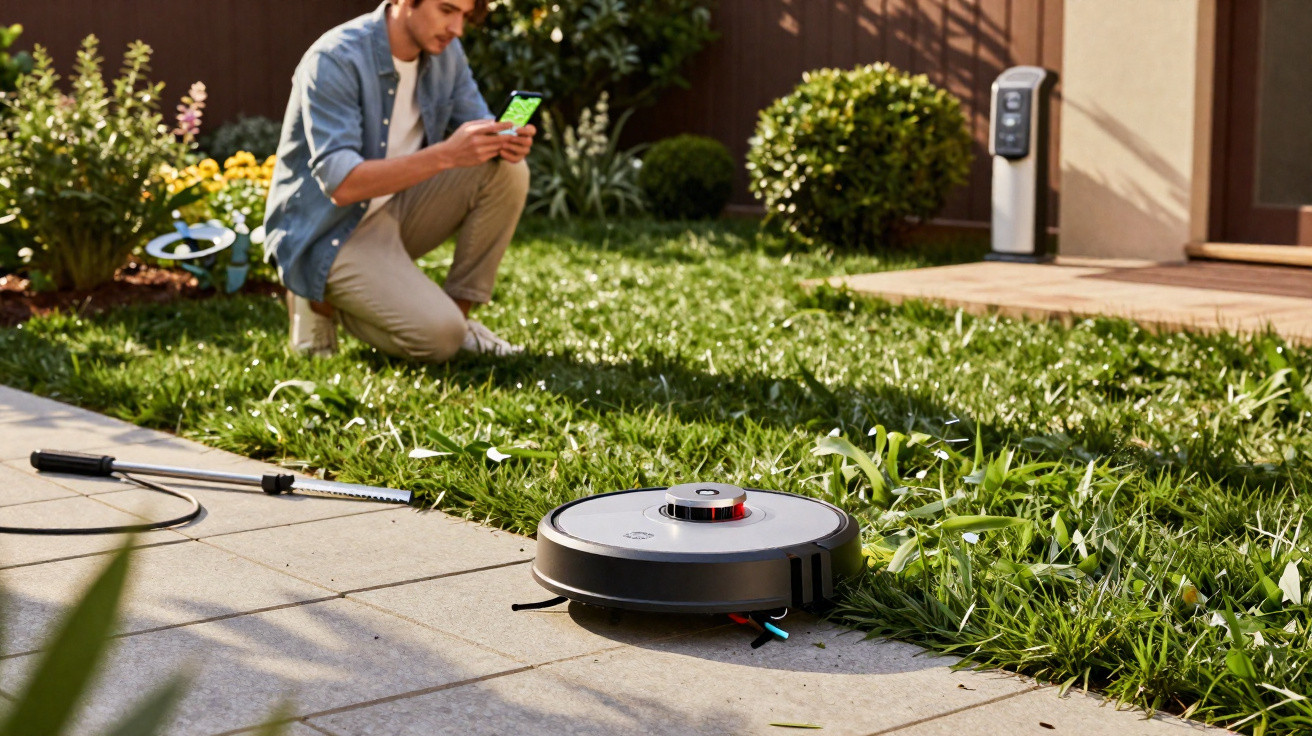
Fitting a strimmer to a wire-free robot mower was a bold move. With its Goat A1600 LiDAR Pro, Ecovacs says it has solved one of these machines’ last shortcomings: the few centimetres of grass left along lawn edges. Following two months in our garden, we now know whether this innovation can genuinely retire the manual edge trimmer.
In just a few years, robot mowers have expanded their capabilities at a remarkable pace. Most now work without an RTK antenna, automatically map a garden and avoid all kinds of obstacles. They can also tackle steep slopes or provide a live video feed, as we explain in our guide to choosing the right robot mower in 2026.
Yet one issue remains unresolved: edges. The explanation is straightforward: the cutting disc sits beneath the chassis, so it can never reach right up to a fence, flower bed or patio. Until now, manufacturers have chiefly tried to narrow this strip of uncut grass through more accurate routes, twin discs or dedicated modes. The aim has always been to bring the main blades as close as possible to the boundary.
Ecovacs has taken a different approach with the Goat A1600 LiDAR Pro. The manufacturer has fitted a proper strimmer directly to the side of the robot, with a line that automatically extends and retracts. Known as TruEdge, this feature cuts the areas the main blades cannot reach. Its promise is simple: no final lap of the garden with a handheld edge trimmer.
The question is whether this solution truly transforms edge cutting and, beyond this innovation, whether the Goat A1600 LiDAR Pro is equally convincing at the rest of its job.
What we liked about the Ecovacs Goat A1600 LiDAR Pro
An edge trimmer that finally delivers
Before it can tackle your lawn edges, you need to fit this unusual attachment to the robot’s left-hand side. It is a quick job: secure the module using three screws, then clip on the brush. This brush prevents cut grass from building up around the strimmer. One important point: this feature never operates at the same time as the main blades. Edge cutting is therefore a separate task in the Ecovacs Home app.
The first option is to schedule a dedicated automatic run. This was our preferred choice along walls and wire fences. The robot then independently goes around the selected edges again. The strimmer dramatically reduces the uncut strip of grass, although it cannot entirely overcome the laws of physics. As the chassis meets vertical obstacles, a few blades remain. However, the residual strip is very slight, just 2 or 3 centimetres.
The other option is manual mode. The principle is similar to that offered by models such as the Mova ViAX 250, where you remotely steer the robot to revisit the edges. Here, however, the line positioned on the side reaches grass far beyond the disc concealed underneath the machine.
We mainly used this mode beside drive-over edges, such as our flush patio and some gravel paths. By steering the robot, you can allow it to slightly overhang the hard surface. The line then trims the entire boundary right down.
Across our large 586 m² area, these two approaches complemented one another perfectly. Automatic operation was enough for most of the perimeter, while manual control finished off selected edges. It does admittedly involve extra work. Nevertheless, of every robot mower we have tested over the past two years, none has proved as effective at this task.
Navigation that is simply outstanding
As is customary with Ecovacs robot mowers, setting up the Goat A1600 LiDAR Pro will not take an entire afternoon. Once the station has been secured to the ground and Bluetooth and Wi-Fi connections have been made, mapping can begin immediately.
In our sharply defined areas, automatic mapping handled the job alone, requiring only two or three minor adjustments afterwards. For more awkward sections, such as the area divided by a narrow passage at the back of our garden, we chose to take control with the joystick and manually draw the boundaries. We recommend this method whenever edges become less clear-cut.
For positioning, the Goat relies on two LiDAR sensors. The rotating dome on its cover scans its surroundings through 360 degrees and creates a map of the garden, while a second sensor at the front measures whatever lies at close range. An AI camera completes the system, identifying encountered obstacles in greater detail, with more than 200 supported categories.
The results continued to impress us over the weeks. Across two months, we never once had to free it after it became stuck. Beneath our trees, beside walls and through the tightest passages, the machine consistently retained its bearings.
Even where foliage blocks much of the sky, its path remains neat and consistent. It detects obstacles early enough, including small items left on the lawn. It then passes around them closely without ever making contact.
A wide cut with settings tailored to each square metre
Looking after the edges is one thing, but the rest of the lawn must also be properly maintained. To achieve this, the Goat A1600 LiDAR Pro uses two decks, each carrying three pivoting blades. Together, they provide a 33-centimetre cutting width. That is a fitting size for the robot’s price positioning. By comparison, the Navimow i208 LiDAR (£1,199) is limited to 22 centimetres, while the Dreame A3 AWD Pro 5000 (£2,999) reaches 40 cm.
Throughout our weeks of mowing, we never saw missed strips or differences in grass height between sections of the same zone. The Goat A1600 LiDAR Pro performs properly on this ground partly because of its extensive mowing settings.
Using the app, every zone can have its own configuration. Cutting height from 3 to 9 centimetres, travel speed and stripe direction can all be set individually rather than fixed across the entire garden.
This breadth of options is especially useful for protecting a more delicate part of the garden or one exposed to too much sun. Conversely, you can leave the grass slightly longer beneath trees and in shaded areas.
One final detail won us over: the detection threshold setting. You enter the average height of your lawn, and the machine determines the size at which an item should be treated as a hazard. Without this safeguard, a simple tuft of overgrown grass may be mistaken for an obstacle and carefully avoided.
What we liked less about the Ecovacs Goat A1600 LiDAR Pro
Two-wheel drive and 4G sold separately
The robot is driven solely by its two treaded rear wheels, while the two front castors merely follow. The manufacturer nevertheless claims it can handle slopes of up to 50% and cross obstacles measuring 4 centimetres. On dry ground, the machine does indeed climb without complaint. After several rainy days, however, its 17.8 kg weight causes it to sink in, and even a modest steep incline becomes challenging.
If parts of your garden are seriously sloped and retain water, all-wheel drive would be the better choice. This type of traction is available at the same price from Mammotion with the Luba Mini 2 AWD 1000 (£1,499), or for slightly more from Segway with the Navimow i210 LiDAR Pro (£1,599). Both, however, are limited to 1,000 m², compared with 1,600 m² here.
Connectivity is another drawback that comes at a cost. Once the robot gets too far from your router, live video and anti-theft location tracking require a module sold for £150. At that price, a SIM card is not even included. You must therefore also pay for a subscription suited to connected devices.
At Mammotion, the module costs £99 and includes three years of 4G service. Segway, meanwhile, builds 4G directly into its Navimow models, offering the first year free before charging £29.99 per year.
Disappointing battery life, only just rescued by rapid charging
This is our main criticism of the robot. At only 96 Wh, its battery seems rather small for a machine claimed to manage 1,600 m². In our garden, after one hour of work and around 190 m² covered, the Goat A1600 LiDAR Pro already needs to return to its station for a recharge.
On our largest area (586 m²), it always required more than three cycles to finish the job. The many settings available in the app can also further alter the outcome. Fortunately, the Goat does not linger at its charging base.
In our measurements, around fifty minutes was enough for it to return to work. That is particularly fast for this category. For comparison, the Navimow i208 LiDAR and Dreame A3 AWD Pro both need around two hours.
For the 1,600 m² stated by Ecovacs, you should therefore expect more than eight runs. With standard settings and charging time included, covering this area will take 15 to 16 hours. That estimate will naturally vary according to cutting height, speed and the spacing selected between passes.
It is worth remembering that the strimmer works in separate sessions. Its own operating time must therefore be added to the total, meaning mowing will be spread out and the work divided among several zones.
A bulky, noisy strimmer
Once fitted, the TruEdge module is intended to remain in place. It is not really designed to be removed and reinstalled between mowing sessions. Consequently, it makes an already sizeable Goat A1600 LiDAR Pro even wider. In tight corners and narrow passages, it was sometimes uncomfortable, needing several manoeuvres to find its turning angle.
The other consequence is audible. When the strimmer begins operating, Ecovacs claims a noise level of 82 dB. The manufacturer is not understating that figure: the Goat A1600 LiDAR Pro makes quite a racket when it takes on the edges. It is therefore best not to schedule this task early in the morning or late in the evening if you want to remain on good terms with neighbours.
Price, availability and rivals
Launched at £1,499, the Goat A1600 LiDAR Pro sits in the middle of Ecovacs’ LiDAR Pro range. The manufacturer also offers the more compact O1200 LiDAR Pro for gardens up to 1,200 m², along with the A3000 LiDAR Pro for larger properties of up to 3,000 m². Crucially, the A1600 does not have exclusive use of the strimmer, as this function is also included on both of those models.
There is no shortage of competition at this price. The Segway Navimow i215 LiDAR (£1,399) covers 1,500 m² but has no line edge trimmer. For buyers who prioritise traction, the Mammotion Luba Mini 2 AWD 1000 (£1,499) and Segway Navimow i210 LiDAR Pro (£1,599) drive all four wheels, though their coverage area falls to 1,000 m².
Our verdict on the Ecovacs Goat A1600 LiDAR Pro robot mower
Ecovacs is not the first manufacturer to address the edge problem, but it is among the few to offer such a radical solution. Attaching a genuine strimmer to a robot mower might have seemed excessive. After two months, however, its effectiveness is difficult to deny. On drive-over boundaries, it genuinely allows you to put the manual edge trimmer away, while alongside walls and fences it reduces the remaining work to the absolute minimum. This is an innovation-and, above all, a genuine hardware gamble-that deserves recognition.
That said, the idea still needs refining. The strimmer is genuinely loud in use and adds more bulk to an already sizeable robot. More generally, battery life is slightly disappointing for a model rated for 1,600 m². Its two-wheel drive also occasionally shows its limits on steep slopes, while the price of the 4G module is a little frustrating.
The Goat A1600 LiDAR Pro is therefore best suited to large, fairly level gardens where edges require substantial finishing work. On very hilly, frequently muddy or particularly fragmented ground, a four-wheel-drive model would be more appropriate.
Otherwise, there is little to criticise. Its dual LiDAR system provides remarkable navigation, mapping is fast, and its two decks deliver a combined cutting width of 33 cm for a clean, even result. It therefore fully deserves its place in our comparison of the best robot mowers of 2026. Ultimately, the most interesting point may not be that Ecovacs added a strimmer to its robot mower, but that it managed to do so without sacrificing too much elsewhere.
Ecovacs Goat A1600 LiDAR Pro
£1,499
Overall score: 8.7
| Category | Score |
|---|---|
| Installation and mapping | 9.0/10 |
| Navigation and obstacle detection | 9.5/10 |
| Mowing and edge-cutting quality | 9.5/10 |
| App and options | 8.0/10 |
| Battery life and charging | 7.5/10 |
We like
- Innovative, effective strimmer for lawn edges
- Impeccable dual-LiDAR navigation
- Fast, accurate automatic mapping
- Appreciable, customisable cutting performance
- Rapid charging
We like less
- Battery life could be improved
- Noisy, bulky strimmer
- Only two driven wheels
- Expensive 4G module without a SIM card





Comments
No comments yet. Be the first to comment!
Leave a Comment