
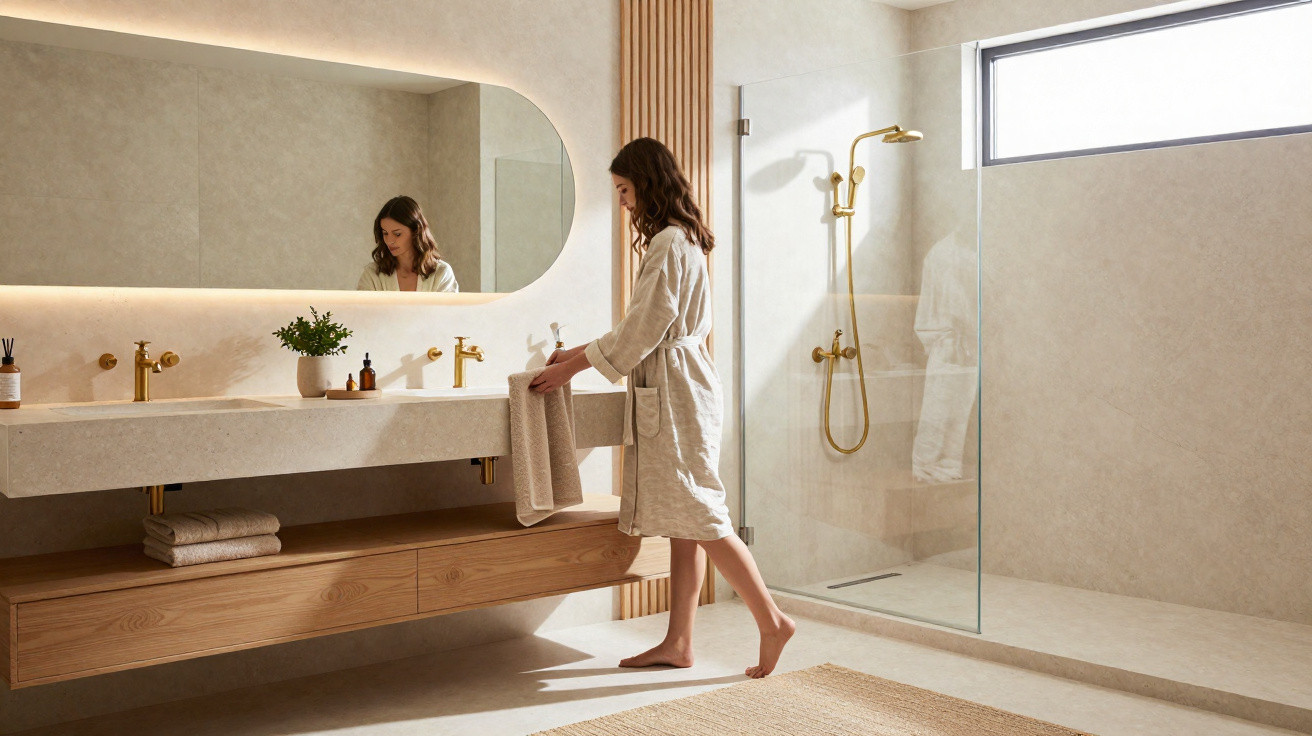
With a few smart choices, it can become a modern, comforting room with the feel of a boutique hotel.
Many bathrooms in German-speaking countries still look much as they did in the early 2000s: tiles running up to the ceiling, cold lighting and no sense of comfort. In the morning, people rush through their routine rather than enjoying a brief spa-like moment. Bathroom trends for 2026 turn that idea on its head, shifting from a purely practical room to a warm, graphic retreat – often by working with what is already there rather than stripping everything out.
Why it is worth reassessing your bathroom in 2026
The major change is subtle but clear. Bathroom planning is no longer focused solely on tiled splashbacks and storage; ambience, accessibility and durability now matter too. In many cases, materials and products can be installed directly over existing surfaces. This cuts down on mess, time and cost, while being far more sustainable than ripping everything out.
With just a few well-chosen interventions, an old bathroom can feel almost new in 2026 – without a full renovation and weeks of building work.
Five key ideas are at the heart of the approach:
- seamless, continuous surfaces instead of a patchwork effect
- slip-resistant flooring with personality
- decorative panels and carefully styled vanity units
- level-access showers with a spa-like feel
- striking taps, lighting and textiles as the finishing touch
Seamless surfaces and slip-resistant tiles as a modern foundation
The clearest departure from an outdated bathroom is created by continuous finishes on walls and, in some cases, floors. Rather than drawing attention to every individual tile, these create a calm surface with very few or no joints.
Microcement and similar finishes: a new look over old tiles
Microcement, mineral skim coatings and technical panels can be applied directly over existing tiles. Keeping the old covering underneath offers several benefits:
- no labour-intensive removal of tiles
- considerably less dust and noise
- minimal time without use of the bathroom
- substantially less construction waste
As the existing grout lines disappear, there are fewer places for dirt, limescale and moisture to collect. This noticeably reduces both the risk of mould and the cleaning effort, which is particularly beneficial in a shower.
Texture underfoot: safer and more inviting
Another essential element is flooring that does not resemble a hospital floor while still providing reliable grip. In 2026, designers are increasingly choosing:
- lightly textured, natural-stone-style finishes
- slip-resistant porcelain tiles with a matt surface
- colour patterns, such as checkerboard designs or zoned areas
A particularly interesting trend is to visually define routes through the bathroom, for example with contrasting blocks of colour. This supports orientation, adds visual energy and can also improve safety for wheelchair users or children.
Decorative panels, vanity units and showers: major change with minimal disruption
Anyone wanting to avoid chasing out walls will quickly come across large-format decorative panels. Made from composite materials, these boards are waterproof, easy to clean and bonded directly over old tiled surfaces.
Marble, concrete or timber-look walls without natural stone
Depending on the design, the panels can resemble:
- dramatic marble with bold veining
- softly understated exposed concrete
- warm timber panelling
- a rugged, highly textured stone wall
They can transform shower walls, niches or the area behind the basin completely within a few hours. Their main advantages are the lack of drying times associated with conventional tiling, minimal mess and an instantly more contemporary-looking room.
The vanity unit takes centre stage
The traditional white standard basin with a bulky base unit is steadily disappearing. Current projects favour more deliberately presented furniture pieces:
| Option | Visual effect | Practical benefit |
|---|---|---|
| Wall-hung vanity unit | light, floating, uncluttered | Clear floor space makes mopping easier |
| Metal frame with worktop | airy, almost like a designer console table | Plenty of legroom and easy to pair with baskets |
| Bespoke vanity at a non-standard height | individual, architectural | Ergonomically suitable and easier to access |
Designers are placing greater emphasis on longevity. Instead of short-lived trend furniture, the focus is on solutions that work for many years, even as life circumstances change. A lower basin, for instance, can be useful for children, shorter people or wheelchair users.
The level-access shower as tomorrow’s standard
A shower tray with raised sides feels like a relic in 2026. The preferred choice is a generous, almost step-free shower space featuring:
- a flush floor with no trip edge
- a wide entrance, often with no door at all
- an integrated bench or shelf
- a hand shower and large overhead shower
The combination of comfort and easy maintenance is especially appealing. A built-in seat finished in a hard-wearing surface suits every generation, whether for shaving, longer showers or assistance in later life.
Taps, lighting and textiles: small details with a big impact
Once the foundation is right, the finishing details determine whether a bathroom truly feels current for 2026 or simply looks “newly tiled”.
Taps as jewellery pieces
Taps are no longer inconspicuous functional components. Sought-after finishes include:
- matt black for graphic contrast
- brushed steel for a technical look
- brass or bronze for warm accents
Unlacquered brass options that develop a patina over time are particularly appealing. The result feels more alive than flawless chrome and works especially well with warm earth tones or natural-stone looks.
Layers of light instead of a fluorescent tube
Many people underestimate how profoundly lighting can alter a bathroom. The classic harsh ceiling light is becoming less important, while several lighting layers are being used instead:
- indirect illumination behind mirrors or beneath furniture
- side wall lights for more flattering facial lighting
- warm-white spotlights in the shower and WC areas
A slightly warmer colour temperature makes skin tones appear more natural and the room less clinical. With dimmable fittings, it is possible to switch between “getting ready quickly in the morning” and an “evening spa atmosphere”.
Textiles and accessories for quick updates
In 2026, bathroom textiles are treated as part of the interior scheme rather than merely consumable items. Thick towels in muted shades, vintage-style rugs or a small wooden stool introduce warmth.
A new colour palette for towels, mats and the shower curtain can make a bathroom look completely different within a day.
Another notable trend is the intentional inclusion of one older furniture piece, such as an antique stool beside the bath. It makes the room feel less sterile and connects it more closely with the style of the rest of the home.
What to establish before renovating
Before starting, a few key questions help ensure the bathroom is not only stylish but genuinely practical for everyday life:
- Who uses the bathroom now, and who might use it in ten years’ time?
- Are there people with limited mobility or young children?
- How much storage is actually needed, and where should it be located?
- Is there enough natural light, or are more artificial light sources required?
- How much of the budget is for appearance, and how much is for technical work such as waterproofing and plumbing?
Professional advice is particularly worthwhile for seamless systems and level-access showers. The appearance can be selected quickly, but screed height, falls and waterproofing are what really matter. Errors often become apparent only later and can then be difficult to put right.
Practical examples and sensible combinations
Those not planning a full makeover can select and combine individual elements. Three possible scenarios are:
- Mini upgrade in rented homes: replace the shower curtain with a glass screen, add a mirror with integrated lighting, fit new taps and choose high-quality towels – all of it reversible.
- Medium-sized renovation: re-clad the shower area with decorative panels, install slip-resistant floor tiles, use a wall-hung vanity unit and introduce a warm lighting scheme.
- Adaptation with the future in mind: create a level-access shower, a wide entrance, a low or wheelchair-accessible basin, easy-grip finishes and pre-installed connections for grab rails.
Planning for durability saves money in the long run: fewer later adaptations, less moisture damage and less frustration with impractical solutions. At its best, a thoughtfully planned bathroom for 2026 supports several stages of life without requiring a fresh start every few years.
Comments
No comments yet. Be the first to comment!
Leave a Comment