
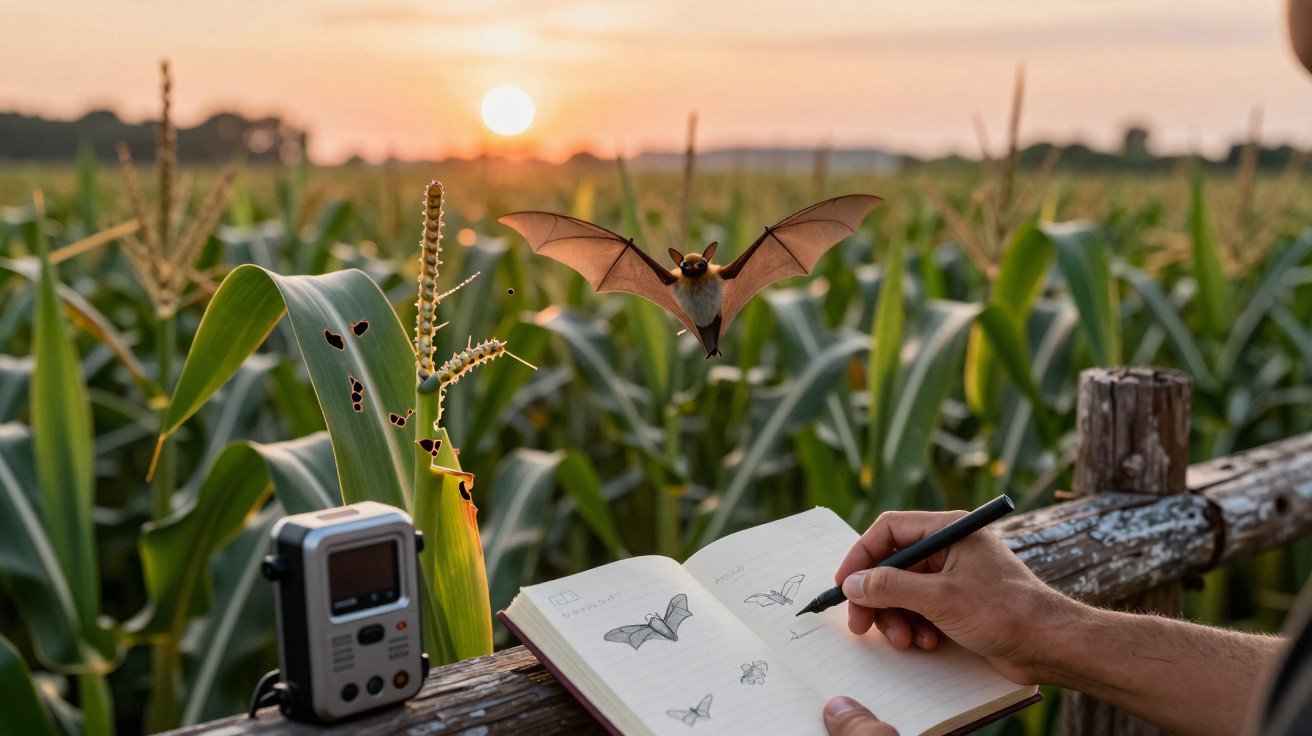
As night falls over maize fields, insectivorous bats begin their almost unseen role in pest control. The insects they eat include the moth Spodoptera frugiperda, the adult form of the feared fall armyworm. A Brazilian study estimated that this ecological service could prevent losses worth around US$ 390.6 million in each national maize harvest.
How can a bat tackle a caterpillar living in maize?
The answer lies in the pest’s life cycle. The fall armyworm is simply the juvenile stage of Spodoptera frugiperda. Once it has developed, it becomes a moth that flies mainly at night, mates and lays the eggs from which another generation of caterpillars will emerge.
This is the point at which the habits of the two animals overlap. Insectivorous bats hunt after dark, catching moths while they are flying. By eating an adult female before she lays eggs, bats can disrupt part of the pest’s reproductive cycle before fresh caterpillars reach the plants. Researchers detected S. frugiperda DNA in the droppings of bats studied in Brazil’s Central-West region.
Why is the fall armyworm such a concern for maize growers?
The pest chiefly damages young leaves and may settle in the plant’s whorl, leaving holes and decreasing the area available for photosynthesis. During severe infestations, the damage can substantially reduce yields:
- Adult moths can travel over long distances;
- Females can produce large numbers of caterpillars in a new generation;
- Larvae mainly feed on young maize tissues;
- The pest also uses other crops as host plants;
- Resistant populations can make certain control methods more difficult;
- Management generally requires continuous crop monitoring.
What is the value of bats’ work in maize fields?
A study published in 2021 examined DNA found in the droppings of five insectivorous bat species living in buildings in Brasília and nearby towns. The researchers identified 83 arthropod groups in their diet; among those identified to species level, many were recognised as agricultural pests.
Using a conservative model based on the predation of fall armyworm moths, the authors calculated potential savings of roughly US$ 94 per hectare of maize, reaching US$ 390.6 million per Brazilian harvest. The study itself stresses that this is an estimate founded on assumptions, rather than a figure directly observed across every maize field in the country.
What helps keep these allies close to crops?
Bats need access to food, safe roosting sites and a landscape that supports their survival. Protecting biodiversity around productive land helps sustain the different species that can provide ecological services, including insect predation:
- Retain fragments of native vegetation near agricultural land;
- Protect trees and other natural roosting places;
- Avoid destroying bat colonies out of fear or lack of knowledge;
- Limit unnecessary disturbance in areas used as refuges;
- Include the conservation of natural enemies within pest management;
- Avoid treating every bat as a threat to production.
Why is bats’ reputation so far removed from the work they do?
In the popular imagination, bats are still linked chiefly with blood and disease, even though their diets vary greatly between species. Brazil has bats that feed on fruit, nectar, small animals and insects. Insectivorous species can consume an amount of arthropods each day close to a large proportion of their own body mass, making them important predators precisely during the hours when many agricultural moths are active.
They do not eradicate fall armyworm on their own, nor do they replace integrated pest management. Instead, they add a natural barrier to growing populations: every moth caught before reproducing represents eggs that may never reach the crop. For an animal so often regarded as unwanted, this is a remarkably valuable contribution to protecting Brazilian maize.






Comments
No comments yet. Be the first to comment!
Leave a Comment