
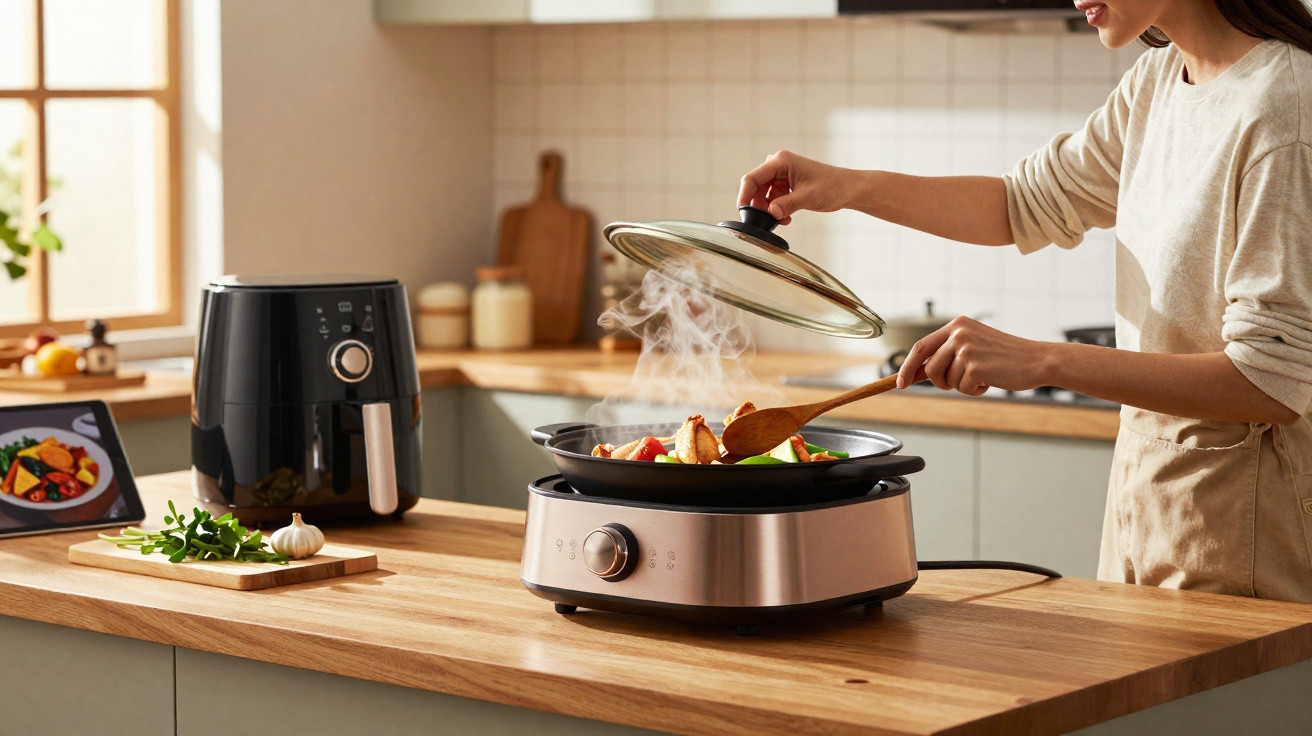
The first time I encountered one, it barely registered as a kitchen appliance. It looked more like an oversized Bluetooth speaker left on the worktop. There was no basket, no awkward little drawer to pull out and no ear-splitting “ding”. Instead, it was a discreet cube with a glass door, a dial and a gentle light that made my ageing oven seem prehistoric.
We had planned to cook frozen chips. Instead, we ended up preparing half the contents of the fridge.
At some point between roasting broccoli and reheating pizza that tasted surprisingly fresh, I had a thought: could this new multi-function gadget genuinely mark the beginning of the end for air fryers?
From air fryer hype to the counter's new quiet star
Everybody remembers the air fryer boom. Almost overnight, it seemed you could not call yourself a proper adult unless a black plastic spaceship was humming away in a corner of your kitchen. There were chips with “90% less fat”, crisp chicken and Instagram reels packed with cheese pulls. It promised guilt-free fast food on a Tuesday evening while you were still in your pyjamas.
Recently, though, that same plastic spaceship has begun to seem a little outdated. There is the noisy fan, inconsistent cooking, and a cumbersome basket that is awful to clean after you have forgotten it and left it soaking. Its appeal is beginning to fade.
A fresh generation of multi-function kitchen gadgets is quietly taking its place. Picture compact convection ovens that can also steam, grill, dehydrate and reheat, or hybrid “air ovens” using flat trays rather than baskets. Among the most talked-about options are devices that move from air fry mode to steam roast to slow cook without requiring you to touch a pan.
My friend Laura replaced her old air fryer with one last month. She had only intended to “test it for a week”. Her air fryer now sits in a box in the hallway, waiting to be listed on Facebook Marketplace.
The reasoning is brutally straightforward. Air fryers excel at one task: circulating hot air around food in a small basket. These newer multi-function units apply the same idea across shelves or a flat tray, while providing more accurate control over temperature, humidity and timing.
That means the same golden crispness, alongside airy sourdough, slow-roasted vegetables and even steamed salmon that does not leave the entire flat smelling of fish. One box, many roles. Suddenly, the older single-purpose appliance feels rather like a flip phone in the smartphone era.
How the multi-function gadget works in everyday cooking
In practical terms, the experience changes considerably. Rather than taking out a basket, shaking it every eight minutes and hoping the chicken is not raw in the centre, you place food on a tray or rack as you would in a miniature oven. Select “air fry”, “steam roast” or “pizza”, turn the dial and leave it to work.
The appliance fills its chamber with hot air, occasionally adding a measured burst of steam or using a grill element that glows above the food. It makes adjustments during cooking, giving chips an initial high-heat blast before finishing them more gently so they do not become cardboard-dry. The result is crisp outsides and soft middles, without constant monitoring.
Capacity and layout represent the major change. You are no longer restricted to a deep basket. Leftover lasagne in a small dish can go straight inside. Two trays of sweet potato wedges for friends can use the same appliance. Even a whole chicken is possible.
Laura says the point at which she knew she would not return to her air fryer came on a Thursday night. She placed chicken thighs on one level and broccoli on another, chose a combination mode, then went to help her son with his homework. By the time he had completed a reading exercise, dinner was roasted, browned and ready. There was no swapping pans or juggling the hob and basket.
The other important factor is the relationship between technology and routine. Air fryers altered how we approach oil and speed, yet they still kept us in a pattern of “small batch, one mode” cooking. These newer gadgets broaden that approach. They encourage cooking in the manner of an oven user, while retaining an air fryer's speed and control.
Let us be honest: hardly anyone follows elaborate recipes every day. We warm up pizza, make nuggets crisp and tip in frozen vegetables. A multi-function appliance handles these lazy, everyday habits better, with fewer trade-offs and fewer additional gadgets taking up worktop space.
Using a multi-function gadget to replace your air fryer
To make this appliance a genuine air fryer replacement, begin with the meals you cook every week: chips, nuggets, roasted vegetables, leftover pizza and quick fish fillets. There is no need to make it complicated.
Choose a preset based on the texture you want rather than the food name. For maximum crispness, select pure air fry or high convection. For food that stays juicy in the middle, use a steam-roast combination or a lower-temperature bake followed by a brief final crisp. Think of it as a speedy, smart miniature oven, not an elaborate novelty.
One frequent error is using the new appliance exactly as if it were a basket air fryer: overcrowding its tray, turning the heat up to maximum and expecting perfect results in eight minutes. That is how food ends up brown on top but strangely pale below.
Allow food room for air to circulate. Lay chips out in one layer, turn trays halfway through when cooking on two levels, and rely on slightly lower temperatures with a few additional minutes. The magic is in the balance between heat, air and time. If useful, think of it as “gentle speed” rather than an “aggressive blast”.
“Once I stopped rushing it like an air fryer and started treating it like an oven with superpowers, the results changed overnight,” says Laura. “Now my kids think I secretly learned how to cook.”
- Use trays, not piles
Flat layers become crisper than overcrowded baskets. - Experiment with modes
Try air fry, bake, roast and steam with the same food to understand the difference. - Clean as you go
Wiping the glass and tray quickly after every use helps it stay looking new. - Keep one reliable setting
For plenty of people, that is a 190°C “combo roast” for nearly everything. - Allow it to preheat
Two or three minutes creates a noticeable improvement in crispness and colour.
So, are air fryers actually on their way out?
Some early adopters will insist that they are, entirely. Others will hold on to their dependable basket for wing nights and late-night snacks. The reality is generally less dramatic than the headlines: a multi-function gadget does not eliminate the air fryer overnight; it simply makes it seem less essential.
When one appliance can toast bread in the morning, roast a chicken at the weekend, reheat leftovers without drying them out and still produce crisp chips after work, the question subtly shifts from “Do I need this?” to “Why am I keeping the other one?”
You may not throw your air fryer away straight away. It could be moved to a lower shelf “just in case”. It may become a back-up for parties, or your university-age child's new favourite appliance in their tiny halls kitchen. Alternatively, it may eventually leave your home in a cardboard box labelled “works perfectly” in scruffy handwriting.
What is clear is that kitchen space and mental space are linked. Whenever a genuinely multi-purpose gadget delivers what it promises, single-function appliances lose a little more ground. Less clutter, more freedom to cook without thinking too hard.
Perhaps that is the real story. It is not only about gleaming technology, but also about how weary we are of managing gadgets and their promises. We want one appliance on the worktop that quietly performs its task day after day, for ordinary dinners in real, occasionally messy lives.
The issue is not simply “Is this better than an air fryer?” It is which appliance truly deserves to remain plugged in.
| Key point | Detail | Value for the reader |
|---|---|---|
| Multi-function advantage | Brings together air fry, bake, roast, steam and reheat in a single unit | Clears worktop space and reduces the need for several appliances |
| Better everyday use | Flat trays, greater capacity and smarter presets for everyday meals | Quicker, simpler cooking for families and busy routines |
| Transition strategy | Begin by making your weekly air fryer recipes in the new appliance | An easy switch without changing every habit at once |
FAQ:
- Question 1 Does food really taste different compared with a classic air fryer? Yes. You still get crisp textures, but you will generally notice juicier centres and less dryness, particularly with chicken, fish and roasted vegetables.
- Question 2 Will this kind of gadget increase my energy bill? It usually consumes less energy than a full-sized oven and a similar or slightly greater amount than a small air fryer, but it cooks bigger portions at once, so the overall effect is often neutral or even positive.
- Question 3 Is it complicated to use all the different modes? The learning curve is much like using a microwave with presets. Most people use two or three modes regularly and ignore the rest without any difficulty.
- Question 4 Can I bake bread and pastries in it? Yes, many models cope very well with small loaves, rolls and pastries because of their even heat and, in certain units, controlled steam for improved crusts.
- Question 5 Should I get rid of my air fryer right away? No. Keep it for a while, make your usual recipes in the new appliance, and only part with the air fryer when you truly stop using it.





Comments
No comments yet. Be the first to comment!
Leave a Comment