
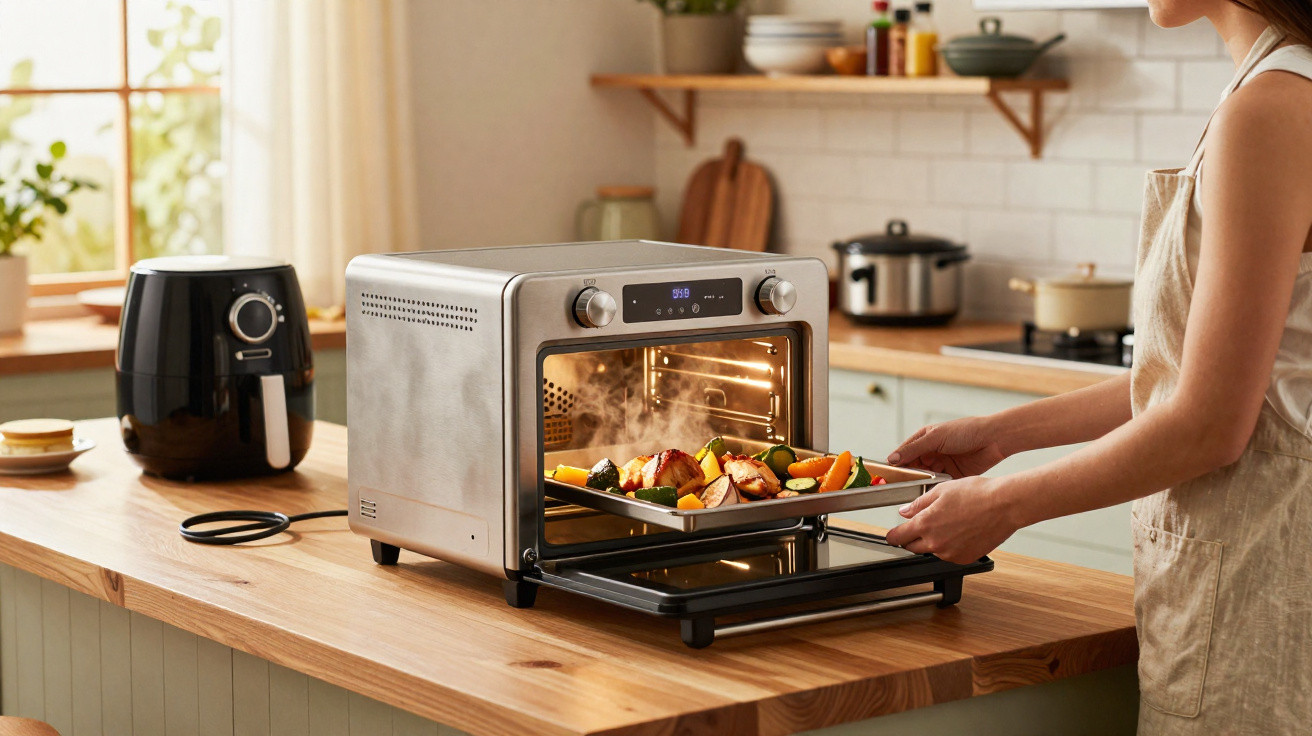
The first time I saw one, it looked as though a bulky Bluetooth speaker and a miniature oven had produced a child. There was no basket or clattering drawer: only a shiny cube quietly whirring on the worktop of a small London flat. In a TikTok video, a creator waved goodbye to her air fryer and petted the new appliance as though it were a companion. The comments were raging. “This is just a fancy oven.” “No, it’s a lifesaver, you don’t get it.” The algorithm amplified the video, the brand name was trending by the next day, and food writers and chefs found themselves fielding one repeated question: does this mark the end of the air fryer era? Its claim is ambitious: a single appliance that replaces nine others. The truth is more complicated.
Our kitchens are changing, whether everyone is prepared for it or not.
From air fryer favourite to multi-cooker powerhouse
The original air fryer came with an easy proposition: make food crispier with less oil, more quickly than an oven, without warming the entire home. It was straightforward to market and equally simple to grasp. This newer generation of “9‑in‑1” worktop ovens and smart cookers arrives with a far more extensive list of credentials. They can air fry, steam, slow cook, grill, toast, bake, dehydrate and sous-vide; certain models can pressure cook as well. It is a lot to take in before the appliance has even been switched on. But browse any home-cooking group and the pattern is familiar: air fryers are being stored away, donated or relegated to a cupboard as one multi-purpose device gradually claims the centre of the worktop.
Consider Emma, 34, who lives in a tight Manchester flat whose galley kitchen is scarcely wider than the fridge. Last winter, she had an air fryer, bread maker, rice cooker, smoothie blender and slow cooker, all arranged Tetris-style on one shelf. “Every time I wanted to cook, I had to move something to the sofa,” she laughs in one viral Instagram Reel. When a friend introduced her to a new 9‑in‑1 worktop oven, she was doubtful. After two months, she shared an image of a half-cleared shelf captioned: “Goodbye air fryer, hello one box to rule them all.” Her former appliances were sold on Vinted within a weekend.
Brands have noticed what people need. Energy costs have risen, homes are more compact and consumers are looking for fewer possessions that can handle more tasks. Heating a freestanding oven for one person’s dinner can seem excessive, while a dedicated egg cooker can feel needlessly wasteful. A multi-purpose appliance aims to bridge that gap, combining the focused heat of an air fryer with the flexibility of a full oven and the speed benefits of a pressure cooker. Chefs are divided: the technology is clearly ingenious, but the advertising can resemble a magic act. No single device can perform nine jobs flawlessly, yet for many weekday meals, “good enough and fast” is preferable to “perfect and fussy.”
How a 9‑in‑1 gadget reshapes your kitchen routine
Operating one of these newer all-in-one appliances is unlike using an air fryer. Rather than shaking a basket and crossing your fingers, you select a setting as you might choose a playlist: steam-crisp, grill, roast, bake, slow or pressure. Numerous models offer small onscreen instructions, telling you to add water, turn the food or open the vent. Add chicken and potatoes, select an automatic programme, and the cooker can move from pressure cooking to air-crisping without further input. In practical terms, the main oven remains off on a Tuesday evening as this one box becomes the default cooking option.
There is a genuine learning curve, and this is the point at which some owners give up. They unpack the appliance, become daunted by its buttons and settings, use only the air-fry function and then decide it is “just a big air fryer.” Anyone who has felt bad about an unused appliance gathering dust will recognise the feeling. Those who truly replace nine gadgets generally make one modest change: they try one new feature each week. In week one, they pressure cook a stew. In week two, they steam vegetables. In week three, they grill halloumi rather than using a frying pan. Gradually, through changed routines alone, the rice cooker and slow cooker cease to be necessary.
“As a chef, I don’t believe one tool can be perfect for every technique,” says London‑based chef consultant Marco Bellini. “But in a tiny flat with a single plug and no ventilation, I’ll take a 7 out of 10 for nine jobs over a 10 out of 10 for just one.”
- Begin with settings that replace the appliances you use most - such as the rice cooker, toaster and air fryer - before experimenting with more advanced programmes.
- Put a straightforward cheat sheet on the fridge with the timings and temperatures for three regular meals you genuinely make.
- Make practical substitutions: food that fits in your former air fryer basket can go on the crisping tray, while food normally made in a slow cooker can be tried using pressure or slow mode.
- Recognise that certain specialist appliances still perform better - including a serious espresso machine or high-end blender - and that is perfectly fine.
- Let’s be honest: nobody really reads the entire manual cover to cover every single day.
The 9‑in‑1 kitchen identity crisis nobody mentions
There is an unspoken reason this appliance provokes such strong reactions. The debate is not merely about food; it is also about identity. The air fryer offered an uncomplicated narrative: you are the resourceful home cook who gets dinner sorted in 15 minutes. A 9‑in‑1 appliance presents another version of the story: you are a minimalist with one clever box who can roast, steam and bake like a professional. Some chefs object because it softens the distinction between skill and convenience. Some parents love it because dinner reaches the table with less washing-up and disorder. Both responses show just how emotionally charged our kitchen worktops have become.
It reflects a generational change, too. Younger renters unable to replace old, unreliable ovens depend on worktop appliances. Empty nesters moving into smaller properties may not want cupboards full of cumbersome gadgets to clean and maintain. Energy-aware households appreciate that these machines can often consume less electricity than preheating a full-sized oven for one tray of food. Conversely, committed bakers object to uneven browning on delicate pastries, while barbecue purists scoff at the thought that a “grill mode” could replace real flames. Each view is valid, depending on the food being cooked.
The more useful question, then, is not “Is this the end of the air fryer?” but rather: “What kind of cook do you want your kitchen to support?” If you enjoy ritual and cooking with cast iron, this machine may always remain a supporting act. If you live in a studio flat where the oven is also used for shoe storage, it could take centre stage. The simple reality is that no brand can create a box that resolves taste, time, space and cost for every person simultaneously. It can, however, prompt a practical assessment of which appliances we genuinely use and which we keep only from habit.
| Key point | Detail | Value for the reader |
|---|---|---|
| Space and clutter | One 9‑in‑1 unit can realistically replace 3–5 everyday gadgets for many households | Helps you choose what to retain, sell or donate before the kitchen becomes overcrowded |
| Learning curve | Trying one new mode each week changes the appliance from a “big air fryer” into a genuine multi-tool | Helps the investment earn its place rather than collecting dust on the worktop |
| Cooking style | Excellent for quick, family-style meals; less suited to highly precise baking and specialist jobs | Enables you to assess whether the gadget suits your real everyday cooking, rather than its marketing promise |
Frequently asked questions
- Question 1: Can one 9‑in‑1 gadget really replace nine separate appliances?
- Answer 1: In marketing terms, yes; in everyday use, most owners employ it in place of three to six appliances they genuinely used, including the air fryer, toaster, rice cooker and slow cooker. Specialist equipment, such as high-end blenders or espresso machines, usually remains.
- Question 2: Is food from a 9‑in‑1 as crispy as from a normal air fryer?
- Answer 2: For chips, nuggets and vegetables, most users say the crispiness is very similar, particularly with models that have powerful top heating and a fan. Capacity is the key difference: many multi-cookers hold more at once, so a quick shake or tray rotation may be needed.
- Question 3: Does this kind of gadget really save energy?
- Answer 3: Yes, for small to medium meals, as it heats a compact area and often cooks more quickly. For large-batch baking or sizeable roasts, a full oven may still use energy more efficiently per portion. The greatest savings generally come from avoiding lengthy oven preheating.
- Question 4: Is it safe to pressure cook and air fry in the same machine?
- Answer 4: Certified models are designed specifically for this combination, incorporating safety valves, locking lids and automatic pressure-release systems. The main risk comes from the user rather than the appliance: staying below the maximum-fill lines and adding enough liquid when pressure cooking keeps use within its design limits.
- Question 5: Should I get one if I already love my air fryer?
- Answer 5: If you use your air fryer constantly and rarely need the oven, an upgrade makes sense only if you also intend to remove other appliances, such as the slow cooker or rice cooker. If air frying and toasting are your main needs, your existing arrangement may already be the sweet spot.



Comments
No comments yet. Be the first to comment!
Leave a Comment