
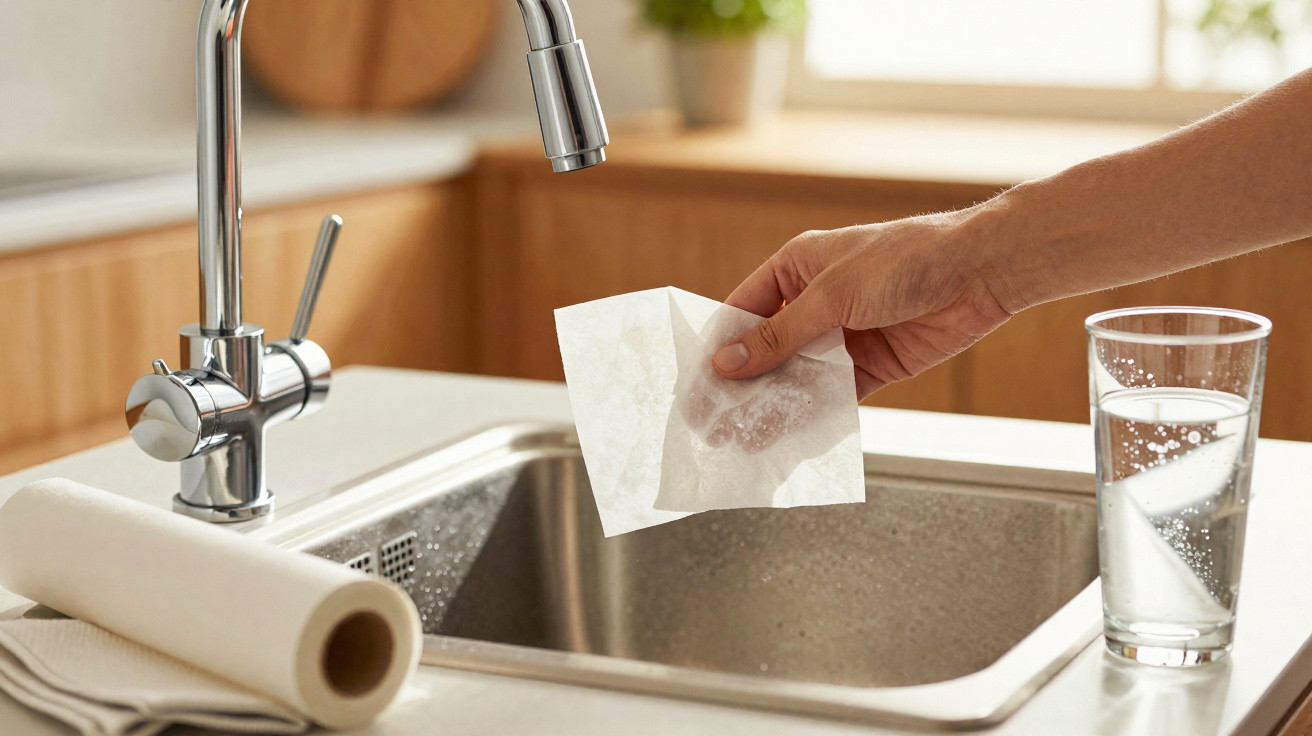
If you live in an area with ‘hard’ tap water, you will know the issue: you have barely finished cleaning the bathroom before the taps look dull again, marked with white rings and spots. Many people, frustrated by this, reach for yet another anti-limescale spray. Yet an ordinary item from the kitchen drawer can help fittings stay clean-looking and shiny for up to a week.
Why limescale clings so stubbornly to taps
Depending on where you live, tap water contains varying amounts of minerals, particularly calcium and magnesium. The greater their concentration, the ‘harder’ the water is – and the more quickly deposits settle on surfaces.
When water is heated or evaporates slowly, these minerals are left behind. On chrome, stainless steel or enamel, they show up as:
- a cloudy film across the tap
- small white rings around the base of the fitting
- deposits inside the aerator (mixing nozzle), which alter the water flow
This is not merely an unsightly effect. Heavy limescale can reduce water pressure, make the stream spray in every direction and, over time, damage seals and surfaces.
Although many shop-bought cleaning products remove such deposits reliably, they often contain acids and fragrances that can bother sensitive noses and may wear down shiny coatings when used frequently. Natural alternatives such as vinegar or citric acid are gentler, but they need time to work and must be rinsed off thoroughly.
“If you stop limescale from building up properly in the first place, you will need to scrub stubborn deposits far less often – and that is exactly where the baking parchment trick comes in.”
Baking parchment for limescale protection: how it works
The key is an item found in almost every kitchen: baking parchment, also known as baking or cooking paper. It has a thin non-stick coating that prevents dough and oven dishes from sticking. On taps, this same coating has a surprisingly useful side effect.
Rubbing a dry tap with baking parchment essentially does two things:
- It gently lifts light limescale haze and water marks mechanically, without scratching.
- It leaves behind an extremely thin, water-repellent film on the surface.
This film encourages water to form droplets rather than spread into a layer. As a result, fewer tiny pools dry onto the surface and noticeably fewer visible limescale rings develop. Many users report that their fittings look clean for much longer – typically for around five to seven days.
Step by step: how to use the baking parchment trick properly
For the method to work properly, the order matters. This simple routine takes only a few minutes.
1. Dry the fitting completely
First, carefully wipe the tap with a dry microfibre cloth. Remove every droplet, especially those around the base of the tap. The fine coating from the baking parchment can only work evenly on a dry surface.
2. Prepare the baking parchment
Tear off a piece of baking parchment and loosely scrunch it into a soft ball. Avoid hard corners that could scratch; the ball should mould gently to curved areas.
3. Rub gently over every surface
Using light pressure, go over the following areas:
- the spout and the top of the tap
- the lever handle or twist controls
- the join between the fitting and the sink or basin
- pull-out spray heads, where applicable
One to two minutes is enough. The aim is not to scrub, but to polish lightly.
4. Give it a quick final polish
Finish by briefly wiping the tap again with the microfibre cloth. This spreads the invisible film evenly and makes the surface look shinier straight away.
“Many users report: polishing with baking parchment once a week is enough to keep the fitting looking freshly cleaned for much longer.”
When the trick reaches its limits
Baking parchment is most suitable for maintenance and prevention, rather than rescuing taps that are already heavily encrusted. If thick layers of limescale are present or water is only coming out in a thin stream, thorough descaling is needed first.
The following approach has proved effective for heavily soiled fittings:
- Unscrew the aerator (mixing nozzle) and soak it in warm vinegar for several hours.
- Wrap badly scaled areas with a cloth soaked in vinegar and leave it to work.
- If necessary, use a little bicarbonate of soda or baking powder as well, then rinse thoroughly.
- Dry the fitting completely – only then should baking parchment be used again.
Once the heavier build-up has gone, the weekly baking parchment treatment takes over as the maintenance step. This keeps new deposits thin and easy to remove.
Where baking parchment is best avoided
The method works very well on polished chrome and stainless steel. Care is advisable with other materials:
- Black or matt fittings: Test first in an inconspicuous spot to check whether it causes streaks or differences in sheen.
- Stone surfaces around the tap: Natural stone, including marble and travertine, should generally be protected from experiments because it is sensitive to many substances.
- Plastic components: These are usually unproblematic, but a quick test will confirm this.
One point is important: baking parchment is not a replacement for regular cleaning of the basin and surrounding surfaces. The method is mainly for the shiny, visible parts of the fitting that otherwise quickly start to look dull.
The ideal anti-limescale routine in practice
If you would rather not keep relying on specialist cleaners, it is easy to establish a straightforward weekly routine:
| Frequency | Action |
|---|---|
| daily | Briefly dry the fitting with a microfibre cloth after washing up or brushing your teeth |
| once a week | Use the baking parchment trick and polish the fitting |
| every 4–8 weeks | Unscrew and descale the aerator, then clean the fitting more thoroughly |
In homes with very hard water, it can also be worth considering additional aids such as aerators with anti-limescale nubs or, on a larger scale, water-softening systems. These reduce limescale levels throughout the system – from the tap to the washing machine.
Why the baking parchment trick is so popular
Baking parchment owes its appeal to a combination of convenience and spontaneity. It is already in the house, and using it requires neither safety goggles nor rubber gloves, nor any waiting time.
Many people dislike the strong smell of conventional bathroom cleaners or want to use fewer aggressive chemicals for environmental reasons. Baking parchment leaves no scent, does not attack the surface and can significantly reduce the need for sprays. Those with young children or pets often feel more comfortable using gentler methods too.
Keeping the risks and limitations in mind
Even so, the trick should not be used without a critical eye. Baking parchment is designed for single use and is often coated paper that cannot always be placed in paper recycling. Anyone who uses a great deal of it simply shifts the issue – from cleaning products to increased waste.
It therefore makes sense to use small pieces and to polish several fittings with one sheet in succession, such as the kitchen and bathroom taps in one go. This keeps material use manageable.
The effect may also be limited for people with extremely limescale-rich water. If water constantly dries on the fitting, visible rings will eventually reappear despite the film. In these cases, it also helps to adjust everyday habits: wipe surfaces briefly after showering, alter the water flow and avoid splashing.
What ‘hard water’ actually means
To understand why your own tap becomes affected so quickly, check the water hardness information from your local supplier. It is usually stated in ‘degrees German hardness’ (°dH):
- 0–8 °dH: soft water – few limescale problems
- 8–14 °dH: medium hardness – regular maintenance is worthwhile
- over 14 °dH: hard water – limescale protection is particularly beneficial
The higher the figure, the more you stand to gain from preventive measures such as the baking parchment trick, combined with sparing descaling and thorough drying.
Anyone who tries this kitchen helper for a few weeks will quickly see whether their own fitting stays looking freshly cleaned for noticeably longer. Especially in the bathroom, where taps are constantly used, this tiny routine can make the difference between ‘always cleaning’ and ‘a quick freshen-up is enough’.



Comments
No comments yet. Be the first to comment!
Leave a Comment