
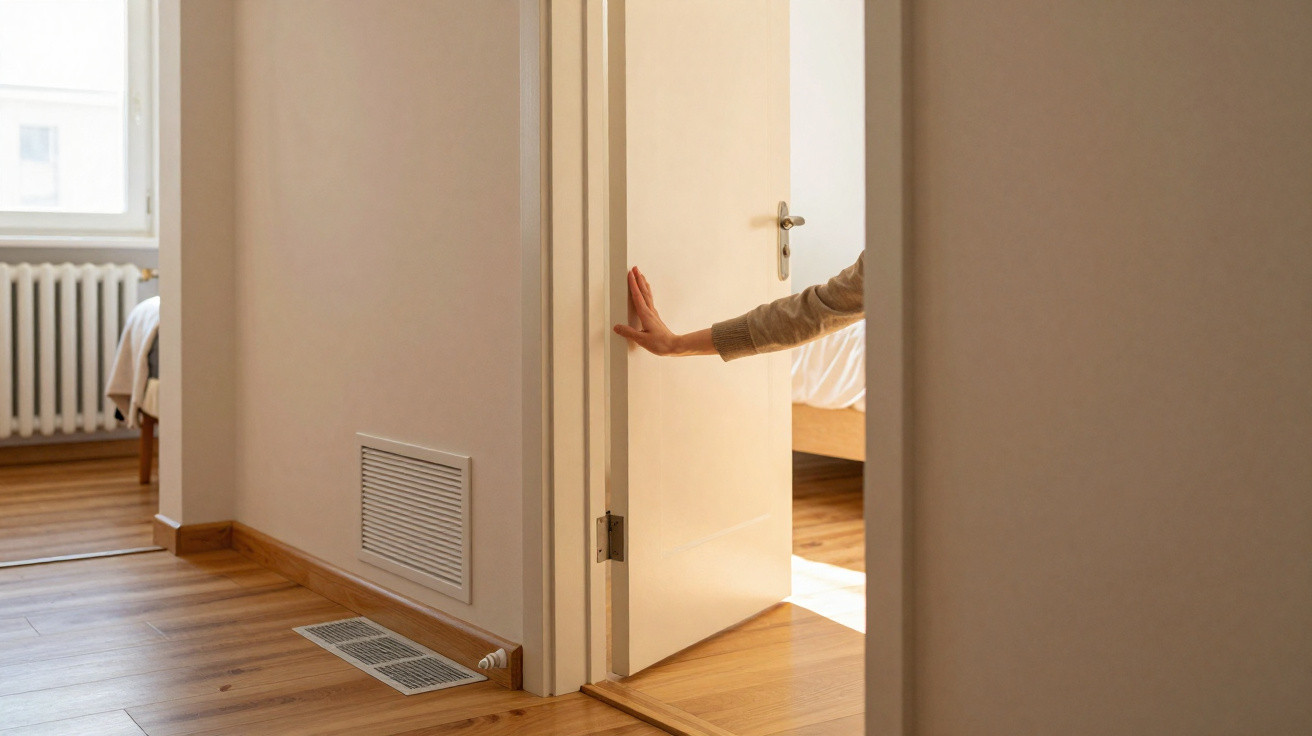
A door left slightly open can make more difference than you might expect.
When temperatures drop, it is tempting to turn up the thermostat, shut every internal door and hope the heat stays put. But whether that actually keeps your home comfortable and your bills under control depends less on winter itself than on the way warm air circulates through your rooms.
Why the way you heat a home depends on air flow
Heating is not simply a case of a boiler, furnace or heat pump producing warmth. It also depends on how warm air moves, mixes and returns to the system. Poor circulation can leave one room stuffy and another cold, while the heating continues running in an effort to reach a balance it never quite achieves.
Good heating is as much about air movement as it is about temperature settings.
Every home has its own air “personality”. Open-plan flats with a central hallway work differently from older houses divided into lots of smaller rooms. Radiators beneath windows distribute heat differently from ceiling vents or wall-mounted units. Once internal doors are involved, air can either move freely or become trapped where it is least helpful.
That is why a blanket rule such as “always shut doors to keep heat in” can be misleading. Closed doors help in some homes. In others, they can quietly work against the heating system, making it run longer and harder without delivering much extra comfort.
Central return vs room-by-room: know your system first
Before choosing what to do with your doors, it helps to understand your heating and ventilation layout. Modern systems generally fall into two broad categories.
Homes with a central return grille
In many US and UK homes with forced-air heating, there is a large “return” grille in a hallway or living area. Used air is drawn back into the system there, filtered and reheated. For this cycle to work well, air needs a clear route from each room back to that central point.
With a central return, closed doors can trap air in rooms and starve the system of what it needs to work efficiently.
When bedroom or home office doors remain closed for extended periods, the warm air being supplied has no easy way out. Pressure rises slightly in those rooms, while the hallway, where the return grille is often located, can become relatively under-supplied. This leads to uneven temperatures and a system that keeps running as it struggles to meet the target temperature evenly.
In more severe cases, a fan fighting these pressure differences may wear out sooner. Parts are put under extra strain, and the system can short-cycle or run almost constantly during cold weather. You may not notice the physics, but you could notice the repair costs a few years down the line.
Homes with individual returns in each room
Some properties, particularly newer or more expensive ones, have return grilles in every heated room. In this arrangement, air follows a smaller local loop: it enters and leaves the room without needing an open route to a central hallway.
In these homes, you have more flexibility. Closing a bedroom door does not interrupt the system because each room can “breathe” independently. Whether doors are open or shut becomes more about comfort, privacy and noise control than an important energy-saving measure.
- If you have one large grille in a hall: keeping doors mostly open while heating is on is usually best.
- If each room has its own supply and return: doors can be closed without a major effect.
- If you are not sure: see where air is being drawn in when the fan is running.
Common mistakes that stop your home heating properly
Heating engineers see the same issue repeatedly: rooms described as “cold” are often not underpowered, but poorly served by air movement. Closed doors can contribute, though they are rarely the only cause.
A lot of “cold room” complaints come down to blocked air paths, from doors to furniture to clogged filters.
Here are common problems that reduce comfort and increase costs:
| Problem | What happens | Simple fix |
|---|---|---|
| Closed doors with central return | Rooms overheat or stay cool, hallway sensor reads wrong, system runs longer | Keep doors open when heating, especially during long run times |
| Blocked vents or radiators | Sofas, curtains or beds trap heat against walls | Leave a clear gap in front and above heat sources |
| Clogged filters | Fan works harder, less air reaches rooms, noise increases | Check and replace filters every 1–3 months in winter |
| Leaky windows and gaps | Warm air escapes faster than the system can replace it | Use draught strips, heavy curtains, and fix obvious gaps |
| Closed internal vents | People shut “unused” rooms, upsetting system balance | Keep most vents open; ask a pro before shutting many off |
So, should you keep doors open or shut in winter?
If you use forced-air heating
In homes with a furnace or air-source heat pump and a central return, leaving doors at least partly open during heating hours usually allows the system to work more effectively. This is especially useful for rooms that never seem to match the thermostat reading in the hall.
Doors do not have to be wide open. Even a 5–10 cm gap can give air a route out of the room and back towards the return grille. Some households use undercut doors or unobtrusive transfer grilles above doors so air can move even when doors are closed.
If you rely on radiators or electric heaters
In UK homes using hot-water radiators without mechanical ventilation, the situation is slightly different. There is no ducted return, so internal doors have less effect on the system itself. Instead, you are weighing up heat retention against circulation.
Open doors allow warmth to drift into cooler areas of the home, helping reduce cold spots but also spreading heat into rooms you use less. Closing doors can keep one room cosier, particularly overnight, though hallways and neighbouring rooms may feel much colder.
With radiators, closing a door can create a cosy bubble, while open doors even things out across the home.
For electric space heaters, closed doors often make sense for both safety and efficiency. The heater can warm a defined room more quickly without sending energy into unused spaces. Just avoid sealing the room so tightly that moisture builds up; a short airing once or twice daily can help.
Practical winter scenarios: what actually works
Scenario 1: busy family home, central return
Parents are in the living room, teenagers are in their bedrooms, and everyone keeps doors shut for privacy. The hallway thermostat reads 20°C, yet one bedroom feels freezing and the furnace runs for long periods.
Trial change: leave bedroom doors open during the day and early evening, then shut them only at night. Add a draught excluder at the front door and clear the area in front of every vent. After a week, bedroom temperatures are more even, and the heating cycles become calmer and shorter.
Scenario 2: small flat with radiators
A one-bedroom flat with a gas boiler and panel radiators loses warmth through old windows. The occupant usually leaves every door open in an attempt to “share out” the heat.
Trial change: close the living room and bedroom doors in the evening, with thermostatic radiator valves set sensibly. The hallway becomes cooler, but both main rooms feel warmer at the same boiler setting. Heavy curtains at the windows further reduce the need to increase the thermostat.
Extra tips that pair well with smart door use
Door position is only one part of the picture. Pairing it with a few straightforward habits can improve comfort and reduce costs over the winter.
- Use a steady thermostat setting rather than making large jumps up and down.
- Bleed radiators once or twice each season if the top feels cold.
- Keep large furniture at least a few inches away from radiators or vents.
- Seal obvious draughts around skirting boards, loft hatches and letterboxes.
- Arrange a check-up for older systems that run almost constantly.
Two terms are useful to remember. “Supply air” is the warm air blown or pushed into a room. “Return air” is the air drawn back to be reheated. In ducted homes, doors alter the route between those two points. In homes with radiators, doors affect how long warm air remains where you want it.
On the coldest days, the best approach is often a combination: leave doors open when you need more even heating and healthy air movement, and close them when you want to hold warmth in a room you are using. Watching how your own home responds over a few winter evenings will tell you more than any one-size-fits-all rule.




Comments
No comments yet. Be the first to comment!
Leave a Comment