
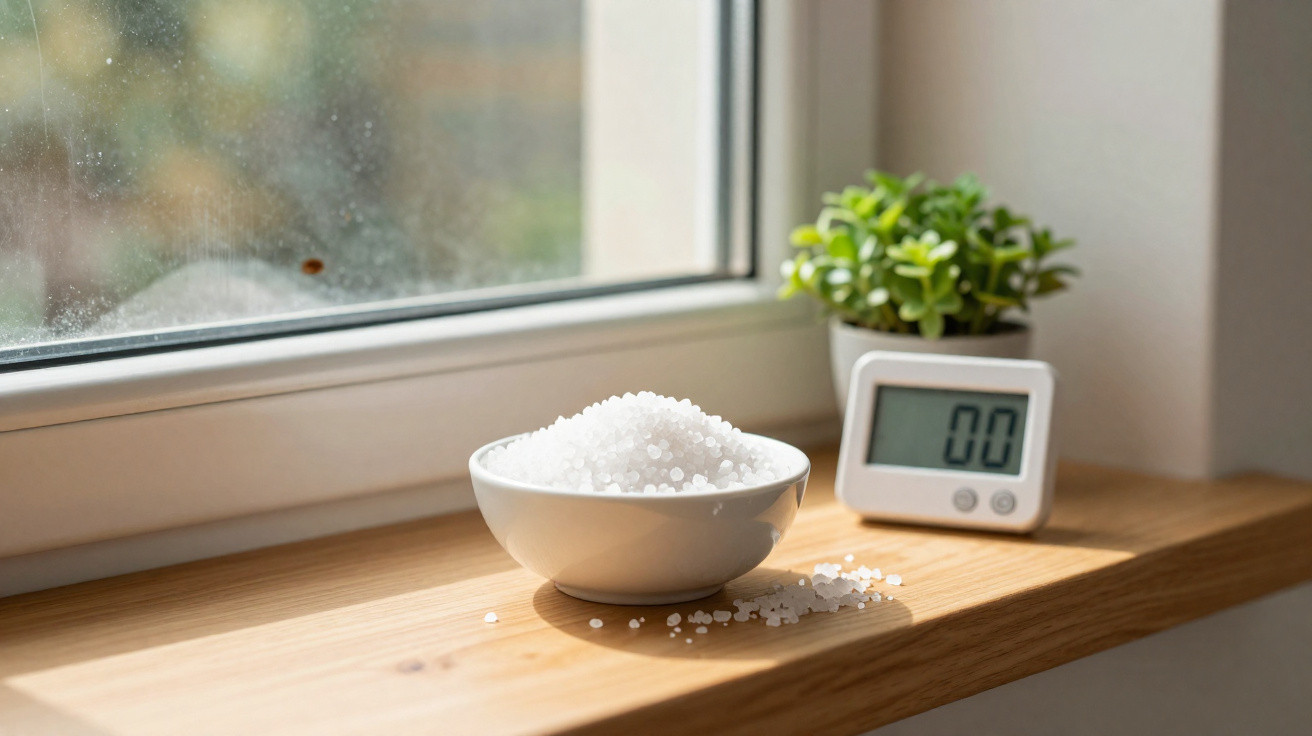
Damp walls, misted-up windows and a faint musty smell you cannot quite identify: this is the sort of indoor humidity that quietly takes hold and welcomes mould. One scientist insists there is an inexpensive, straightforward moisture buffer already in your kitchen: a bowl of salt placed in the corners.
The paint had blistered near floor level, the wardrobe carried a stale odour, and condensation left the window sills damp by morning. Beside the cold exterior wall was what appeared to be a cereal bowl of rock salt, slightly clumped together, with a small pool underneath resembling tears.
He gave a shrug, looking almost sheepish. “The lab trick,” he said. “Salt eats water.” The scientist in me objected, but by the end of the week the bowl was heavier and a shiny layer of brine had appeared. Somehow, the room felt calmer. It was only table salt.
The subtle physics of a bowl of salt
Look closely at a bowl of coarse salt on a humid morning and it will first form a crust before becoming slippery. Leave it for a day or two and the crystals will collapse into a watery layer at the base. There is no magic involved; it is simple kitchen chemistry.
Salt attracts water molecules from the surrounding air. As it takes in that moisture, its surface dissolves and produces a salty liquid that continues drawing in more water. Moisture is persistent, but an ordinary bowl can at least slow its progress.
In a quick home experiment, I weighed a bowl containing 500 g of rock salt and placed it in a bathroom that regularly reached 70% relative humidity. After 48 hours, it was 85 g heavier. Brine was clearly visible - enough to wobble when touched with a fingertip. It was not a flood, but it was certainly something.
The same arrangement in a drier bedroom, at around 50% RH, changed very little. A neighbour put two bowls in a cupboard that remained at 72% RH; across a week, his inexpensive hygrometer recorded a daytime fall to 64%, while the musty smell became less noticeable. The space was not bone-dry, but it was less welcoming to mould.
The science behind it is elegant. Salt is hygroscopic, which means that it attracts water vapour. At room temperature, ordinary sodium chloride begins to liquefy actively - a process known as deliquescence - once the air reaches roughly 75% relative humidity. The resulting brine keeps drawing in moisture, altering the microclimate around the bowl.
Even local reductions in humidity can make a difference. Most household moulds flourish when air remains above 60% RH for extended periods, particularly beside cold surfaces where thin films of water develop. If a little brine helps keep the air close to that wall within the 50–60% range, mould colonies develop more slowly. Less fuzz. Less odour.
Where to put a salt bowl and how to use it
Keep the approach simple. Choose a wide, shallow ceramic or glass bowl and fill it with coarse salt; rock salt or kosher salt are both suitable. A broader surface lets more air reach more crystal edges. Place one bowl in each small room, or two in a large bedroom, positioning them in the coldest corners or beneath windows where condensation gathers.
For a neater arrangement, place a colander or mesh strainer inside a larger bowl, keeping the salt above and the brine below. Set it on a coaster to protect the floor. When liquid begins to collect, tip it away, replenish the salt and expose the bowl to fresh air. Change the brine weekly when it becomes soupy.
We have all had the moment when an odour makes us wrinkle our nose and think, “Something’s growing.” Realistically, nobody manages this every day. Instead, choose one day - Sunday, for example - to inspect the bowls, wipe down cold corners and open a window for ten minutes. Keep salt away from unprotected metal because brine encourages rust. If you have pets or young children, position bowls out of reach, as salty water is not safe for drinking.
If a room feels particularly clammy, run a fan on a low setting to move air across the salt’s surface. Combine this with small practical habits: cover boiling pans, keep lids on laundry baskets and leave doors ajar after showering. Target under 60% RH using a basic hygrometer; they cost less than a takeaway. The bowl is there to assist, not to solve everything.
Treat it as triage. A bowl can reduce humidity spikes, but leaks and cold bridges still determine the underlying problem. As Dr. Lina Mercer, an indoor air scientist I spoke with, told me:
“Salt is a buffer. It trims the top off daily humidity spikes, especially in small, closed zones. It doesn’t cure water getting in - it buys you time to notice and fix it.”
- Open trickle vents or windows for 5–10 minutes twice a day.
- Dry clothes near a window or outdoors whenever possible.
- Use pan lids while cooking, then run the extractor for 10 minutes afterwards.
- Maintain steady heating on cold days to prevent cycles of condensation.
- Look for concealed leaks; salt cannot overcome a drip.
What a bowl of salt cannot replace - and why it still helps
One point bears repeating: salt cannot remove water from a wall or a leaking pipe. It will not prevent rainwater ingress or repair a thermal bridge behind a wardrobe. Its role is to reduce the humidity peaks that encourage surface dampness and mould, particularly in stagnant corners. In very small rooms, cupboards and under-sink spaces - areas where a dehumidifier may not fit or might seem excessive - salt can be a quiet, useful ally.
There are also limits to its performance. Standard table salt becomes properly effective only above approximately 75% RH, so in less humid conditions it offers more of a gentle nudge than a strong pull. That can still be worthwhile: mould is opportunistic, but it develops slowly. For greater capacity, calcium chloride desiccants and plug-in dehumidifiers are available for good reason. Begin with salt, monitor your RH for a week and make a decision based on evidence rather than instinct. Your nose will often notice the difference first.
| Key point | Detail | Benefit for the reader |
|---|---|---|
| How salt works | Hygroscopic crystals create brine above ~75% RH, drawing moisture from nearby air and surfaces | Understand the mechanism and identify where it is most effective |
| Best placement | Use wide, shallow bowls in cold corners, near windows and inside cupboards; refresh them weekly | Practical measures that can improve everyday air quality |
| Limits and upgrades | Salt moderates peaks; repair leaks, ventilate, and use stronger desiccants or dehumidifiers if RH remains high | Select the appropriate solution and avoid wasted effort |
FAQ:
- Will any salt work, or do I need special crystals? Any sodium chloride will work, but coarse grains provide more surface area and clump less. Rock salt or kosher salt is better than fine table salt.
- How much humidity can a bowl of salt remove? In small rooms at 60–75% RH, expect a modest reduction and less condensation near the bowl. It is a buffer rather than a full dehumidifier.
- Is this safe around children and pets? Keep bowls out of reach. Brine is highly salty, may cause stomach upset and can corrode nearby metal surfaces if spilled.
- How often should I replace the salt? Refill it when it forms a crust or turns liquid. Pour away brine and refresh it weekly during damp seasons, or monthly in milder periods.
- Why not simply buy a dehumidifier? You should if RH remains above 60% or mould continues to appear. Salt is cheap and silent, making it useful for cupboards and corners, whereas machines can manage entire rooms.



Comments
No comments yet. Be the first to comment!
Leave a Comment