
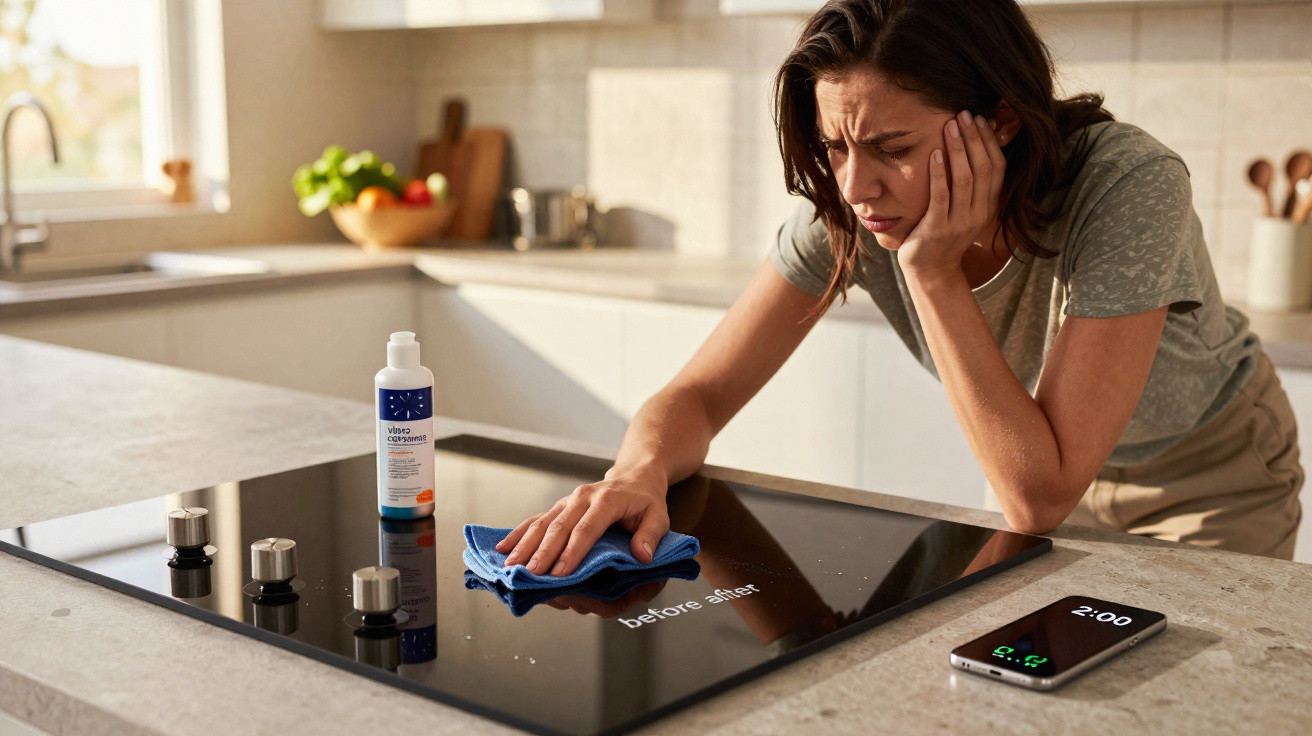
On a quiet Tuesday evening, Emma bent over her brand-new glass-ceramic cooktop and stopped cold. Under the unforgiving light beneath the cupboards, a fine white mark cut across the black finish, looking as damaging to her mood as a crack.
She had owned it for only six months. No pan had been dropped and there had been no dramatic cooking mishap - only a scrape that refused to disappear when cleaned.
By the weekend, she was in her kitchen looking at a quote of almost £300 from an appliance repair firm to “refinish” the surface. The technician’s warning was still playing on her mind: “If you don’t deal with it quickly, it’ll get worse.”
Later that night, while browsing on her phone, she found a home-repair group where someone casually said that these marks could be removed within minutes using products already found in many homes.
That was when her frustration truly set in.
Why small glass-ceramic cooktop scratches can cost so much
Across the country, glass-ceramic cooktop owners are experiencing the same sinking feeling as Emma. One pale line on a glossy black surface can make an entire kitchen appear worn, dated or even unclean.
Repair companies understand the impact. These polished, showroom-style surfaces have become a focal point in modern kitchens, meaning even the smallest imperfection is immediately noticeable.
So, when a specialist says, “You really should get that professionally repaired,” people tend to take the advice seriously, particularly when the alternative seems uncertain or potentially unsafe.
However, a growing number of appliance technicians and DIY experts are sharing a different view. They say that many supposed “scratches” can be lifted, blended or simply buffed out in less than 10 minutes - for the cost of a latte rather than a substantial repair bill.
Browse any home forum and the same story quickly emerges: a concerned photograph of a scratched cooktop, followed by comments such as, “Mine looked like this, I paid £250 to fix it,” or, “They told me the whole top had to be replaced.”
Then there are the dissenting voices. One person recommends a small dab of white toothpaste and a microfibre cloth. Another shares before-and-after images after applying a tiny quantity of cerium oxide glass polish, the type also used for repairing car windscreens.
There are some uncomfortable figures behind these stories. Replacing an entire glass-ceramic cooktop can cost from £350 to more than £700, depending on the brand. Even a visit for “professional buffing and refinishing” can easily exceed £200 after the call-out charge is included.
Set that against a £10 polishing kit or a £4 tube of non-gel toothpaste, and it becomes clear why so many people feel angry.
Some of the misunderstanding comes down to terminology. Consumers often call any white, grey or cloudy surface mark a “scratch”, although these marks are not all the same.
Light scuffs caused by pans, mineral deposits left by boiling water and baked-on residue may sit on the glass-ceramic surface rather than having cut into it. These marks can often be dissolved or polished away using remarkably straightforward methods.
Genuine deep gouges are different and can create a safety concern. This is what professionals concentrate on, sometimes combining reasonable caution with a sales message.
The simple reality is that most everyday cooktop “scratches” are cosmetic surface damage rather than structural failures. Once that is clear, expensive repair quotes can look rather different.
The two-minute glass-ceramic cooktop test before arranging repairs
The first tip that many off-duty appliance technicians share is not a hidden product or specialist tool. It is a quick fingernail check carried out before anyone starts discussing costs.
Gently run a clean, dry fingernail across the mark. If your nail catches noticeably, the surface may have a deeper groove and aggressive DIY polishing could be unwise.
If your nail moves smoothly across it, or only just notices the line, you are likely looking at a superficial scuff, mineral mark or residue. That is the ideal situation for a home treatment.
After that, the method is simple and rather uneventful. Allow the cooktop to cool fully, clear away crumbs, and apply a very small amount of a mild abrasive, such as a dedicated glass-ceramic cleaner, baking-soda paste or plain white toothpaste.
Use a microfibre cloth in gentle circular movements. Apply light pressure and a little patience, then wipe the area clean and check it in bright light.
Many people damage their cooktops long before repair is even considered. It is not necessarily through carelessness, but through anxiety combined with poor advice.
They use the green side of a sponge “just once”, or slide heavy cast-iron pans over the surface instead of lifting them.
Some attack burnt-on marks with razor blades held at awkward angles, leaving small nicks in the glass. Others place hot, gritty pans fresh from the oven repeatedly in one area, pressing micro-scratches into the surface like sandpaper.
We have all had that moment after dinner when, while wiping down the kitchen, we say, “I’ll do a proper clean tomorrow.” Let’s be honest: almost nobody manages it every day.
The more gently you treat your cooktop in daily use, the more forgiving it is likely to be when you later need to polish away minor imperfections.
“People are paying hundreds for what is basically a five-minute polish,” says Marc, an independent appliance technician who now shares tutorials online.
“The industry has every interest in making glass ceramic feel like some mystical, untouchable material. It’s tough, it’s engineered, and yes, it can be cleaned.”
- Safe DIY “scratch check”
Start with the fingernail test, then test a mild polish on a small concealed section before working on visible areas. - Gentle polishing kit
Keep a soft microfibre cloth, non-gel toothpaste or specialist glass-ceramic cleaner, plus a spray bottle of water, beneath the sink. - Professional red-flag signs
- Visible chips, cracks or starburst patterns extending to the edge of the heating zone.
- Scratches that catch your fingernail deeply and pass directly across the active heating ring.
Why the “erased in minutes” method is undermining trust at home
When people learn that a £200 “refinishing” appointment produced the same result they could have achieved with a cloth and a mild polish, something changes. The issue is not only the cost, although that can hurt.
It is also about trust: trust in the term “expert”, and trust in the belief that high-tech surfaces should be handled only by professionals.
Increasing numbers of homeowners are recording their own attempts and sharing failures as openly as successes. One woman films a first try that makes no difference, followed by a second pass using another cleaner under better lighting, where the line visibly fades on camera.
These videos do more than become viral. They quietly alter the idea of who is allowed to “authorise” what happens in the kitchen.
| Key point | Detail | Value for the reader |
|---|---|---|
| Check before you panic | Use the fingernail test and bright light to determine whether the mark is a surface scuff or a deep groove | Avoid rushing into expensive repairs when gentle polishing may be sufficient |
| Start with mild methods | Work on a clean, cool surface, using tiny amounts of toothpaste, baking-soda paste or glass-ceramic cleaner with microfibre | A low-risk, low-cost way to improve the appearance dramatically within minutes |
| Know when to call a professional | Chips, cracks and deep scratches over heating zones may be structural rather than cosmetic | Helps protect your safety and stops concealed damage from worsening |
FAQ:
Can every scratch on a glass-ceramic cooktop be removed?
No. Minor surface scuffs and residue can often be polished out, whereas deep grooves, chips and cracks generally cannot be removed safely and may need professional assessment or replacement.Is toothpaste really safe for my cooktop?
A small amount of plain white, non-gel toothpaste can work as a very mild abrasive on many glass-ceramic cooktops. Test it first in an unobtrusive corner, use gentle pressure and wipe the surface thoroughly afterwards.What products should I avoid completely?
Avoid steel wool, abrasive pads, powdered scouring products and harsh chemical cleaners that are not labelled for glass-ceramic surfaces. They may create fresh scratches or dull areas that no polish can correct.How often should I polish my glass-ceramic surface?
Light polishing is needed only when visible scuffs or hazy patches appear. For everyday care, routine cleaning after cooking with a soft cloth and gentle cleaner is usually sufficient.When is a scratch actually dangerous?
Contact a professional if a mark clearly catches your fingernail, crosses an active heating ring or appears to be a crack or chip. Damage that penetrates the surface can affect heat distribution and safety.




Comments
No comments yet. Be the first to comment!
Leave a Comment