
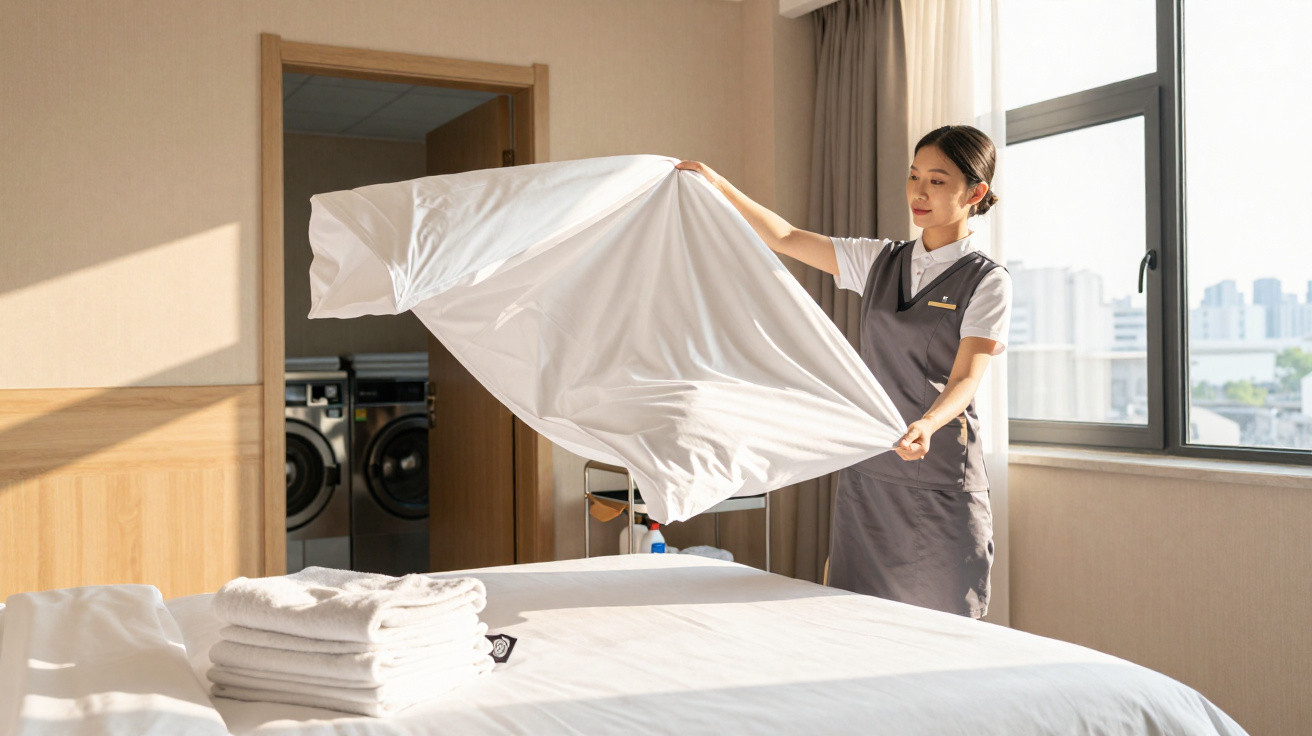
You leave your suitcase by the entrance, tap in with your key card and walk into the room. Before the view, the miniature shampoo bottles or the soft sigh of the air conditioning, one thing commands your attention: the bed. Vast, brilliant and almost dazzlingly white, it resembles a clean page that your life will rumple for a single night.
Without consciously deciding to, you search it for stains. You run a hand across the duvet, forming an opinion of the hotel before you have even checked the bathroom. The bedding passes inspection. It appears clean, safe and almost indulgent.
There is a reason hotels place so much faith in that white rectangle at the centre of the room.
Why hotel beds are dressed in pure white
Once it catches your attention, it is impossible to ignore. Whether you are in a low-cost roadside motel or a five-star palace, the bed nearly always follows the same formula: sharply pressed white sheets, a white duvet and white pillows piled up like clouds.
Everything else can vary, from the carpet colour and headboard design to the lamps. Yet the bed remains a luminous expanse of white, quietly declaring: “You can trust this.” It is neither an accident nor an arbitrary interiors fashion. It is an intentional psychological tactic, refined through decades of testing, mistakes and guest feedback.
Imagine arriving late after a delayed flight, with 3% charge left on your phone and frayed nerves. You open the door to find patterned bedding: perhaps deep red, or green with swirling motifs. You pause. Is it clean? Would a stain even be visible?
Now imagine the same bed made up in plain white. Every fleck is obvious. A hair, mark or shadow can look like a crime scene under a spotlight. Hotels understand that the mind interprets “visible = honest = safer”. A white bed asks to be inspected. Because it invites that scrutiny, it must meet the standard every time.
There is a fiercely practical explanation for this fixation on white, too. White cotton can be boiled, subjected to industrial detergents and bleached repeatedly without developing strange shades. Coloured or patterned bedding, by contrast, fades, streaks, conceals stains and wears poorly.
Hotels therefore adopted the fabric that withstands daily punishment while continuing to look fresh: white. It provides the ideal blend of technical efficiency and psychological reassurance. Guests see cleanliness; laundry managers see a material capable of enduring chlorine and 90°C water without breaking down. Both sides get what they need.
The unseen routine behind fresh hotel sheets
Every white hotel bed is supported by a backstage ballet that most guests never witness. Housekeepers remove and remake dozens of beds during a shift, each one held to the same unspoken expectation: a crisp, taut, snowy-white finish that looks good in photographs and reassures exhausted travellers.
The linen passes through industrial laundries, where loads are sorted, pre-treated, hot-washed and deliberately bleached intensively. Every trace of the previous guest must disappear, not merely for hygiene but for appearance. Whiteness acts as theatrical lighting for cleanliness. Place one slightly yellow pillowcase among the rest and the entire illusion collapses.
Most of us know the feeling: you pull back the duvet and your mind immediately conducts a silent assessment. One loose hair or a greyish edge, and the hotel falls in your personal ranking at once. You may still spend the night, but you are unlikely to return.
Hotels know how unforgiving this instinctive response can be. They therefore err on the side of excess, using several white layers, spare pillowcases, mattress protectors and white mattress toppers, all of which can be washed and bleached. Anything that cannot be restored completely is taken out of circulation. That expense is easier to accept than a negative review referring to “dirty sheets”. Online, a single photograph of a questionable stain can follow a brand for years.
Psychologists refer to “signal value”: the capacity of one visible feature to shape a person’s entire impression. In a hotel room, that feature is the bed. When the sheets appear perfectly white, the brain becomes more relaxed about everything else, including the bathroom, carpet and even the remote control.
White sheets therefore perform two functions. They make intensive disinfection with chlorine and hot water possible, which greatly benefits hygiene standards and housekeeping teams. They also visually demonstrate that nothing is concealed. A white bed is like a hotel saying: here, judge us by the thing you care about most. That is the straightforward reality of modern hospitality.
How hotels keep white sheets truly white
Anyone who has tried to keep white bedding bright at home knows it is not as simple as hotels make it appear. That immaculate finish depends on a process. It begins with quality cotton, generally a hard-wearing, high-thread-count fabric intended to survive hundreds of washes.
Next comes the established routine: a powerful pre-wash, hot wash cycles, particular detergents, precisely measured bleach and quick drying. Housekeeping managers often work from written procedures that resemble laboratory protocols more closely than ordinary domestic laundry habits. They must balance stain removal, fabric durability and an even, convincing white. One careless wash can turn an entire batch yellow.
At home, most of us take shortcuts. We combine colours, add towels, use excessive detergent or put everything through the same “eco” cycle and hope it works out. In truth, hardly anyone follows a perfect regime every day. That is why white fabrics gradually become grey.
Hotels cannot afford that flexibility. White sheets are their calling card and their unspoken TripAdvisor pitch. Loads are separated with military precision, while stains from wine, make-up, blood and coffee are dealt with before they can set. The emotional objective is straightforward: when you get into bed at night, you should not think at all about the person who slept there before you.
“Guests don’t see the laundry room,” a housekeeping manager in Lisbon told me once. “They see the bed. If the bed looks clean, the whole hotel feels clean. White forces us to be honest.”
- Bleaching power
White sheets withstand chlorine-based products and high temperatures without losing their colour. - Immediate stain detection
Every mark is instantly apparent on white, enabling staff to remove damaged or soiled linen quickly. - Psychological reassurance
A bright white bed signals at a glance that the room is fresh and well cared for.
What white hotel sheets reveal about us
Once you understand this, a hotel bed feels different the next time you enter a room. It is no less comforting, but it seems less “magical”. You recognise the strategy, logistics and quiet battle against stains that lie behind its peaceful white surface. You also see your own expectations mirrored there: the desire to feel safe and to believe a space has been cleared of strangers.
White sheets form a contract between you and the place where you are staying briefly. You agree to place your trust in the room for one night. In return, the hotel promises to reveal everything: no patterns, camouflage or dark shades masking yesterday. This is why one tiny mark can trigger such a disproportionate response: it violates that contract.
There is an odd intimacy to the ritual. You arrive weary, unpack your toothbrush and your anxieties, then settle into a bed used by thousands of bodies before yours. The experience only feels acceptable when your senses are persuaded that, for this one night, the bed belongs to you alone. The bright sheets allow your mind to rewrite that story.
Perhaps that explains why so many people want “hotel-style” white bedding at home after an enjoyable trip. It is not solely a design choice. It is an attempt to bring the sensation of a fresh beginning and managed chaos into your own bedroom. White sheets become a small daily equivalent of checking into somewhere gentler than the day you have had.
The next time you draw back a hotel duvet and experience that subtle rush of relief - “Okay, this looks clean” - consider how carefully that moment has been engineered. Rows of humming washing machines, strict processes, large containers of bleach and countless hands tucking in corners precisely all serve that single second when your shoulders relax.
You may still favour coloured sheets on your own bed. Or you may choose to try a white set and discover whether it changes how you sleep. Either way, hotel linens quietly communicate the same message: we know you worry, we know you look, and we are hiding nothing. The rest of the room is decoration. The bed is the message.
| Key point | Detail | Value for the reader |
|---|---|---|
| White permits bleaching | Pure cotton sheets can be hot-washed using chlorine-based products | Helps you understand how hotels maintain hygiene on a large scale |
| White signals cleanliness | Stains are easier to see, reassuring guests that nothing is concealed | Gives you a clearer way to assess rooms when travelling |
| Standardised appearance | The same white bed appears in budget stays and luxury suites | Helps you recreate a “hotel feel” at home through simple choices |
FAQ:
Why do almost all hotels use white sheets now?
White sheets can be extensively bleached and washed at high temperatures, making them easier to keep hygienic and visibly clean, which reassures guests.Is white bedding actually more hygienic than coloured bedding?
Not by magic, but white tolerates stronger products and makes stains obvious, so in practice it often ends up cleaner.Do luxury hotels use different sheets than budget hotels?
Often yes in quality and thread count, but both usually choose white cotton to allow the same industrial washing and bleaching process.Can I get the same “hotel white” effect at home?
You can get close by choosing good-quality white cotton, washing hot when the fabric allows, treating stains quickly, and using oxygen-based bleach.Why do some older hotels still have patterned bedspreads?
These are often decorative covers; underneath, most have moved to white sheets and duvets to meet guest expectations of visible cleanliness.




Comments
No comments yet. Be the first to comment!
Leave a Comment