
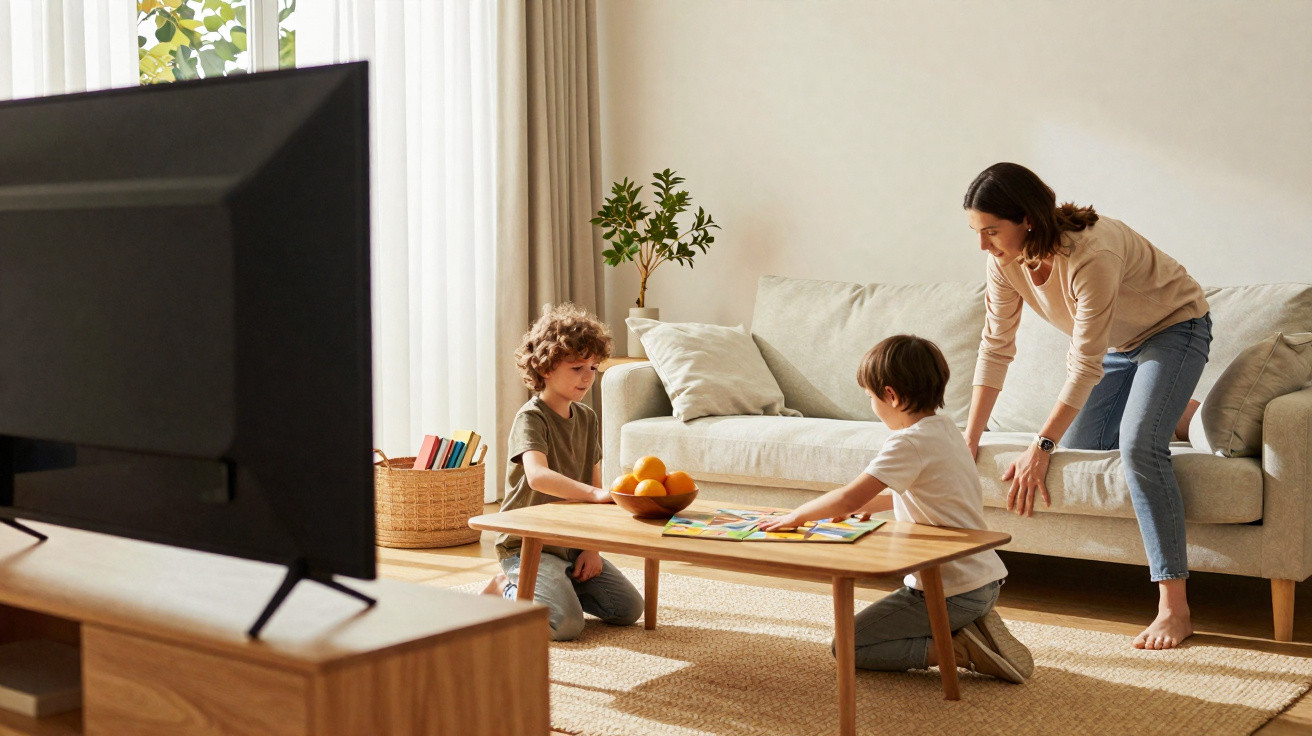
The image has become almost a cliché.
A family of four sits in a bright living room, illuminated less by the afternoon daylight than by separate screens. The television hums away behind them; the teenagers swipe through their phones, while the parents partly follow a series and partly reply to emails. No one is arguing, but no one is speaking either.
Nothing in the room feels unfriendly. The sofa is comfortable, the rug is warm and framed photographs hang on the walls. Even so, every item of furniture is directed towards the same point: the television. Each chair, sofa and supposedly cosy nook functions as a seat in a miniature private cinema. The room’s message is unmistakable: here, we watch rather than connect.
Turn just one armchair by ninety degrees, however, and something curious happens. Faces orient towards one another. Eyes meet. One person makes a remark and somebody else responds. It is the same family, on the same day, with the same screens within reach, but the arrangement has changed. So has the entire evening.
Why your sofa is quietly deciding how much your family talks
In most living rooms, you can identify the main activity within seconds. Seating arranged in a tidy line? The television is in charge. An enormous corner sofa pressed along the walls, with everyone absorbed in their own personal spot? That is a Netflix arena, not somewhere designed for conversation. We seldom consider it, but furniture placement gives us unspoken directions: “Look over there, not at each other. Unwind alone, not together.”
The gap between two chairs, the position of a coffee table and the television’s height may seem like matters of decoration, not psychology. Yet our bodies respond to these signals almost automatically. When staring ahead is the simplest option, that is what you will tend to do. When looking at another person’s face is marginally easier, you are more likely to do that instead. Every evening, your living room layout is making small choices on your behalf.
A London interior designer once told me that she can identify screen-first homes in less than a minute. In one family home she visited, all five living-room seats were positioned against the walls and faced a huge television, much like a home cinema. The parents insisted that they “barely watched any” television during the week. Their teenage son quietly rolled his eyes. After they turned one armchair to face the sofa and moved the television slightly to one side, weekday arguments over “too much screen time” dropped within a month.
You do not need a formal study to recognise the pattern, although research figures are available. One survey by a US home retailer reported that families with conversation-centred layouts - where furniture faced inward in a loose circle - said they ate together and spoke more often in the evenings. Another found that children in homes where the television was not the room’s visual focal point spent more minutes each day in unstructured play. These are not vast or dramatic changes. They are gentle prompts, but prompts repeated daily turn into habits.
At its most basic, the explanation is that our brains are lazily human: we follow visual lines and points of focus without considering why. If every seat faces a glowing rectangle, the rectangle captures your attention. It is not a battle of willpower or a moral shortcoming; it is simply geometry. Turn seating so that more faces than screens fall within your view, and conversation does not become compulsory - it simply becomes the default. At 8 p.m. on a Tuesday, this may feel like a minor adjustment, yet it gradually reshapes what an evening together means in your household.
There is something more profound involved too: proximity and angles affect how secure and open a room feels. Two seats beside each other, both facing forward, encourage quiet; two angled seats encourage sideways looks, jokes and small remarks that do not feel like “a big talk”. Your furniture arrangement influences more than the amount of time spent looking at screens. It also determines how often people have an opportunity to be heard without anyone having to arrange a “family meeting”.
Simple layout shifts that turn a TV room into a living room
Begin with one modest change: choose a seat, turn it 45 degrees away from the television and slightly towards another seat. Nothing more is required. You are not prohibiting screens; you are giving the body another possible direction. Whoever sits there can still see the television, but another face will also naturally sit within their line of sight. It is a tiny adjustment with a surprisingly powerful effect.
Then consider conversation clusters rather than individual pieces of furniture. Place two chairs opposite each other with a small table between them. Put a pouffe across from the sofa, close enough to rest feet on but not so close that the space feels cramped. Aim to create at least one area where two people can speak without craning their necks. In a compact living room, choose lightweight, movable furniture: a narrow armchair, a floor cushion or a stool that can also serve as a side table. The aim is flexible closeness, not a magazine-perfect arrangement.
Let us be honest: nobody rearranges their living room like an interior designer every Sunday. Choose changes you can actually maintain. Pull the sofa 10 centimetres away from the wall to create breathing room and a sense of a defined area rather than an empty perimeter. Lower the television slightly so it does not dominate your sightline the moment you enter. Where possible, disrupt the straight line: position the television on one wall, with the sofa slightly offset rather than directly opposite it. This softens the home-cinema atmosphere and encourages different ways of using the room.
A frequent error is allowing the coffee table to become a dividing barrier. When it is large and far away, it creates a gulf between people. Move it a little nearer to one side and leave a clearer route between seats. Suddenly, children may sit on the floor to draw, adults may set down books and someone may lean in to say something. That additional half-step of physical ease often creates emotional comfort too.
When I asked a family therapist about living rooms, she laughed and said:
“You don’t need more family rules. You need to make the warm choice the easy choice.”
That sentence stayed with me. A room that quietly encourages you to “come sit here together” accomplishes much of what you may be trying to achieve through screen-time charts and guilty promises.
A few layout changes that reflect that advice include:
- Turn at least one main seat towards another seat, rather than only towards the television.
- Keep a small table or ottoman within arm’s reach of every conversation seat.
- Position soft lighting close to people, not only beside screens.
- Use a rug to mark out a social area, even in a very small room.
- Keep one corner screen-light: a chair, a lamp and no direct view of the television.
On a calm evening, that final corner may become a reading nook or somewhere to talk while another relative watches a match. On a busy evening, it offers a retreat without requiring anyone to leave the room. You are not pursuing an idealised way of life; you are allowing the layout to suit who you really are, on exhausting Wednesdays as much as on bright Sunday mornings.
Living with your layout, not against it
There is an unexpected comfort in acknowledging that your furniture can be both part of the issue and part of the answer. It means the feeling that “we never talk anymore” is not solely about willpower or discipline. It also relates to the quiet choreography of your home. At the end of a long day, your body follows the easiest route. Your living room can either direct you immediately towards a screen or gently make you pause beside somebody you love.
Practically speaking, you can simply experiment for one week. Move a chair, angle the sofa or shift the television slightly off-centre. Then observe what happens, like a discreet reporter in your own home. Do your children end up sitting together on the floor more frequently? Does your partner choose a seat facing you without noticing? Is the television on just as often, while feeling slightly less like the sun around which everything revolves?
You may find that conversations do not instantly become profound or magical. They will still concern homework, bills, memes and who left the light on. That is perfectly fine. The meaningful change is not the subject matter but the frequency. Every extra glance, every “look at this” moment and every shared silence on the same piece of furniture rather than from separate islands adds texture to a different kind of family evening. Quietly, your layout is voting for more of those moments.
Some weeks will still disappear into binge-watching, and that is fine. On a cold, rainy night, no one wants to analyse a seating plan. Once you have experimented with the furniture, though, the default pattern changes. As soon as you enter, the room itself begins to ask one straightforward question: do we watch together, or live together?
| Key point | Detail | Benefit for the reader |
|---|---|---|
| Seating orientation | Turn at least one armchair towards another seat, rather than only towards the television | Naturally increases interaction without “forcing” conversation |
| Creating zones | Form small clusters using sofas, chairs and rugs | Changes a passive space into a warmer, more lived-in room |
| The role of micro-adjustments | Move furniture by a few centimetres or turn it by 45° | Lets you test changes without major work and see quick results |
FAQ:
- Do I have to get rid of my TV to encourage more family interaction? Not at all. The aim is to prevent the television from becoming the room’s only “star”. Moving it slightly off-centre and creating one or two face-to-face seating areas can rebalance the room without any drastic ban.
- My living room is tiny. Can layout really change anything? Yes, and possibly even more so in a small room. One armchair angled towards the sofa, a floor cushion instead of a large additional chair or a narrow rug defining a talking zone can alter how people use the space.
- What if my family just moves the chairs back toward the TV? That is information, not failure. It shows which pieces feel natural and which do not. Test smaller changes, such as moving the coffee table or adding a lamp to make a non-TV corner especially inviting.
- How do I handle kids who only want to be near screens? Create mixed-use spaces: somewhere they can use a tablet or controller while still sitting near others. Over time, being close to conversation and warmth can become as appealing as the screen itself.
- Is it worth hiring a professional for this? If your budget permits, a designer can be very helpful, especially with awkwardly shaped rooms. That said, many families see strong results simply by experimenting one weekend and noticing what truly changes in their evenings.



Comments
No comments yet. Be the first to comment!
Leave a Comment